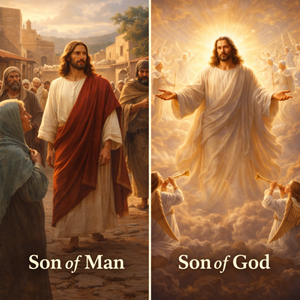
Son of Man and Son of God
Two Titles, One Saviour
A Question Worth Asking
If you read through the four Gospels, something striking stands out. When Jesus spoke about Himself, He almost never called Himself the Son of God. Instead, He used a different title, again and again: the Son of Man. He used it when He spoke about forgiving sins, when He foretold His death and resurrection, when He described His return in glory, and when He stood before the high priest at His trial. It is the title He chose for Himself more than any other.
Meanwhile, Son of God appears far less often on His own lips - though others called Him that, and He never denied it when they did.
Why the difference? What do these two titles actually mean? And why does it matter for us today?
These are not merely academic questions. The answer goes to the very heart of who Jesus is - fully human and fully divine - and why He alone could do what He came to do.
Son of Man - Where the Title Comes From
To understand why Jesus used this phrase, we have to go back to the Old Testament. In everyday Hebrew and Aramaic, "son of man" could simply mean a human being. God addresses the prophet Ezekiel as "son of man" over ninety times, using it to remind him that he is a mortal man standing before the eternal God. The psalmist uses it the same way:
What is man, that thou art mindful of him? and the son of man, that thou visitest him?
-Psalm 8:4
In that sense, "son of man" simply meant: a member of the human race. A creature of dust and breath.
But there is a second and far more dramatic use of the phrase - one that Jesus clearly had in mind when He applied it to Himself. It comes from the prophet Daniel, in one of the most remarkable visions in all of Scripture:
I saw in the night visions, and, behold, one like the Son of man came with the clouds of heaven, and came to the Ancient of days, and they brought him near before him. And there was given him dominion, and glory, and a kingdom, that all people, nations, and languages, should serve him: his dominion is an everlasting dominion, which shall not pass away, and his kingdom that which shall not be destroyed.
-Daniel 7:13-14
Stop and take that in. Daniel sees a heavenly figure - not an angel, not an ordinary man, but one "like the Son of man" - who comes before the very throne of God and receives an everlasting kingdom over all nations. This is not a description of a mere human being. This is a cosmic, divine ruler.
When Jesus called Himself the Son of Man, His Jewish hearers who knew their Scriptures would have recognised that echo immediately. He was not just saying "I am a human being." He was pointing to Daniel's vision and saying: I am that figure. The one to whom all dominion is given. The one who comes with the clouds of heaven.
Why Jesus Preferred This Title
Jesus had a very deliberate reason for choosing "Son of Man" as His primary title, rather than openly declaring "Son of God" at every turn. In first-century Israel, the term "Son of God" had specific and explosive political connotations. Many expected the Messiah to be a warrior king who would overthrow Rome and restore David's earthly throne by force.
To march into Jerusalem loudly proclaiming "Son of God" would have almost certainly ignited a political revolt built on misunderstanding - a movement Jesus did not come to lead. He came not to conquer Caesar, but to conquer sin and death.
"Son of Man," by contrast, was a title that gave Him room to reveal His identity gradually and on His own terms - while still carrying an enormous theological freight for those who had ears to hear. It allowed Him to be present among His people as one of them, while simultaneously pointing forward to His ultimate authority and glory.
He used it plainly when He spoke of His mission:
For the Son of man is come to seek and to save that which was lost.
-Luke 19:10
He used it when He spoke of His authority over the Sabbath:
Therefore the Son of man is Lord also of the sabbath.
-Mark 2:28
He used it when He spoke of His power to forgive sins - a claim that outraged the religious leaders who knew that only God could forgive:
But that ye may know that the Son of man hath power on earth to forgive sins, (then saith he to the sick of the palsy,) Arise, take up thy bed, and go unto thine house.
-Matthew 9:6
And He used it when He foretold both His suffering and His coming glory:
For as the lightning cometh out of the east, and shineth even unto the west; so shall also the coming of the Son of man be.
-Matthew 24:27
The title carried both humility and majesty at once. The Son of Man would suffer, die, be buried - and then rise, return, and reign. That is the full sweep of the phrase as Jesus used it.
The Moment He Said Both at Once
The most dramatic moment of all came at Jesus' trial before the high priest Caiaphas. The high priest asked Him directly whether He was the Son of God. And Jesus answered by reaching for the title He always used - Son of Man - and combining it with Daniel's vision:
And the high priest answered and said unto him, I adjure thee by the living God, that thou tell us whether thou be the Christ, the Son of God. Jesus saith unto him, Thou hast said: nevertheless I say unto you, Hereafter shall ye see the Son of man sitting on the right hand of power, and coming in the clouds of heaven.
-Matthew 26:63-64
The high priest tore his robes and cried "blasphemy." Why? Because he understood exactly what Jesus was claiming. By fusing together the image of Daniel 7:13 - the Son of Man coming on clouds - with Psalm 110:1 - sitting at the right hand of power - Jesus was declaring Himself to be the divine, eternal ruler of all things. The claim was unmistakable.
It cost Him His life. And it was the truth.
Son of God - What This Title Declares
If "Son of Man" emphasises that Jesus entered into our humanity and bears the divine authority of the one Daniel saw in his vision, then "Son of God" declares something even more foundational: His eternal divine nature, His unique relationship with God the Father.
In the Old Testament, "son of God" was occasionally used to describe angels (Job 38:7), or the nation of Israel collectively (Exodus 4:22), or the king of Israel as God's representative (Psalm 2:7). But when applied to Jesus, it carries a weight that goes far beyond any of those uses.
The foundational Old Testament text is Psalm 2, which speaks of the Lord's anointed king and records God's own declaration:
I will declare the decree: the LORD hath said unto me, Thou art my Son; this day have I begotten thee.
-Psalm 2:7
The New Testament writers understood this as pointing directly to Jesus. But the most important voice on the matter was God the Father Himself. At Jesus' baptism in the Jordan, as He came up out of the water, heaven opened and the Father spoke:
And lo a voice from heaven, saying, This is my beloved Son, in whom I am well pleased.
-Matthew 3:17
And again at the Transfiguration, when Jesus was briefly revealed in His glory on the mountain before Peter, James, and John:
While he yet spake, behold, a bright cloud overshadowed them: and behold a voice out of the cloud, which said, This is my beloved Son, in whom I am well pleased; hear ye him.
-Matthew 17:5
This was not a title earned or assigned. The Father was declaring the eternal relationship between Himself and the Son - a relationship that existed before the world was made. The Gospel of John opens with one of the most profound statements in all of Scripture:
In the beginning was the Word, and the Word was with God, and the Word was God. The same was in the beginning with God. All things were made by him; and without him was not any thing made that was made.
-John 1:1-3
The Son of God is not a created being who became divine. He is God, the eternal Word, who took on human flesh and entered our world. John puts it plainly:
And the Word was made flesh, and dwelt among us, (and we beheld his glory, the glory as of the only begotten of the Father,) full of grace and truth.
-John 1:14
When others called Jesus the Son of God, He received it as the truth. When the demons cried it out, He did not deny it. When the disciples worshipped Him and Peter confessed it, He affirmed it as a revelation from the Father:
And Simon Peter answered and said, Thou art the Christ, the Son of the living God. And Jesus answered and said unto him, Blessed art thou, Simon Bar-jona: for flesh and blood hath not revealed it unto thee, but my Father which is in heaven.
-Matthew 16:16-17
Two Titles, One Person - Why It Had to Be This Way
Now here is the astonishing truth that holds these two titles together. Jesus did not come as either Son of Man or Son of God. He came as both at the same time - and it had to be exactly that way for our salvation to be possible.
Think carefully about the problem He came to solve. Human beings had sinned against God. The penalty for that sin was death - separation from God. Who could pay that penalty on behalf of humanity?
It had to be a human being. An angel could not stand in our place; angels are not human. God in His pure divine nature could not die. Only a member of the human race could represent the human race and bear the weight of human guilt. This is why the Son of God became the Son of Man - fully human, born of a woman, under the law, capable of dying.
But when the fulness of the time was come, God sent forth his Son, made of a woman, made under the law, To redeem them that were under the law, that we might receive the adoption of sons.
-Galatians 4:4-5
But there is the other side. For that sacrifice to count for all who would ever believe - for every sin of every person across all of history - the one who died had to be of infinite worth. The death of an ordinary man could only pay for his own sin, and then only imperfectly. Only the death of the eternal Son of God was of sufficient value to accomplish an atonement that lasts forever.
This is the beauty and the mystery at the centre of the Christian faith. As Son of Man, He could suffer and die in our place. As Son of God, His sacrifice was of infinite worth - sufficient, once for all, for all who would trust in Him.
For such an high priest became us, who is holy, harmless, undefiled, separate from sinners, and made higher than the heavens.
-Hebrews 7:26
By the which will we are sanctified through the offering of the body of Jesus Christ once for all.
-Hebrews 10:10
The Old Testament Already Saw It Coming
Remarkably, the Old Testament not only contains the raw material for both titles - it also anticipated that both natures would be united in the coming Messiah.
The prophet Isaiah, seven hundred years before Christ, described a servant who would be both a suffering man and the arm of the Lord - simultaneously bearing the sins of His people and being exalted above all:
He is despised and rejected of men; a man of sorrows, and acquainted with grief: and we hid as it were our faces from him; he was despised, and we esteemed him not. Surely he hath borne our griefs, and carried our sorrows...
-Isaiah 53:3-4
That is the Son of Man - fully human, suffering, bearing our grief.
And yet just before this, in the same sweep of prophecy, Isaiah records the Lord speaking of this very servant with startling words:
Behold my servant, whom I uphold; mine elect, in whom my soul delighteth...
-Isaiah 42:1
Micah the prophet foretold that the ruler who would come from Bethlehem had origins that reached back to eternity itself:
But thou, Bethlehem Ephratah, though thou be little among the thousands of Judah, yet out of thee shall he come forth unto me that is to be ruler in Israel; whose goings forth have been from of old, from everlasting.
-Micah 5:2
Born in Bethlehem - the Son of Man.
From everlasting - the Son of God.
And the prophet Zechariah, looking forward to the one who would be pierced for our transgressions, records the LORD Himself speaking these remarkable words:
...they shall look upon me whom they have pierced, and they shall mourn for him...
-Zechariah 12:10
The one who is pierced - a human death. And yet God says "me." The Old Testament was already pointing toward the same staggering truth that the New Testament would make plain: the one who died on the cross was both a man and God.
What This Means for You
These two titles are not merely theological terms to file away in your mind. They speak directly to you in your need.
Because Jesus is the Son of Man - truly human, having walked through hunger, grief, temptation, suffering, and death - He is not a distant or indifferent God who has never known what your life feels like. He knows.
For we have not an high priest which cannot be touched with the feeling of our infirmities; but was in all points tempted like as we are, yet without sin.
-Hebrews 4:15
And because He is the Son of God - eternal, holy, of infinite worth - His sacrifice on the cross is fully sufficient for your sin. Every failure, every darkness, every thing you are ashamed of: the cross of God's own Son is enough to cover it completely, permanently, and freely for all who trust in Him.
The same Jesus who called Himself the Son of Man as He walked the dusty roads of Galilee is the Son of God who sits at the right hand of the Father now, and who is coming again. He is the one Daniel saw coming with the clouds of heaven. He is the beloved Son the Father declared over the waters of the Jordan. He is, as the aged John wrote from the island of Patmos:
...Fear not; I am the first and the last: I am he that liveth, and was dead; and, behold, I am alive for evermore, Amen; and have the keys of hell and of death.
-Revelation 1:17-18
Conclusion
When Jesus called Himself the Son of Man, He was not hiding His divinity. He was claiming the title of Daniel's heavenly ruler, wrapped in a human life, walking among us as one of us - the One who had come to seek and save the lost.
When Scripture calls Him the Son of God, it declares what was true before time began - that He is the eternal Word, one with the Father, by whom all things were made, and in whom alone life is found.
Two titles. One person. Fully human enough to die in our place. Fully divine enough for that death to save us forever.
Son of Man. Son of God. Saviour of the world.
That if thou shalt confess with thy mouth the Lord Jesus, and shalt believe in thine heart that God hath raised him from the dead, thou shalt be saved.
-Romans 10:9