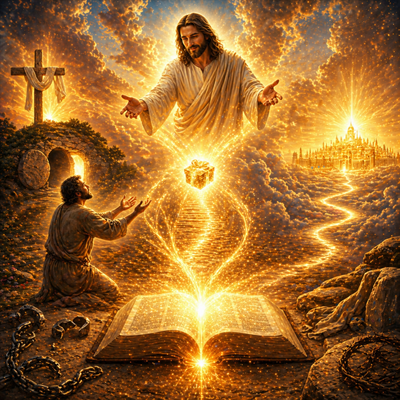
Salvation By Faith Alone
What the Bible Actually Says About How We Are Saved
Introduction
Few questions matter more than this one: What must I do to be saved?
The answer the Bible gives is both beautifully simple and profoundly humbling. Believe on the Lord Jesus Christ. Not believe and commit fully to His lordship. Not believe and produce sufficient fruit. Not believe and surrender every area of your life first. Simply believe.
This study will walk through what Scripture teaches about salvation — how it is received, what secures it, and why any addition to faith alone ultimately undermines the gospel itself.
Part 1 — Our Condition Before God
Before we can understand what saves us, we must understand why we need saving in the first place.
Romans 3:10
As it is written, There is none righteous, no, not one.
This verse leaves no room for exceptions. Not one person — regardless of their sincerity, their moral effort, or their spiritual commitment — stands righteous before God in their own right. This is not an exaggeration for effect. It is the foundational diagnosis of the human condition.
Isaiah 64:6
But we are all as an unclean thing, and all our righteousnesses are as filthy rags.
Notice carefully what Isaiah says here. Not our sins — our righteousnesses. Our very best efforts, our most sincere acts of devotion, our deepest commitments — are filthy rags in God's sight. This is critical, because it tells us that we cannot bring anything of value to the table when it comes to our salvation. Not our good works. Not our moral reformation. And not our surrender to Christ's lordship.
If our best is filthy rags, what hope do we have? That question leads us directly to the gospel.
Part 2 — The Gospel: God Does What Man Cannot
Matthew 19:26
But Jesus beheld them, and said unto them, With men this is impossible; but with God all things are possible.
Salvation is impossible for man. That is not a pessimistic statement — it is a liberating one, because it shifts the entire weight of salvation off our shoulders and onto God's. What we cannot accomplish, God can and does.
This principle runs through the entire gospel. We cannot make ourselves righteous — so God credits righteousness to us. We cannot pay our sin debt — so Christ paid it on the cross. We cannot secure our own eternal standing — so God secures it for us. This is grace. Unearned. Unmerited. Entirely from God's side.
Part 3 — How Salvation Is Received: Faith, Not Works
Romans 4:5
But to him that worketh not, but believeth on him that justifieth the ungodly, his faith is counted for righteousness.
This verse may be the clearest single statement on salvation in all of Scripture. Paul makes a deliberate and sharp contrast: the one who is justified is not the one who works — it is the one who believes. And the object of that belief is striking: God who justifies the ungodly. Not the sufficiently committed. Not the properly surrendered. The ungodly.
Righteousness is not earned. It is counted — credited, imputed — to the one who believes. This is a legal declaration from God, not a reward for spiritual performance. Romans 3:10 tells us no one is righteous on their own. Romans 4:5 tells us how righteousness is received — by faith alone, in the One who justifies the ungodly.
Part 4 — The Moment of Salvation: A Completed Transaction
One of the most important things to understand about salvation is that it happens at a definite moment — and it is complete at that moment.
John 5:24
Verily, verily, I say unto you, He that heareth my word, and believeth on him that sent me, hath everlasting life, and shall not come into condemnation; but is passed from death unto life.
Look carefully at the tenses Jesus uses here. The believer hath everlasting life — present tense, right now. The believer shall not come into condemnation — a settled future. And the believer is passed from death unto life — past tense, already accomplished.
Salvation is not a process that unfolds over time as we demonstrate sufficient lordship or produce adequate fruit. It is a completed crossing — from death to life — that occurs the moment a person genuinely believes.
John 6:40
And this is the will of him that sent me, that every one which seeth the Son, and believeth on him, may have everlasting life: and I will raise him up at the last day.
Here Jesus frames salvation as the direct will of the Father. Every one who believes will have everlasting life and will be raised up at the last day. This is not conditional on subsequent performance. It rests entirely on the Father's will and Christ's promise — both of which are completely reliable.
Part 5 — The Security of the Believer: Held by Christ, Not by Us
Perhaps nothing causes more unnecessary anguish among believers than uncertainty about their salvation. Am I truly saved? Have I surrendered enough? What if I fall away? These questions torment people who have been taught, in one form or another, that their salvation depends partly on them.
Scripture answers this anxiety directly and completely.
John 10:28
And I give unto them eternal life; and they shall never perish, neither shall any man pluck them out of my hand.
Christ gives eternal life. Christ says they shall never perish. Christ holds them in His hand. The security of the believer rests entirely on the One who saves — not on the one who is saved. "Never perish" does not mean "will not perish as long as they maintain sufficient commitment." It means never. The promise is absolute because the One who made it is absolute.
There is a critical question embedded here: if a believer could lose their salvation through insufficient lordship or inadequate fruit, who would be at fault — the sheep or the Shepherd? John 10:28 places the keeping entirely in Christ's hands. He does not say "they shall hold on to Me" — He says neither shall any man pluck them out of my hand.
Part 6 — The Honest Reality: Even Saved People Sin
A common objection to salvation by faith alone goes something like this: if you are truly saved, you will live a changed life, and persistent sin proves you were never saved to begin with. But consider who wrote these words:
Romans 7:19
For the good that I would I do not: but the evil which I would not, that I do.
This is the Apostle Paul — the man who wrote most of the New Testament, who planted churches across the Roman world, who endured imprisonment, beatings, and shipwreck for the gospel. And he describes an ongoing, present-tense struggle with sin that he cannot fully overcome in his own strength.
If persistent struggle with sin were evidence of a false conversion, Paul himself would be in trouble. But Paul is not doubting his salvation in Romans 7 — he is being brutally honest about the reality of the Christian life. The saved person is a new creation (2 Corinthians 5:17), but they still live in a fallen body, in a fallen world, and the battle with sin is real and ongoing.
This does not mean sin is unimportant. It means that our imperfect sanctification is not the measure of our salvation. Christ's perfect work on the cross is.
Part 7 — The Danger of "Jesus Plus"
When anything is added to faith as a condition of salvation — even something as seemingly noble as surrendering to Christ's lordship — the gospel is fundamentally altered.
Consider what this position requires in practice:
You must believe and submit to Christ's authority over your life.
You must believe and demonstrate that submission through changed behaviour.
You must believe and produce fruit sufficient to evidence genuine faith.
Each of these additions shifts part of the weight of salvation from Christ to the believer. And the moment that happens, a new question arises that can never be fully answered: How much is enough?
How surrendered must I be? How much fruit is sufficient? There is no answer — because the standard was never meant to be human performance. The standard is the perfect righteousness of Christ, which is credited to the believer the moment they believe. (Romans 4:5)
The Apostle Paul addressed exactly this kind of addition to the gospel. In his day it was circumcision and the Law rather than lordship commitment, but the structure is identical — grace plus something. His response was unambiguous:
Galatians 1:8
But though we, or an angel from heaven, preach any other gospel unto you than that which we have preached unto you, let him be accursed.
Adding to the gospel is not a minor theological disagreement. Paul regarded it as a matter of the gravest seriousness. The purity of the gospel — salvation by grace through faith alone — is worth defending.
Part 8 — But What About Works and Fruit?
This is the question that always follows, and it deserves a clear answer.
Works matter enormously. Fruit matters enormously. The transformed life is real, expected, and important. But they are the result of salvation — not its condition, and not its proof of purchase.
Think of it this way: a tree produces fruit because of what it is — not to prove what it is, and certainly not to become what it is. The apple tree does not produce apples to earn its identity as an apple tree. It produces apples because that is its nature. In the same way, the believer who has been genuinely transformed by the Holy Spirit will, over time and imperfectly, produce fruit — not to secure their salvation, but as the natural outworking of their new nature.
The fruit is the evidence of life already given — not the payment for life received.
We are saved unto good works (Ephesians 2:10), but we are not saved by good works. That distinction is everything.
Summary
1. Every person stands guilty before God. There are no exceptions. (Romans 3:10) Our best efforts do not meet His standard. (Isaiah 64:6)
2. Salvation is impossible for us — but possible for God. He does what we cannot. (Matthew 19:26)
3. Righteousness is credited to the one who believes — not the one who works. This is grace. (Romans 4:5)
4. The moment you genuinely believe, you have everlasting life. It is a completed crossing from death to life. (John 5:24, John 6:40)
5. Christ holds you. Your security rests entirely in His hands, not yours. (John 10:28)
6. Saved people still struggle with sin. This does not cancel salvation — even Paul struggled. (Romans 7:19)
7. Adding anything to faith corrupts the gospel. (Galatians 1:8) Salvation is by faith alone, in Christ alone, by grace alone.
8. Good works and fruit flow from salvation as its natural result — they are not its cause or its condition. (Ephesians 2:10)
A Word to the Reader
If you have never trusted Christ as your Saviour, the message of this study is for you. You do not need to clean up your life first. You do not need to promise God a fully surrendered future. You do not need to meet a standard of commitment before He will accept you.
You simply need to believe — truly, from the heart — that Jesus Christ is the Son of God, that He died for your sins, and that He rose again. At that moment, on the authority of His own Word, you have everlasting life and you shall not come into condemnation.
That is not a small promise. That is the gospel.
Key Cross-References
Acts 16:31 - Believe on the Lord Jesus Christ, and thou shalt be saved.
Ephesians 2:8-9 - Saved by grace through faith, not of works.
Titus 3:5 - Not by works of righteousness which we have done, but according to His mercy He saved us.
Romans 8:38-39 - Nothing shall be able to separate us from the love of God.
1 John 5:13 - Written that ye may know that ye have eternal life.