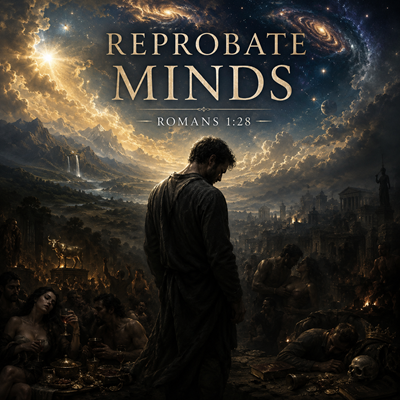
The Reprobate Mind
What Scripture Really Means by Adokimos
Introduction
There are words in the Bible that carry more weight than their plain English suggests, and reprobate is one of them. Most people who encounter it in Scripture feel its severity without quite grasping its meaning. It sounds like a verdict — and in some cases, it is. But the word appears in several different contexts across the New Testament, and lumping those contexts together produces more confusion than clarity.
This study will look at every place the KJV uses the word reprobate, examine what it actually means in the original Greek, and answer the questions that naturally arise: What is a reprobate mind? How does a person reach that condition? Does this apply to Christians, unbelievers, or both? And what should the believer take away from it?
The answers are sobering in places — but they are also clarifying, and for the genuine believer, ultimately reassuring.
The Greek Word Behind "Reprobate"
In every passage where the KJV translates reprobate, the underlying Greek word is adokimos (ἀδόκιμος). Understanding this word is the key to understanding everything that follows.
The word is built from two parts. The root dokimos means approved, tested, and found genuine — the way a coin or a piece of metal might be assayed and confirmed as real. The prefix a- negates it. So adokimos means: failing the test. Disapproved. Rejected upon examination. Counterfeit.
It is a word drawn from the world of metallurgy — ore put to the assay that comes back base metal rather than gold. It carries the idea of something that appears genuine but is not, or something that has been tested and found wanting.
The same root word appears in a positive form when Paul writes of a workman that needeth not to be ashamed (2 Timothy 2:15) — the approved workman is dokimos. And it appears in the negative when Paul speaks of becoming a castaway in 1 Corinthians 9:27 — that word is also adokimos. These connections help us understand the full range of the word before we look at each passage individually.
The Reprobate Mind — Romans 1:28
"And even as they did not like to retain God in their knowledge, God gave them over to a reprobate mind, to do those things which are not convenient;"
— Romans 1:28
This is the most severe use of the word in all of Scripture, and it requires its context to be understood properly.
Romans chapter 1 describes a process of spiritual deterioration that unfolds in stages. Paul begins by establishing that God has made Himself visible through creation, so that those who reject Him are "without excuse" (v.20). He then traces what happens when people choose to suppress that knowledge rather than honour it.
Verse 21 — They knew God but chose not to glorify Him or give thanks. This is not ignorance; it is wilful rejection.
Verses 22-23 — Professing to be wise, they exchanged the glory of God for idols. Worship does not disappear when God is rejected; it redirects downward.
Verses 24, 26, 28 — Three times in this passage the phrase appears: "God gave them over." This is the most chilling progression in the chapter. It is not God causing their sin. It is God withdrawing the restraining influence of His grace and allowing people to travel the road they have chosen — to its end. This is what theologians call divine judicial abandonment.
The phrase in verse 28 is precise and pointed: "even as they did not like to retain God in their knowledge" — the Greek here is ouk edokimasan, literally, they did not approve of having God in full knowledge. They applied their own test to God and rejected Him. The consequence is exact and just: God gives them over to an adokimos mind — a mind that now itself fails every test. The punishment mirrors the crime.
A reprobate mind, then, is not simply a sinful mind. Every person born has a sinful mind (Romans 3:23). A reprobate mind is the condition of a person who has persistently, progressively, and wilfully rejected the knowledge of God until God has, in judgment, handed them over to that rejection permanently.
This does not happen overnight. Romans 1 describes a process — steps of increasing departure, each one followed by a divine "gave them over." It is the picture of a road with a point of no return.
The Counterfeit Professor — 2 Timothy 3:8 and Titus 1:16
These two passages apply adokimos in a closely related but distinct way — not to pagans who have rejected God, but to religious people who claim to know Him.
"Now as Jannes and Jambres withstood Moses, so do these also resist the truth: men of corrupt minds, reprobate concerning the faith."
— 2 Timothy 3:8
"They profess that they know God; but in works they deny him, being abominable, and disobedient, and unto every good work reprobate."
— Titus 1:16
The reference to Jannes and Jambres is instructive. These are the Egyptian magicians of Pharaoh's court who imitated the signs that God gave Moses (Exodus 7-8). They were not strangers to religious practice. They performed what looked like miracles. They operated within a religious system. But they were counterfeits — and ultimately they were exposed. When Moses brought lice from the dust and the magicians could not replicate it, they said "This is the finger of God" (Exodus 8:19) — and that was the end of their imitation.
Paul uses this as the perfect picture of the false teachers in 2 Timothy 3. These men resist the truth — not from outside the church, but from within it. Their minds are corrupt, and they are adokimos with respect to the faith itself. They fail the assay. They look like gold but are not.
The Titus 1:16 description is equally sobering: "They profess that they know God; but in works they deny him." These are people making a public confession of faith. But their lives tell a different story. They are adokimos unto every good work — disqualified, rejected, counterfeit as workers in God's house.
Together these two passages describe what the Lord Himself warned about in Matthew 7:21-23 — those who say "Lord, Lord" but are turned away because He never knew them. Religion without regeneration. Profession without possession.
The Self-Examination Passage — 2 Corinthians 13:5-7
"Examine yourselves, whether ye be in the faith; prove your own selves. Know ye not your own selves, how that Jesus Christ is in you, except ye be reprobates?"
— 2 Corinthians 13:5
"But I trust that ye shall know that we are not reprobates."
— 2 Corinthians 13:6
"Now I pray to God that ye do no evil; not that we should appear approved, but that ye should do that which is honest, though we be as reprobates."
— 2 Corinthians 13:7
This passage is the most frequently misread of the group, and understanding its context rescues it from misapplication.
Paul is writing to the Corinthian church at a point of tension. Some members have been questioning his authority as an apostle. His response throughout 2 Corinthians has been to defend his ministry — not with boasting, but with appeals to what God has done through him. And here, at the close of the letter, he turns the credential question back on the church itself.
The argument runs like this: You are asking whether I am a genuine apostle. But ask yourselves first whether you are genuine believers. If Christ is in you — and He is, unless you are counterfeit — then I am validated, because I was the instrument God used to bring you the gospel.
The phrase "except ye be reprobates" (v.5) is not a warning that they might be counterfeit. It is a rhetorical device — Paul is saying, the only way I would be adokimos is if you are, and you are not. He goes on in verse 7 to say "though we be as reprobates" — meaning, even if we appear to fail the credential test in your eyes, what matters is that you do what is right.
The call to "examine yourselves" is a call to assurance, not to fear. Paul is not introducing doubt about their salvation; he is inviting them to look at the evidence of Christ in their lives and let that evidence settle the question.
Who Does This Apply To?
Having examined each passage, we can now answer the central question clearly.
The reprobate mind of Romans 1:28 applies to unbelievers — specifically to those who have travelled a long road of deliberate truth-rejection until God has judicially handed them over to the fruit of that rejection. It is not the automatic condition of every unbeliever. It is a terminal point reached through a progressive process of wilful suppression of revealed truth.
The reprobate of 2 Timothy 3:8 and Titus 1:16 applies to false teachers and religious professors — people operating within the context of Christianity who are nonetheless spiritually counterfeit. They are not ignorant of God; they are making a claim to know Him while their doctrine or their lives betray that claim.
The reprobate language of 2 Corinthians 13:5-7 is rhetorical — used in the context of apostolic authentication, not eternal standing. It is not a warning addressed to genuine believers that they might become reprobate. It is Paul using the credential test as a logical device to validate his ministry.
The following table summarises how adokimos is used across these passages:
| Passage | Subject | Sense of Adokimos | Who |
|---|---|---|---|
| Romans 1:28 | Reprobate mind | Judicially abandoned by God | Wilful, truth-suppressing unbelievers |
| 2 Timothy 3:8 | Reprobate concerning faith | Doctrinally counterfeit | False teachers |
| Titus 1:16 | Reprobate unto good works | Disqualified as workers | Religious professors, unsaved |
| 2 Corinthians 13:5-7 | Reprobate credential test | Failing authentication | Rhetorical — about Paul's apostleship |
Does any of this apply to genuine believers? In the sense of Romans 1 — no. A person regenerated by the Holy Spirit, in whom Christ dwells (Romans 8:9-11), has not suppressed the knowledge of God to the point of divine abandonment. The Spirit of God in the believer is the very opposite of being given over.
In the sense of 2 Corinthians 13, Paul's invitation to self-examination is valid and healthy for any Christian — not to create doubt, but to build assurance. The question "Is Christ in me?" is one every believer should be able to answer, and the evidence of that answer is found not in feelings, but in the reality of faith and the fruit of the Spirit.
Conclusion
The word reprobate is one of the Bible's most misunderstood terms — often treated as a loose synonym for "wicked" when it carries a much more specific meaning. It means failing the test. It means counterfeit. It means rejected upon examination.
In its most severe form, in Romans 1, it describes the judicial consequence of a life that has persistently refused God — a mind handed over by God Himself to the direction it has chosen. It is a sobering picture of where wilful rejection of revealed truth ultimately leads.
In its religious form, in 2 Timothy and Titus, it describes people who have religion without reality — who profess God but whose minds and works betray them. These are the Jannes and Jambres of the church age: imitators who cannot ultimately replicate what God alone produces.
And in 2 Corinthians, Paul uses the language not as a threat but as an instrument of assurance — inviting believers to look honestly at the evidence of Christ in their lives and find confidence there.
The genuine believer need not read Romans 1:28 with fear. But neither should it be read with detachment. The reprobate mind is the end of a road. Romans 1 shows us where that road begins: in the choice not to retain God in one's knowledge. The warning is not primarily about arrival — it is about direction.
Key Scriptures
Romans 1:18-32 — The progressive suppression of truth and its consequences
Romans 1:28 — God gives them over to a reprobate mind
1 Corinthians 9:27 — Paul's use of adokimos regarding himself
2 Corinthians 13:5-7 — Examine yourselves; the credential test
2 Timothy 3:8 — Reprobate concerning the faith; the Jannes and Jambres type
Titus 1:16 — Profess God but deny Him in works
Matthew 7:21-23 — Those who say Lord, Lord
Romans 8:9 — The Spirit of Christ in the believer
Study Questions
1. The word reprobate in Greek means "failing the test" or "counterfeit." How does understanding that original meaning change the way you read these passages?
2. Romans 1 describes a three-stage progression where God "gave them over" (vv.24, 26, 28). What does each stage involve, and what does this tell us about the relationship between human choice and divine judgment?
3. Paul describes the false teachers in 2 Timothy 3:8 using Jannes and Jambres as an illustration. What is the danger of religious imitation — and how can a person tell genuine faith from a counterfeit?
4. Titus 1:16 says some people "profess that they know God; but in works they deny him." What does it look like in practice when a person's confession and their life point in different directions?
5. In 2 Corinthians 13:5, Paul says "Examine yourselves, whether ye be in the faith." Why is this kind of honest self-examination healthy for a believer, and what should a person look for when they examine themselves?
6. Romans 1 shows that the reprobate mind is reached through a process, not a single decision. What does that tell us about the importance of daily choices regarding how we respond to what God has revealed?
7. Romans 8:9 says "if any man have not the Spirit of Christ, he is none of his." How does the presence of the Holy Spirit in the believer provide assurance in light of everything this study has covered?