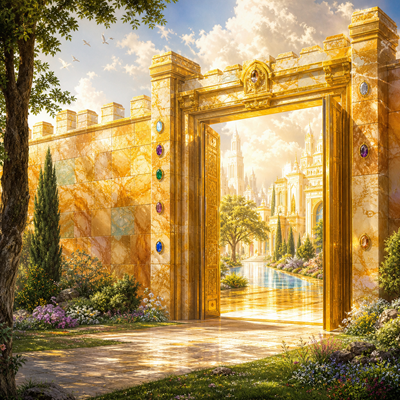
Outside the New Jerusalem
Who Will Be There — and What Does Scripture Actually Say?
Introduction
Revelation 21 and 22 contain the Bible's most detailed and breathtaking description of the eternal state — the final destination of all creation after the last judgment. These chapters describe a new heaven and a new earth, and at the centre of that renewed creation stands the New Jerusalem: the holy city that descends from God out of heaven, the dwelling place of God with His redeemed people.
But Revelation 22:15 draws a sharp contrast. Inside the city are the blessed — those who have the right to the tree of life. And then comes a sobering list: "For without are dogs, and sorcerers, and whoremongers, and murderers, and idolaters, and whosoever loveth and maketh a lie."
Who exactly are these people "outside"? Are they a second category of humanity living somewhere else on the new earth? And if so, why is a whole new heaven and earth created if everyone ultimately lives inside the city? These are questions that careful Bible students have wrestled with, and the answers matter — not just for eschatology, but for understanding the full weight of the gospel itself.
This study works through Revelation 21–22 carefully, examining what Scripture says about the eternal state, who is inside the New Jerusalem, who is "without," and how to understand the remarkable picture of a renewed creation that God's Word paints for us.
Part 1 — The Eternal State: A New Heaven and a New Earth
Revelation 21 opens with one of the most important transitions in all of Scripture. The old order has passed. The great white throne judgment is complete (Revelation 20:11–15). And now John sees something entirely new:
"And I saw a new heaven and a new earth: for the first heaven and the first earth were passed away; and there was no more sea. And I John saw the holy city, new Jerusalem, coming down from God out of heaven, prepared as a bride adorned for her husband."
— Revelation 21:1–2
Two things are presented side by side in these opening verses: a renewed creation (the new heaven and new earth) and a specific city (the New Jerusalem) descending within it. This distinction is important. Scripture does not say that all of the new creation is the city, nor that the city is all of the new creation. They are related but distinct.
What Is the New Heaven and New Earth?
The concept of a renewed creation did not originate with John. Isaiah wrote of it centuries earlier:
"For, behold, I create new heavens and a new earth: and the former shall not be remembered, nor come into mind."
— Isaiah 65:17
Peter confirms its coming in his second letter:
"Nevertheless we, according to his promise, look for new heavens and a new earth, wherein dwelleth righteousness."
— 2 Peter 3:13
And Paul, in Romans, describes the whole creation groaning under the curse of sin and awaiting its liberation:
"Because the creature itself also shall be delivered from the bondage of corruption into the glorious liberty of the children of God."
— Romans 8:21
God's plan was never to simply save souls out of a ruined world and abandon His creation. From the beginning, He intended to renew it. Sin and the curse defiled the first creation; the new creation is God's answer — a restored and glorified universe, purged of every trace of sin, death, and corruption, fit for His redeemed people to inhabit forever.
What Is the New Jerusalem?
The New Jerusalem is described in extraordinary detail across Revelation 21 and into 22. It is a city of staggering scale and beauty — twelve thousand furlongs on each side (roughly 1,400 miles), built with jasper, pure gold, and twelve kinds of precious stones. More importantly than its physical description, it is the seat of God's presence:
"And I heard a great voice out of heaven saying, Behold, the tabernacle of God is with men, and he will dwell with them, and they shall be his people, and God himself shall be with them, and be their God."
— Revelation 21:3
The city is not merely a beautiful place to live — it is where God dwells in His fullness with His people. It is the fulfilment of everything the tabernacle in the wilderness, the temple in Jerusalem, and the person of Jesus Christ ("Emmanuel — God with us," Matthew 1:23) were pointing toward. In the New Jerusalem, God's presence is no longer mediated by institutions, priesthoods, or even the incarnation — He is simply, finally, with His people.
Who Lives Inside?
Scripture is absolutely clear that only the redeemed will enter the New Jerusalem. The qualification is stated without any ambiguity:
"And there shall in no wise enter into it any thing that defileth, neither whatsoever worketh abomination, or maketh a lie: but they which are written in the Lamb's book of life."
— Revelation 21:27
The phrase "in no wise" translates the Greek ou mē — the strongest possible form of negation in the Greek language. There is no loophole, no exception, no second category. Inside the city: only those whose names are written in the Lamb's book of life. The redeemed and only the redeemed.
Part 2 — The Nations Walking in Its Light
Before we come to the sobering "without" of Revelation 22:15, there is an important passage that raises a different kind of "outside." Revelation 21:24–26 presents a striking picture that has long prompted careful study:
"And the nations of them which are saved shall walk in the light of it: and the kings of the earth do bring their glory and honour into it. And the gates of it shall not be shut at all by day: for there shall be no night there. And they shall bring the glory and honour of the nations into it."
— Revelation 21:24–26
Note carefully: these are "the nations of them which are saved" — not unsaved nations, not a second tier of humanity below the fully redeemed, but the saved themselves, described as nations and peoples living in the light of the city.
What Does This Tell Us?
Several things are significant here. First, the gates of the city are never shut — they stand permanently open. In the ancient world, city gates were shut at night for security; here there is no night and no threat. The open gates imply free movement between the city and the wider new creation. Second, the redeemed are described as bringing "glory and honour" into the city — suggesting active, purposeful activity in the broader realm of the new earth that finds its culmination in the city itself.
Revelation 22:3–5 reinforces this broader picture of redeemed activity:
"And there shall be no more curse: but the throne of God and of the Lamb shall be in it; and his servants shall serve him: and they shall see his face; and his name shall be in their foreheads. And there shall be no night there; and they need no candle, neither light of the sun; for the Lord God giveth them light: and they shall reign for ever and ever."
— Revelation 22:3–5
The redeemed will "reign for ever and ever" — not sit idle, but rule and serve across God's renewed creation. This connects directly to God's original mandate to humanity in the beginning:
"And God blessed them, and God said unto them, Be fruitful, and multiply, and replenish the earth, and subdue it: and have dominion over the fish of the sea, and over the fowl of the air, and over every living thing that moveth upon the earth."
— Genesis 1:28
What sin and the fall broke — humanity's blessed dominion over God's good creation — God fully restores in the eternal state. The redeemed will not merely inhabit the new earth; they will steward it in righteousness, as they were always meant to.
A Useful Way to Think About It
Think of the New Jerusalem as the capital city and temple of the new creation combined — the central seat of God's throne, the place where His presence is most fully manifest, the destination for the glory and worship of all the redeemed. Think of the New Earth as the wider realm: the home and inheritance of God's people, ruled and tended by them under God's reign.
The city is not a container that confines. It is the radiant heart of a whole world. The redeemed are citizens of it — free to enter, free to worship at its throne, free to live throughout the wider creation that is equally their inheritance. The New Jerusalem is not all of heaven; it is the glory at heaven's centre.
Part 3 — "Without Are Dogs": The Meaning of Revelation 22:15
We come now to the verse at the heart of this study's question. Revelation 22:14–15 sets up one of the sharpest contrasts in all of Scripture:
"Blessed are they that do his commandments, that they may have right to the tree of life, and may enter in through the gates into the city. For without are dogs, and sorcerers, and whoremongers, and murderers, and idolaters, and whosoever loveth and maketh a lie."
— Revelation 22:14–15
Inside (verse 14): the blessed — those who have washed their robes in the blood of the Lamb, who have right to the tree of life, who enter freely through the gates. Outside (verse 15): a list of the wicked — those who have rejected God, remained in their sin, and refused His grace.
Who Are the "Dogs"?
In the ancient Semitic world, "dog" was a term of strong contempt — not a reference to literal animals, but to people considered impure and dishonourable. The same usage appears in Philippians 3:2, where Paul warns against false teachers: "Beware of dogs, beware of evil workers." In Deuteronomy 23:18, the term describes those whose offerings God would not accept.
The full list in Revelation 22:15 — dogs, sorcerers, whoremongers, murderers, idolaters, lovers of lies — represents not a checklist of specific offences but the character of those who have lived in rebellion against God. It is a description of lives lived in defiance of His holiness and in rejection of His Son.
But Where Exactly Are They?
This is the critical question. Are those "without" in Revelation 22:15 simply on the new earth outside the city walls — a second group of people living somewhere else in the new creation? The answer is clearly no, and Scripture itself closes that door firmly.
Revelation 20:14–15 tells us what happened to these people before the eternal state even began:
"And death and hell were cast into the lake of fire. This is the second death. And whosoever was not found written in the book of life was cast into the lake of fire."
— Revelation 20:14–15
And Revelation 21:8 confirms their state in language that permits no ambiguity:
"But the fearful, and unbelieving, and the abominable, and murderers, and whoremongers, and sorcerers, and idolaters, and all liars, shall have their part in the lake which burneth with fire and brimstone: which is the second death."
— Revelation 21:8
Notice that the list in Revelation 21:8 is almost identical to the list in Revelation 22:15. These are the same category of people. And Scripture is explicit: they are in the lake of fire. There is no version of the eternal state in which the wicked are physically present in the new creation — whether inside or outside the city walls.
Then Why Does Revelation 22:15 Say "Without"?
Because "without" is not primarily a geographical term here — it is a statement of exclusion and separation. In the ancient world, to be "outside the city" was to be excluded from its life, its protection, its citizenship, its honour. Those outside a city's walls were those who had no place in it — the outcasts, the exiled, the condemned.
Revelation uses this imagery with full force. The redeemed are inside — citizens, royalty even, with full access to the tree of life and the throne of God. The condemned are "without" — permanently, irreversibly excluded from everything the city represents: life, light, the presence of God, blessing, and belonging. It is a declaration of eternal separation, not a description of a physical location just beyond the city gate.
Part 4 — Two Different Senses of "Outside"
To read Revelation 21–22 carefully, it is important to recognise that the word "outside" or "without" is used in two distinct senses, and context is everything in telling them apart.
The First Sense: Spatial (Neutral — Still Redeemed)
As we saw in Revelation 21:24–26, the saved nations walk "in the light" of the New Jerusalem and bring their glory into it, while the gates remain perpetually open. This implies that redeemed people may live, serve, and reign throughout the broader new earth — not permanently confined within the city walls. Being "outside" in this sense simply means being in the wider new creation, which is equally the inheritance of God's people. It carries no negative meaning whatsoever.
The Second Sense: Moral / Existential (Condemnation — Eternal Separation)
The "without" of Revelation 22:15 is of an entirely different kind. This is not "outside the city walls but still within the blessed new creation." This is "outside the new creation entirely" — excluded from God's presence, from the tree of life, from every blessing of the eternal state. The lake of fire is not a location within the new earth. It is the place of the second death: permanent, irreversible separation from the God of life.
How to Tell the Difference
The distinction is always determined by who the passage is talking about. When Revelation speaks of the saved nations, kings, and peoples bringing glory into the city, we are dealing with the redeemed — those in the Lamb's book of life. When Revelation speaks of dogs, sorcerers, murderers, and liars being "without," we are dealing with the condemned — those whose names are not written in the book of life and who have already been cast into the lake of fire (Revelation 20:15).
A useful summary: the redeemed may be outside the city walls while still inside the new creation. The condemned are outside the new creation entirely — not somewhere else on the new earth, but excluded from it altogether.
Part 5 — Why Create a Whole New Heaven and Earth?
This question arises naturally. If the condemned are in the lake of fire and the redeemed all have access to the New Jerusalem, why does God create a whole new heaven and earth? The answer reveals something profound about God's purposes.
God's Original Plan Was Never Abandoned
When God created the world in Genesis 1–2, His design was not a temporary holding place until something better came along. He created a good world — "very good," in His own words (Genesis 1:31) — and placed humanity within it as His image-bearers, charged with ruling and caring for it. Sin did not cancel that design. It corrupted it. But what sin corrupts, God redeems.
The new creation is not Plan B. It is the full realisation of Plan A, freed from everything that sin brought with it. God does not abandon His creation; He restores and glorifies it.
Human Dominion Fulfilled at Last
Genesis 1:28 gave humanity the mandate to have dominion over the earth. Romans 8:20–21 tells us that the creation itself was subjected to futility because of human sin, and is waiting for liberation. Revelation 22:5 announces that the redeemed "shall reign for ever and ever." The eternal state is not passive — it is the fulfilment of redeemed human purpose. The whole new earth is the arena for that purpose to be exercised perfectly and forever.
God Dwelling With Man — Throughout All of It
Revelation 21:3 declares that God's tabernacle — His dwelling — is now with men. The New Jerusalem is the fullest expression of that presence, but Revelation 21:23 says the city itself has no need of sun or moon because God's glory illuminates it. That glory does not stop at the city walls. The whole of the new creation is lit and governed by God's presence, even as the city is its radiant heart.
The new creation, in other words, is not merely a backdrop for the city. It is God's eternal gift to His people — a whole world to inhabit, steward, explore, and enjoy in His unhindered presence, forever.
Part 6 — The Weight of "Without"
It is easy to read the vivid imagery of Revelation and miss the pastoral weight that underlies it. The contrast between "inside" and "without" in Revelation 22:14–15 is not placed there to satisfy our curiosity about the geography of eternity. It is placed there as a solemn warning and a gospel invitation.
The Seriousness of the Second Death
To be "without" in the ultimate sense is to have no part in the tree of life, no access to God's presence, no place in His city, no share in the inheritance of the redeemed. Revelation 20:14 calls this "the second death." Physical death separates the soul from the body. The second death separates the soul from God — permanently, irreversibly, without remedy.
Jesus Himself spoke of this with a gravity that we should not soften. In Matthew 25:41, He describes the final sentence as: "Depart from me, ye cursed, into everlasting fire, prepared for the devil and his angels." The lake of fire was not made for human beings — but those who reject God's offer of salvation in Christ will share in it. This is the ultimate meaning of being "without."
The Generosity of "Inside"
Over against that warning stands the overwhelming generosity of God's invitation. Revelation 22:17 — coming just two verses after the sobering "without are dogs" — is one of the most open invitations in all of Scripture:
"And the Spirit and the bride say, Come. And let him that heareth say, Come. And let him that is athirst come. And whosoever will, let him take the water of life freely."
— Revelation 22:17
Whosoever will. Freely. The gates of the New Jerusalem are always open (Revelation 21:25) — and so, in this present age before the end, the gate of grace stands equally open. No one is excluded from the city by anything other than their own rejection of the One who purchased the right of entry with His blood.
Revelation 21:27 says that those inside are "they which are written in the Lamb's book of life." The question is not whether you are good enough — no one is. The question is whether you are trusting in the Lamb who is.
What the Early Church Saw
Christians have been thinking carefully about the eternal state since the earliest centuries, and it is worth noting that the broad picture presented in this study is not a modern innovation.
Irenaeus of Lyons (c. 130–202 AD), one of the most important early church fathers, taught in his work Against Heresies that the saints would enjoy resurrection life on a renewed and restored earth, with the New Jerusalem as the centrepiece of God's renewed presence among them. He emphasised that God would restore to His people the inheritance that sin had forfeited.
Augustine of Hippo (354–430 AD) in his monumental City of God developed an extended theology of the two cities — the City of God and the city of man. For Augustine, the New Jerusalem represented the perfected community of God's people in His presence. He understood the new earth as the inheritance of the righteous, the place where God's own people would enjoy perfect and unending fellowship with their Creator.
Both of these great thinkers understood that the eternal state involved a whole renewed creation for God's redeemed people — not a disembodied existence in a vague spiritual realm, but physical, glorious, embodied life in a world made new. And both understood that "outside" — in the deepest sense — was the condition of those who had no place in that world.
Reflection and Discussion
- Revelation 21:27 says only those "written in the Lamb's book of life" will enter the New Jerusalem. What does it mean to you personally that access to the city is based entirely on what the Lamb has done, not on what you have done?
- The new creation is described as a whole world for the redeemed to inhabit, rule, and enjoy — not merely a city to sit in. How does this expand your understanding of what God is promising to His people?
- Revelation 22:15 describes those "without" the city as murderers, sorcerers, and liars — but Revelation 21:8 adds "the fearful and unbelieving" to the same list. Why do you think unbelief is grouped with those other sins? What does that tell us about God's view of rejecting the gospel?
- The gates of the New Jerusalem are said to never be shut (Revelation 21:25). John then says in Revelation 22:17, "whosoever will, let him take the water of life freely." What does the imagery of permanently open gates say about the character of God's invitation?
- God's original mandate to humanity was to have dominion over the earth (Genesis 1:28). That mandate is restored in the eternal state (Revelation 22:5). What does this tell us about the purpose God had in mind for human beings from the very beginning?
- The "second death" in Revelation 20:14 is described as the lake of fire — permanent separation from God. Jesus speaks of it in Matthew 25:41. How does a clear understanding of what being "without" truly means affect how you think about sharing the gospel with those who do not yet know Christ?
Key Scriptures for Meditation
- Revelation 21:1–3 — The new heaven, new earth, and God dwelling with His people.
- Revelation 21:8 — The second death and those who have their part in the lake of fire.
- Revelation 21:24–26 — The nations of the saved walking in the light of the city.
- Revelation 21:27 — And there shall in no wise enter into it any thing that defileth, neither whatsoever worketh abomination, or maketh a lie: but they which are written in the Lamb's book of life.
- Revelation 22:3–5 — The redeemed serving God and reigning for ever and ever.
- Revelation 22:14–15 — The blessed inside; the wicked without.
- Revelation 22:17 — And whosoever will, let him take the water of life freely.
- Revelation 20:14–15 — Death and hell cast into the lake of fire; the final judgment of the lost.
- Genesis 1:28 — God's original mandate to humanity to have dominion over the earth.
- Romans 8:21 — Creation delivered from the bondage of corruption into the liberty of God's children.
- 2 Peter 3:13 — A new heaven and earth wherein dwelleth righteousness.
- Isaiah 65:17 — God's promise to create new heavens and a new earth.
Conclusion
Revelation 21 and 22 present a vision of the eternal state that is more expansive and more glorious than is often imagined. The New Jerusalem is not a cage for the redeemed — it is the radiant heart of a whole new creation that belongs to God's people. The saved will inhabit the new earth, reign across it, and enjoy free and open access to the city where God's throne stands and His presence is most fully revealed.
Those who are "without" are not a second tier of humanity living happily somewhere on the new earth outside the city walls. They are those cast into the lake of fire — the second death — permanently excluded not merely from the city but from the new creation entirely. "Without" in Revelation 22:15 is not a geographical description. It is a declaration of irreversible separation from God, from life, and from every blessing He holds out in Christ.
And that is precisely why the invitation of Revelation 22:17 lands with such weight. Before the eternal state is sealed, the Spirit and the bride are still saying: Come. The water of life is still freely given. The gates are still open. The Lamb's book of life is still open. There is still time — but not unlimited time — to be written in it.
"He that overcometh shall inherit all things; and I will be his God, and he shall be my son."
— Revelation 21:7