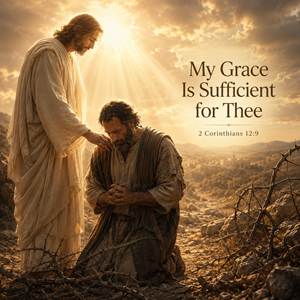
My Grace Is Sufficient for Thee
Grace Alone, Received Through Faith Alone
"My grace is sufficient for thee: for my strength is made perfect in weakness."
— 2 Corinthians 12:9
The Setting
Paul is writing to a church being courted by "super-apostles" who boasted of their credentials, their visions, and their spiritual strength. It would have been easy for Paul to answer boast for boast — he had seen more, suffered more, and been given revelations few men ever receive. Instead, he tells the Corinthians about a weakness.
"And lest I should be exalted above measure through the abundance of the revelations, there was given to me a thorn in the flesh, the messenger of Satan to buffet me, lest I should be exalted above measure. For this thing I besought the Lord thrice, that it might depart from me."
— 2 Corinthians 12:7-8
Whatever the thorn was exactly, Scripture does not say — and that is likely deliberate, so every reader can see their own weakness in it. What matters is Paul's request and God's reply.
Not Removal, but Grace
Paul asked three times for the thorn to be taken away. God's answer was not the removal Paul requested — it was a promise:
"And he said unto me, My grace is sufficient for thee: for my strength is made perfect in weakness. Most gladly therefore will I rather glory in my infirmities, that the power of Christ may rest upon me."
— 2 Corinthians 12:9
Notice the word sufficient. It means nothing more is needed. God does not say His grace is a good start, a discount, or a down payment that Paul must complete with effort. It is enough, in itself, for whatever the need is — even an apostle's ongoing weakness. That is the same claim the gospel makes about salvation: grace, on its own, is sufficient to save.
Strength Made Perfect in Weakness
God did not answer Paul's prayer by increasing Paul's strength. He answered by locating the strength somewhere else entirely — in Himself. "My strength is made perfect in weakness" means Christ's power reaches its full, intended effect precisely where human capacity has run out.
If this is true for an apostle's sanctified service, it is true all the more for salvation itself. If Paul cannot supply strength enough for his own ministry, no sinner can supply strength — or merit, or good works — enough to earn a right standing with God. The weakness is not a footnote to the gospel. It is the very place grace is designed to meet us.
The Same Pattern in Paul's Doctrine of Salvation
This is not an isolated idea in one letter. It is Paul's settled teaching everywhere he explains how a sinner is made right with God. Grace is sufficient — nothing of ours needs to be added to it.
"For by grace are ye saved through faith; and that not of yourselves: it is the gift of God: Not of works, lest any man should boast."
— Ephesians 2:8-9
"For all have sinned, and come short of the glory of God; Being justified freely by his grace through the redemption that is in Christ Jesus."
— Romans 3:23-24
"Knowing that a man is not justified by the works of the law, but by the faith of Jesus Christ... for by the works of the law shall no flesh be justified."
— Galatians 2:16
"Now to him that worketh is the reward not reckoned of grace, but of debt. But to him that worketh not, but believeth on him that justifieth the ungodly, his faith is counted for righteousness."
— Romans 4:4-5
"Not by works of righteousness which we have done, but according to his mercy he saved us."
— Titus 3:5
Every one of these verses draws the same line Paul drew in his own weakness: on one side stands human working, earning, and boasting; on the other stands grace, received simply by believing. Scripture never blends the two together as partners. It sets them against each other, and grace alone stands.
A Faith That Rests, Not Strives
Paul's response to God's answer is remarkable. He does not grudgingly accept the thorn — he says he will "most gladly" glory in his weaknesses:
"Therefore I take pleasure in infirmities, in reproaches, in necessities, in persecutions, in distresses for Christ's sake: for when I am weak, then am I strong."
— 2 Corinthians 12:10
This is what faith alone actually looks like lived out. It is not indifference to weakness, and it is not a frantic effort to overcome it. It is a settled trust that Christ's power rests on the one who has stopped relying on his own. Paul's boasting is the opposite of merit-based boasting — he glories not in what he has done, but in what grace has supplied where he could supply nothing.
Summary
• Paul asked three times for his weakness to be removed. God's answer was grace, not removal — and He called that grace sufficient, meaning nothing more was needed.
• God's strength is "made perfect" in weakness — it reaches its purpose exactly where human capacity ends.
• If even an apostle's strength cannot supplement grace, no sinner's works or merit can supplement it for salvation.
• This mirrors Paul's teaching everywhere else: salvation is by grace, through faith, not of works (Ephesians 2:8-9; Romans 3:23-24; Galatians 2:16; Romans 4:4-5; Titus 3:5).
• Paul's glorying in weakness models what faith alone looks like — resting in what grace supplies, not straining to add to it.
Key Verses
2 Corinthians 12:7–10 · Ephesians 2:8–9 · Romans 3:23–24 · Romans 4:4–5 · Galatians 2:16 · Titus 3:5