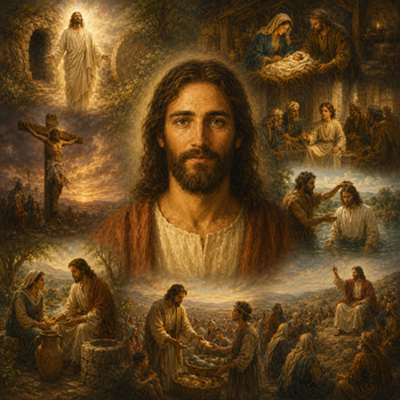
Major Events in the Life of Jesus Christ
The life of Jesus Christ is the central event of all human history. Every line of the Old Testament points toward it; every book of the New Testament flows from it. Yet for many who come to Scripture for the first time, the story of Jesus can feel scattered across four Gospel accounts, each told from a different perspective and for a different audience. This study gathers the major events of His earthly life and arranges them in chronological order, not to replace the Gospels, but to provide a framework — a way of seeing the whole before going deeper into the parts.
What you will find here is not a biography in the modern sense. The Gospel writers were not journalists recording facts for the historical record; they were witnesses testifying to a Person. Each event in this study is therefore presented with the Scripture that describes it, because the goal is not simply to know what happened, but to understand what it means. From the manger in Bethlehem to the upper room at Pentecost, every event in the life of Jesus is freighted with purpose, and much of that purpose was announced centuries before His birth in the writings of the prophets.
This study is written for the beginner, but it does not assume that the beginner wants shallow answers. The life of Jesus is deep enough to occupy a lifetime of careful study, and familiar enough that even those who have read it many times will find something they had not noticed before. Whether you are approaching these events for the first time or returning to them again, the aim is the same: to see Jesus Christ more clearly, and through that seeing, to understand more fully what He accomplished and why it matters for you personally.
The Birth of Jesus (around 4–6 BC)

The birth of Jesus Christ was unlike any birth before or since. At the center of it was a young woman named Mary, known for her faithfulness and humble spirit. God chose her for a purpose of eternal consequence: she conceived by the power of the Holy Spirit, remaining a virgin, and brought forth the Son of God. The place of His birth was not a palace or a place of honor, but a stable in the small town of Bethlehem — the city of David — fulfilling prophecies that had stood for centuries.
Therefore the Lord himself shall give you a sign; Behold, a virgin shall conceive, and bear a son, and shall call his name Immanuel. - Isaiah 7:14
Behold, a virgin shall be with child, and shall bring forth a son, and they shall call his name Emmanuel, which being interpreted is, God with us. - Matthew 1:23
But thou, Bethlehem Ephratah, though thou be little among the thousands of Judah, yet out of thee shall he come forth unto me that is to be ruler in Israel; whose goings forth have been from of old, from everlasting. - Micah 5:2
And thou Bethlehem, in the land of Juda, art not the least among the princes of Juda: for out of thee shall come a Governor, that shall rule my people Israel. - Matthew 2:6
That God chose such humble circumstances for His Son's entrance into the world was no accident. Jesus was not born among the powerful. He was laid in a manger — a feeding trough — a fitting symbol of One who would come not to be served, but to serve. From His very first night on earth, His mission was written in the details: to reach the lowly, the forgotten, and the lost, and to bring them into the kingdom of God.
Therefore the Lord himself shall give you a sign; Behold, a virgin shall conceive, and bear a son, and shall call his name Immanuel. - Isaiah 7:14
Behold, a virgin shall be with child, and shall bring forth a son, and they shall call his name Emmanuel, which being interpreted is, God with us. - Matthew 1:23
But thou, Bethlehem Ephratah, though thou be little among the thousands of Judah, yet out of thee shall he come forth unto me that is to be ruler in Israel; whose goings forth have been from of old, from everlasting. - Micah 5:2
And thou Bethlehem, in the land of Juda, art not the least among the princes of Juda: for out of thee shall come a Governor, that shall rule my people Israel. - Matthew 2:6
That God chose such humble circumstances for His Son's entrance into the world was no accident. Jesus was not born among the powerful. He was laid in a manger — a feeding trough — a fitting symbol of One who would come not to be served, but to serve. From His very first night on earth, His mission was written in the details: to reach the lowly, the forgotten, and the lost, and to bring them into the kingdom of God.
Matthew 1:18-25
Luke 2:1-7
The Visit of the Wise Men (sometime after Jesus' birth)
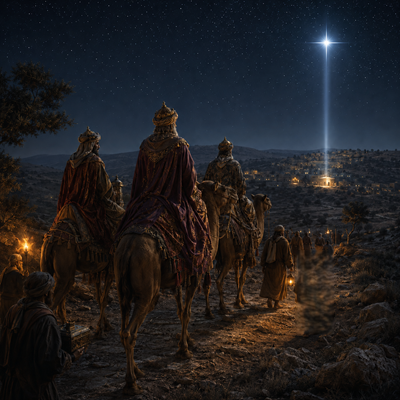
In the days following Jesus' birth, wise men from the East — the Bible calls them Magi — were drawn westward by the appearance of an extraordinary star. These were men learned in the observation of the heavens, and what they saw told them that a great King had been born among the Jews. Their journey brought them first to Jerusalem, where they inquired of King Herod, then on to Bethlehem, where the star came to rest over the place where the young child lay.
Now when Jesus was born in Bethlehem of Judaea in the days of Herod the king, behold, there came wise men from the east to Jerusalem, Saying, Where is he that is born King of the Jews? for we have seen his star in the east, and are come to worship him. - Matthew 2:1-2
When they found the child, they worshipped Him and presented three gifts, each rich in meaning. Gold acknowledged His kingship — He was the rightful King of the Jews and of all mankind. Frankincense, a fragrant resin burned in temple worship, recognized His divinity — God dwelling among men. Myrrh, a bitter resin used in burial preparation, was a sobering foreshadowing of His death — even at the beginning, the cross was in view.
These three gifts together encapsulate the whole of who Jesus is: King, God, and Sacrifice. The visit of the wise men stands as one of Scripture's earliest declarations of His identity, made not by Israel's scholars but by Gentile seekers whom God had drawn to Himself through the witness of creation.
Now when Jesus was born in Bethlehem of Judaea in the days of Herod the king, behold, there came wise men from the east to Jerusalem, Saying, Where is he that is born King of the Jews? for we have seen his star in the east, and are come to worship him. - Matthew 2:1-2
When they found the child, they worshipped Him and presented three gifts, each rich in meaning. Gold acknowledged His kingship — He was the rightful King of the Jews and of all mankind. Frankincense, a fragrant resin burned in temple worship, recognized His divinity — God dwelling among men. Myrrh, a bitter resin used in burial preparation, was a sobering foreshadowing of His death — even at the beginning, the cross was in view.
These three gifts together encapsulate the whole of who Jesus is: King, God, and Sacrifice. The visit of the wise men stands as one of Scripture's earliest declarations of His identity, made not by Israel's scholars but by Gentile seekers whom God had drawn to Himself through the witness of creation.
Matthew 2:1-12
The Flight to Egypt and the Massacre of the Innocents

Even as the wise men were departing, a dark threat was forming. King Herod, terrified by the news of a newborn King of the Jews, resolved to destroy the child. God moved ahead of him. An angel appeared to Joseph in a dream and warned him to take Mary and the child and flee to Egypt immediately. That same night, they went.
Herod, realizing the wise men had not returned to report to him, ordered the slaughter of all male children in Bethlehem two years old and under. It was an act of shocking cruelty, and the grief of the mothers of Bethlehem echoed the words of Jeremiah written centuries before:
In Rama was there a voice heard, lamentation, and weeping, and great mourning, Rachel weeping for her children, and would not be comforted, because they are not. - Matthew 2:18 (cf. Jeremiah 31:15)
The family's time in Egypt was itself a fulfillment of prophecy — Out of Egypt have I called my son (Hosea 11:1) — drawing a deliberate parallel between Jesus and Israel, whom God had also called out of Egypt. From His infancy, Jesus was already opposed by worldly power, already the subject of prophecy's fulfillment, and already under the protecting hand of His Father.
Herod, realizing the wise men had not returned to report to him, ordered the slaughter of all male children in Bethlehem two years old and under. It was an act of shocking cruelty, and the grief of the mothers of Bethlehem echoed the words of Jeremiah written centuries before:
In Rama was there a voice heard, lamentation, and weeping, and great mourning, Rachel weeping for her children, and would not be comforted, because they are not. - Matthew 2:18 (cf. Jeremiah 31:15)
The family's time in Egypt was itself a fulfillment of prophecy — Out of Egypt have I called my son (Hosea 11:1) — drawing a deliberate parallel between Jesus and Israel, whom God had also called out of Egypt. From His infancy, Jesus was already opposed by worldly power, already the subject of prophecy's fulfillment, and already under the protecting hand of His Father.
Matthew 2:13-18
Jesus' Presentation at the Temple (around 40 days after birth)

In obedience to the Mosaic Law, which required every firstborn male to be consecrated to the Lord, Mary and Joseph brought the infant Jesus to the Temple in Jerusalem. What they encountered there was more than a religious formality — it was a moment of prophetic recognition.
A righteous and devout man named Simeon had been promised by the Holy Spirit that he would not die before he had seen the Lord's Christ. When Mary and Joseph entered the Temple with the child, Simeon took Jesus into his arms and praised God:
Lord, now lettest thou thy servant depart in peace, according to thy word: For mine eyes have seen thy salvation, Which thou hast prepared before the face of all people; A light to lighten the Gentiles, and the glory of thy people Israel. - Luke 2:29-32
A prophetess named Anna, who had served God in the Temple night and day with fasting and prayer for many decades, likewise gave thanks and spoke of the child to all who were waiting for the redemption of Jerusalem. Two of Israel's most faithful — one man, one woman; one with a promise, one with a life of prayer — recognized the Messiah when most of Jerusalem did not.
A righteous and devout man named Simeon had been promised by the Holy Spirit that he would not die before he had seen the Lord's Christ. When Mary and Joseph entered the Temple with the child, Simeon took Jesus into his arms and praised God:
Lord, now lettest thou thy servant depart in peace, according to thy word: For mine eyes have seen thy salvation, Which thou hast prepared before the face of all people; A light to lighten the Gentiles, and the glory of thy people Israel. - Luke 2:29-32
A prophetess named Anna, who had served God in the Temple night and day with fasting and prayer for many decades, likewise gave thanks and spoke of the child to all who were waiting for the redemption of Jerusalem. Two of Israel's most faithful — one man, one woman; one with a promise, one with a life of prayer — recognized the Messiah when most of Jerusalem did not.
Luke 2:22-38
The Family's Return to Nazareth (after Herod's death)

After Herod's death, an angel again appeared to Joseph in a dream and directed him to return to the land of Israel. But when Joseph learned that Herod's son Archelaus was now ruling Judea, God warned him in another dream, and he turned aside to the district of Galilee, settling in the town of Nazareth.
And he came and dwelt in a city called Nazareth: that it might be fulfilled which was spoken by the prophets, He shall be called a Nazarene. - Matthew 2:23
Nazareth was an unremarkable town. When the apostle Nathanael first heard that the Messiah was from there, his response was blunt: Can there any good thing come out of Nazareth? (John 1:46). And yet, it was precisely there that God chose to raise His Son. Throughout Jesus' ministry He would be known as Jesus of Nazareth, a man of no great earthly address. That God can work His most profound purposes through the most ordinary of places is a theme that runs throughout all of Scripture.
And he came and dwelt in a city called Nazareth: that it might be fulfilled which was spoken by the prophets, He shall be called a Nazarene. - Matthew 2:23
Nazareth was an unremarkable town. When the apostle Nathanael first heard that the Messiah was from there, his response was blunt: Can there any good thing come out of Nazareth? (John 1:46). And yet, it was precisely there that God chose to raise His Son. Throughout Jesus' ministry He would be known as Jesus of Nazareth, a man of no great earthly address. That God can work His most profound purposes through the most ordinary of places is a theme that runs throughout all of Scripture.
Matthew 2:19-23
Luke 2:39-40
Jesus as a Boy at the Temple (at age 12)
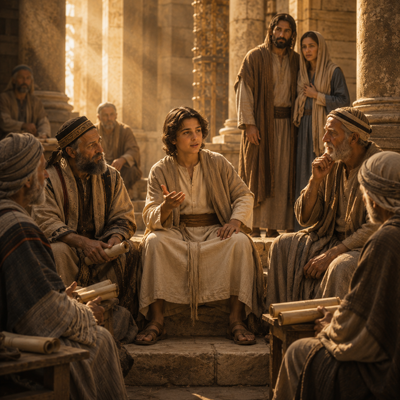
Scripture is largely silent about Jesus' childhood, but Luke records one remarkable episode. When Jesus was twelve years old, His family traveled to Jerusalem for the Passover, as was their custom. On the return journey, Mary and Joseph assumed He was among the company of travelers. When they discovered He was not, they turned back and searched for three days before finding Him in the Temple, seated among the teachers, listening to them and asking questions.
And all that heard him were astonished at his understanding and answers. - Luke 2:47
Mary, relieved but shaken, asked why He had treated them this way. His answer was striking in its calm certainty:
How is it that ye sought me? wist ye not that I must be about my Father's business? - Luke 2:49
This is the first recorded utterance of Jesus in Scripture, and it is a declaration of identity. At twelve years old, He knew whose Son He was and what that meant. Mary and Joseph did not fully understand His words, but Luke tells us that Mary kept all these sayings in her heart (Luke 2:51). After this, Jesus returned with them to Nazareth and was subject to them — a detail that itself speaks to His humility and obedience.
And all that heard him were astonished at his understanding and answers. - Luke 2:47
Mary, relieved but shaken, asked why He had treated them this way. His answer was striking in its calm certainty:
How is it that ye sought me? wist ye not that I must be about my Father's business? - Luke 2:49
This is the first recorded utterance of Jesus in Scripture, and it is a declaration of identity. At twelve years old, He knew whose Son He was and what that meant. Mary and Joseph did not fully understand His words, but Luke tells us that Mary kept all these sayings in her heart (Luke 2:51). After this, Jesus returned with them to Nazareth and was subject to them — a detail that itself speaks to His humility and obedience.
Luke 2:41-52
The Baptism of Jesus (around 26–29 AD)

John the Baptist had been calling Israel to repentance and baptizing in the Jordan River, preparing the way for the Messiah. Among those who came to be baptized was Jesus — a moment that struck John as exactly backward. John protested that he needed to be baptized by Jesus, not the other way around. Jesus' reply was direct:
Suffer it to be so now: for thus it becometh us to fulfil all righteousness. - Matthew 3:15
Jesus had no sin to repent of. His baptism was not for Himself, but an act of identification with the humanity He came to redeem — publicly aligning Himself with sinners as their representative and their substitute.
What followed was a full manifestation of the Trinity: as Jesus came up out of the water, the Spirit of God descended upon Him in the form of a dove, and the voice of the Father spoke from heaven:
This is my beloved Son, in whom I am well pleased. - Matthew 3:17
This was the public inauguration of Jesus' ministry. The Father announced Him. The Spirit anointed Him. And John's testimony to those standing there left no ambiguity: Behold the Lamb of God, which taketh away the sin of the world. (John 1:29)
Suffer it to be so now: for thus it becometh us to fulfil all righteousness. - Matthew 3:15
Jesus had no sin to repent of. His baptism was not for Himself, but an act of identification with the humanity He came to redeem — publicly aligning Himself with sinners as their representative and their substitute.
What followed was a full manifestation of the Trinity: as Jesus came up out of the water, the Spirit of God descended upon Him in the form of a dove, and the voice of the Father spoke from heaven:
This is my beloved Son, in whom I am well pleased. - Matthew 3:17
This was the public inauguration of Jesus' ministry. The Father announced Him. The Spirit anointed Him. And John's testimony to those standing there left no ambiguity: Behold the Lamb of God, which taketh away the sin of the world. (John 1:29)
Matthew 3:13-17
Mark 1:9-11
Luke 3:21-22
John 1:29-34
The Temptation of Jesus (immediately after His baptism)

Immediately after His baptism, the Spirit led Jesus into the wilderness, where He fasted for forty days and forty nights. This echoes other great forty-day periods in Scripture: Moses on Mount Sinai receiving the Law, Elijah journeying to Horeb, Israel wandering forty years in the desert. Jesus was being tested as Israel had been tested — and where Israel failed, He would stand firm.
At the end of the fast, when Jesus was physically at His weakest, Satan came with three temptations. Each was crafted to exploit a real human need or desire — for food, for safety, for power — and each time, Satan twisted Scripture in the attempt. Each time, Jesus answered him with Scripture, drawn from Deuteronomy:
And when the tempter came to him, he said, If thou be the Son of God, command that these stones be made bread. But he answered and said, Man shall not live by bread alone, but by every word that proceedeth out of the mouth of God. - Matthew 4:3-4
Then the devil taketh him up into the holy city, and setteth him on a pinnacle of the temple, And saith unto him, If thou be the Son of God, cast thyself down: for it is written, He shall give his angels charge concerning thee: and in their hands they shall bear thee up, lest at any time thou dash thy foot against a stone. Jesus said unto him, Thou shalt not tempt the Lord thy God. - Matthew 4:5-7
Again, the devil taketh him up into an exceeding high mountain, and sheweth him all the kingdoms of the world, and the glory of them; And saith unto him, All these things will I give thee, if thou wilt fall down and worship me. Then saith Jesus unto him, Get thee hence, Satan: for it is written, Thou shalt worship the Lord thy God, and him only shalt thou serve. - Matthew 4:8-10
Satan departed. Angels came and ministered to Jesus. The significance of this passage goes well beyond a record of events: it establishes that Jesus is the perfect High Priest who was in all points tempted like as we are, yet without sin (Hebrews 4:15). He knows the weight of temptation from the inside. And His weapon throughout was not divine power but the Word of God — the same weapon available to every believer.
At the end of the fast, when Jesus was physically at His weakest, Satan came with three temptations. Each was crafted to exploit a real human need or desire — for food, for safety, for power — and each time, Satan twisted Scripture in the attempt. Each time, Jesus answered him with Scripture, drawn from Deuteronomy:
And when the tempter came to him, he said, If thou be the Son of God, command that these stones be made bread. But he answered and said, Man shall not live by bread alone, but by every word that proceedeth out of the mouth of God. - Matthew 4:3-4
Then the devil taketh him up into the holy city, and setteth him on a pinnacle of the temple, And saith unto him, If thou be the Son of God, cast thyself down: for it is written, He shall give his angels charge concerning thee: and in their hands they shall bear thee up, lest at any time thou dash thy foot against a stone. Jesus said unto him, Thou shalt not tempt the Lord thy God. - Matthew 4:5-7
Again, the devil taketh him up into an exceeding high mountain, and sheweth him all the kingdoms of the world, and the glory of them; And saith unto him, All these things will I give thee, if thou wilt fall down and worship me. Then saith Jesus unto him, Get thee hence, Satan: for it is written, Thou shalt worship the Lord thy God, and him only shalt thou serve. - Matthew 4:8-10
Satan departed. Angels came and ministered to Jesus. The significance of this passage goes well beyond a record of events: it establishes that Jesus is the perfect High Priest who was in all points tempted like as we are, yet without sin (Hebrews 4:15). He knows the weight of temptation from the inside. And His weapon throughout was not divine power but the Word of God — the same weapon available to every believer.
Matthew 4:1-11
Mark 1:12-13
Luke 4:1-13
The Calling of the First Disciples (early in Jesus' ministry)
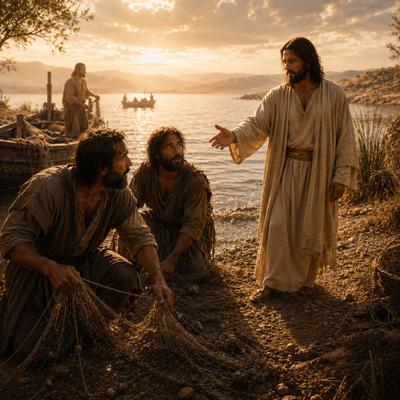
As Jesus began His public ministry along the shores of the Sea of Galilee, He did not recruit scholars or religious leaders. He called fishermen. Walking beside the sea, He saw two brothers, Simon (called Peter) and Andrew, casting a net. His call to them was simple and direct:
Follow me, and I will make you fishers of men. - Matthew 4:19
And they straightway left their nets, and followed him. - Matthew 4:20
A short distance further, He called James and John, sons of Zebedee, who were in a boat mending their nets with their father. They also left immediately and followed Him. The speed of their response is striking — no negotiation, no conditions, no delay. Something in Jesus' call carried an authority that ordinary men do not possess.
These four became the inner circle of His disciples. John's Gospel also records the early calling of Philip and Nathanael, and over the course of His ministry, Jesus would formally appoint twelve men as apostles, chosen to be with Him, to be sent out to preach, and to have authority over unclean spirits (Mark 3:14-15). They were not chosen for their credentials. They were chosen by Christ, and that was sufficient.
Follow me, and I will make you fishers of men. - Matthew 4:19
And they straightway left their nets, and followed him. - Matthew 4:20
A short distance further, He called James and John, sons of Zebedee, who were in a boat mending their nets with their father. They also left immediately and followed Him. The speed of their response is striking — no negotiation, no conditions, no delay. Something in Jesus' call carried an authority that ordinary men do not possess.
These four became the inner circle of His disciples. John's Gospel also records the early calling of Philip and Nathanael, and over the course of His ministry, Jesus would formally appoint twelve men as apostles, chosen to be with Him, to be sent out to preach, and to have authority over unclean spirits (Mark 3:14-15). They were not chosen for their credentials. They were chosen by Christ, and that was sufficient.
Matthew 4:18-22
Mark 1:16-20
Luke 5:1-11
John 1:35-51
The Appointment of the Twelve Apostles
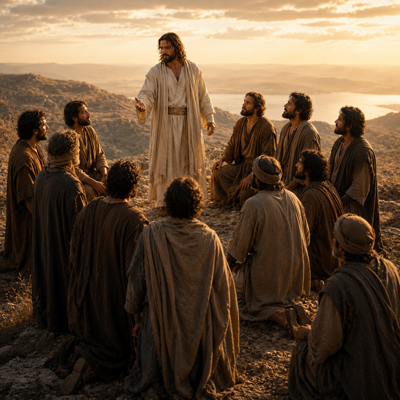
As Jesus' ministry grew and the crowds increased, He withdrew to a mountain to pray — spending the entire night in prayer to God. When day came, He called His disciples to Him and chose twelve of them, whom He also named apostles:
And when it was day, he called unto him his disciples: and of them he chose twelve, whom also he named apostles; Simon, (whom he also named Peter,) and Andrew his brother, James and John, Philip and Bartholomew, Matthew and Thomas, James the son of Alphaeus, and Simon called Zelotes, And Judas the brother of James, and Judas Iscariot, which also was the traitor. - Luke 6:13-16
The word apostle means one who is sent. These twelve were not merely followers — they were commissioned representatives, given authority to preach the kingdom of God, to heal the sick, and to cast out demons (Matthew 10:1). They were a deliberate echo of the twelve tribes of Israel, signaling that Jesus was reconstituting God's people around Himself.
The list is worth noting carefully. It includes a former tax collector (Matthew, who worked for the Roman occupiers), a Zealot (Simon, from a political movement that opposed Roman rule), and the man who would betray Him (Judas Iscariot). Jesus knew Judas from the beginning (John 6:64) and called him anyway — not because God's plan failed, but because it could not be stopped. Every name on this list was chosen in prayer, and every detail of what followed was under the Father's sovereign hand.
And when it was day, he called unto him his disciples: and of them he chose twelve, whom also he named apostles; Simon, (whom he also named Peter,) and Andrew his brother, James and John, Philip and Bartholomew, Matthew and Thomas, James the son of Alphaeus, and Simon called Zelotes, And Judas the brother of James, and Judas Iscariot, which also was the traitor. - Luke 6:13-16
The word apostle means one who is sent. These twelve were not merely followers — they were commissioned representatives, given authority to preach the kingdom of God, to heal the sick, and to cast out demons (Matthew 10:1). They were a deliberate echo of the twelve tribes of Israel, signaling that Jesus was reconstituting God's people around Himself.
The list is worth noting carefully. It includes a former tax collector (Matthew, who worked for the Roman occupiers), a Zealot (Simon, from a political movement that opposed Roman rule), and the man who would betray Him (Judas Iscariot). Jesus knew Judas from the beginning (John 6:64) and called him anyway — not because God's plan failed, but because it could not be stopped. Every name on this list was chosen in prayer, and every detail of what followed was under the Father's sovereign hand.
Matthew 10:1-4
Mark 3:13-19
Luke 6:12-16
The Wedding at Cana — Jesus' First Miracle
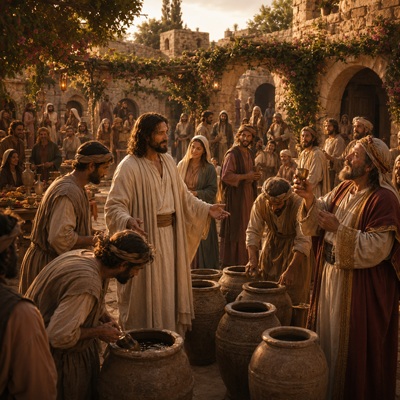
Jesus' first recorded miracle took place not in the Temple or before a large crowd, but at a wedding feast in the small village of Cana in Galilee. Mary, Jesus' mother, was there, and she noticed that the wine had run out — a real social embarrassment for the host family in that culture. She brought the matter to Jesus. His reply has puzzled readers:
Woman, what have I to do with thee? mine hour is not yet come. - John 2:4
A word on His manner of address: in the original Greek, Jesus uses the word gynai — closer to the English ma'am than anything disrespectful. This was a culturally respectful form of address, not a rebuke. His reference to "mine hour" points to the divine timetable for His public work, which He consistently referred to throughout John's Gospel.
Despite this, Mary simply told the servants: Whatsoever he saith unto you, do it. (John 2:5) — perhaps the most universally applicable instruction in all of Scripture. Jesus directed the servants to fill six large stone water jars (used for Jewish ceremonial washing) to the brim, then draw some out and bring it to the master of the feast. What had been water was now wine — and not inferior wine. The master called the bridegroom aside and remarked: Thou hast kept the good wine until now. (John 2:10)
The stone jars meant for ritual purification being filled with the best wine points toward the new covenant: the old ceremonial system giving way to the abundance of grace that Jesus brings. John notes that this was the beginning of His signs, and that through it, he manifested forth his glory; and his disciples believed on him. (John 2:11)
Woman, what have I to do with thee? mine hour is not yet come. - John 2:4
A word on His manner of address: in the original Greek, Jesus uses the word gynai — closer to the English ma'am than anything disrespectful. This was a culturally respectful form of address, not a rebuke. His reference to "mine hour" points to the divine timetable for His public work, which He consistently referred to throughout John's Gospel.
Despite this, Mary simply told the servants: Whatsoever he saith unto you, do it. (John 2:5) — perhaps the most universally applicable instruction in all of Scripture. Jesus directed the servants to fill six large stone water jars (used for Jewish ceremonial washing) to the brim, then draw some out and bring it to the master of the feast. What had been water was now wine — and not inferior wine. The master called the bridegroom aside and remarked: Thou hast kept the good wine until now. (John 2:10)
The stone jars meant for ritual purification being filled with the best wine points toward the new covenant: the old ceremonial system giving way to the abundance of grace that Jesus brings. John notes that this was the beginning of His signs, and that through it, he manifested forth his glory; and his disciples believed on him. (John 2:11)
John 2:1-11
The Cleansing of the Temple

The Temple in Jerusalem was the center of Jewish worship — the house of God. But what Jesus found there when He arrived for Passover was a marketplace. Money changers and those selling oxen, sheep, and doves had set up business in the Temple courts, and the exchange rates and fees being charged amounted to exploitation of the very worshippers who had come to seek God. Jesus drove them all out:
And when he had made a scourge of small cords, he drove them all out of the temple, and the sheep, and the oxen; and poured out the changers' money, and overthrew the tables; And said unto them that sold doves, Take these things hence; make not my Father's house an house of merchandise. - John 2:15-16
This is one of the most direct expressions of Jesus' authority in the Gospels. It also provoked a challenge from the Jewish leaders: by what authority did He do this? Jesus answered cryptically: Destroy this temple, and in three days I will raise it up. (John 2:19) They assumed He was speaking of the stone building. He was speaking of His body — a reference the disciples would only understand after the resurrection.
The Synoptic Gospels record a second cleansing of the Temple during Passion Week (Matthew 21:12-13), where Jesus quoted two prophets together: My house shall be called the house of prayer; but ye have made it a den of thieves. Both cleansings carry the same message: the worship of God cannot be bought, sold, or reduced to a transaction.
And when he had made a scourge of small cords, he drove them all out of the temple, and the sheep, and the oxen; and poured out the changers' money, and overthrew the tables; And said unto them that sold doves, Take these things hence; make not my Father's house an house of merchandise. - John 2:15-16
This is one of the most direct expressions of Jesus' authority in the Gospels. It also provoked a challenge from the Jewish leaders: by what authority did He do this? Jesus answered cryptically: Destroy this temple, and in three days I will raise it up. (John 2:19) They assumed He was speaking of the stone building. He was speaking of His body — a reference the disciples would only understand after the resurrection.
The Synoptic Gospels record a second cleansing of the Temple during Passion Week (Matthew 21:12-13), where Jesus quoted two prophets together: My house shall be called the house of prayer; but ye have made it a den of thieves. Both cleansings carry the same message: the worship of God cannot be bought, sold, or reduced to a transaction.
John 2:13-22
Matthew 21:12-13
The Woman at the Well (Jesus and the Samaritan Woman)
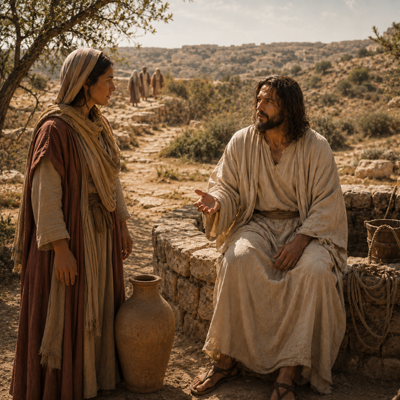
Jews and Samaritans had no dealings with one another — a long-standing social and religious hostility rooted in centuries of history. When Jesus passed through Samaria and sat down at Jacob's Well, He asked a Samaritan woman who had come to draw water for a drink. She was stunned: How is it that thou, being a Jew, askest drink of me, which am a woman of Samaria? (John 4:9)
What followed was one of the longest recorded conversations Jesus had with any individual in the Gospels. He spoke to her about living water — water that quenches not physical thirst but the deep spiritual thirst of the soul:
Whosoever drinketh of this water shall thirst again: But whosoever drinketh of the water that I shall give him shall never thirst; but the water that I shall give him shall be in him a well of water springing up into everlasting life. - John 4:13-14
He then revealed that He knew her personal history — five husbands, and the man she was currently with was not her husband. Rather than fleeing in shame, she pressed further. When the conversation turned to worship and the Messiah, Jesus stated plainly:
I that speak unto thee am he. - John 4:26
This is one of Jesus' most direct "I am" declarations in Scripture, and He made it not to a priest or a Pharisee but to a Samaritan woman with a complicated past. She left her water pot, went into the city, and told everyone she had met a man who told her all things that she ever did. Many from that city believed on Him because of her testimony. The woman at the well became the first evangelist to the Samaritans.
What followed was one of the longest recorded conversations Jesus had with any individual in the Gospels. He spoke to her about living water — water that quenches not physical thirst but the deep spiritual thirst of the soul:
Whosoever drinketh of this water shall thirst again: But whosoever drinketh of the water that I shall give him shall never thirst; but the water that I shall give him shall be in him a well of water springing up into everlasting life. - John 4:13-14
He then revealed that He knew her personal history — five husbands, and the man she was currently with was not her husband. Rather than fleeing in shame, she pressed further. When the conversation turned to worship and the Messiah, Jesus stated plainly:
I that speak unto thee am he. - John 4:26
This is one of Jesus' most direct "I am" declarations in Scripture, and He made it not to a priest or a Pharisee but to a Samaritan woman with a complicated past. She left her water pot, went into the city, and told everyone she had met a man who told her all things that she ever did. Many from that city believed on Him because of her testimony. The woman at the well became the first evangelist to the Samaritans.
John 4:1-42
The Sermon on the Mount (central teaching in Jesus' ministry)
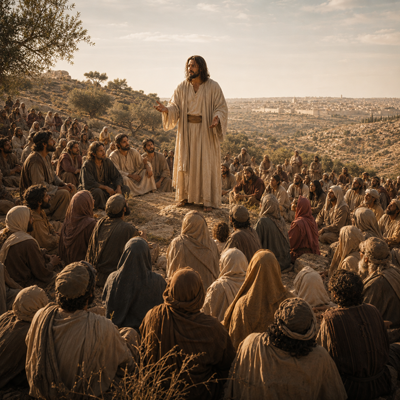
The Sermon on the Mount, recorded in Matthew 5–7, is the longest single block of Jesus' teaching in the Gospels. Delivered to His disciples on a hillside, with the crowds gathered nearby, it is the fullest statement of the ethics and values of the Kingdom of Heaven. It does not replace the Law of Moses; Jesus was explicit: Think not that I am come to destroy the law, or the prophets: I am not come to destroy, but to fulfil. (Matthew 5:17) Rather, it drives the Law deeper, from outward compliance to the condition of the heart.
The sermon opens with the Beatitudes — nine declarations of blessedness, each beginning with Blessed are. They turn the world's understanding of blessing upside down. It is not the powerful, the wealthy, or the respected who are declared blessed, but the poor in spirit, those who mourn, the meek, those who hunger after righteousness, the merciful, the pure in heart, the peacemakers, and those who are persecuted for righteousness' sake (Matthew 5:3-11).
The sermon covers a sweeping range of subjects: anger and reconciliation, lust and purity, oaths, retaliation, love for enemies, giving, prayer, fasting, money, anxiety, and judgment. At its center is the Lord's Prayer (Matthew 6:9-13), offered not as a formula to be repeated but as a model for how to approach God — acknowledging His holiness, submitting to His will, depending on His provision, and seeking His forgiveness.
The sermon ends with a warning and a choice. Those who hear and obey are like a man who builds his house on rock. Those who hear and do not obey are like a man who builds on sand. When the storm comes — and it will come — only one house stands. The crowds who heard it recognized something different from what they were used to: he taught them as one having authority, and not as the scribes. (Matthew 7:29)
The sermon opens with the Beatitudes — nine declarations of blessedness, each beginning with Blessed are. They turn the world's understanding of blessing upside down. It is not the powerful, the wealthy, or the respected who are declared blessed, but the poor in spirit, those who mourn, the meek, those who hunger after righteousness, the merciful, the pure in heart, the peacemakers, and those who are persecuted for righteousness' sake (Matthew 5:3-11).
The sermon covers a sweeping range of subjects: anger and reconciliation, lust and purity, oaths, retaliation, love for enemies, giving, prayer, fasting, money, anxiety, and judgment. At its center is the Lord's Prayer (Matthew 6:9-13), offered not as a formula to be repeated but as a model for how to approach God — acknowledging His holiness, submitting to His will, depending on His provision, and seeking His forgiveness.
The sermon ends with a warning and a choice. Those who hear and obey are like a man who builds his house on rock. Those who hear and do not obey are like a man who builds on sand. When the storm comes — and it will come — only one house stands. The crowds who heard it recognized something different from what they were used to: he taught them as one having authority, and not as the scribes. (Matthew 7:29)
Matthew 5-7
Luke 6:20-49 (the Sermon on the Plain, a parallel account)
The Healing of the Paralytic (a representative miracle of healing)
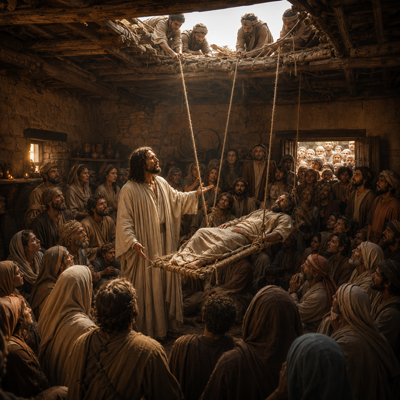
Throughout His ministry, Jesus performed a vast number of healings — the blind received sight, lepers were cleansed, the lame walked, and the deaf heard. One episode stands out not merely as a miracle of physical restoration, but as a direct declaration of His authority to forgive sin.
A paralyzed man was brought to Jesus by four friends. The crowd was so thick that they could not get through the door, so they went up on the roof, removed tiles, and lowered the man down on his mat before Jesus. Jesus, seeing their faith, said something unexpected:
Son, thy sins be forgiven thee. - Mark 2:5
The scribes sitting there were immediately offended. In their minds, this was blasphemy — who can forgive sins but God alone? Jesus addressed their objection directly:
Whether is it easier to say to the sick of the palsy, Thy sins be forgiven thee; or to say, Arise, and take up thy bed, and walk? But that ye may know that the Son of man hath power on earth to forgive sins, (he saith to the sick of the palsy,) I say unto thee, Arise, and take up thy bed, and go thy way into thine house. - Mark 2:9-11
The man rose, took up his bed, and walked out before them all. The physical healing was the visible proof of the invisible reality: Jesus has authority to forgive sin. That is the greater miracle, and it is offered freely to everyone who comes to Him in faith.
A paralyzed man was brought to Jesus by four friends. The crowd was so thick that they could not get through the door, so they went up on the roof, removed tiles, and lowered the man down on his mat before Jesus. Jesus, seeing their faith, said something unexpected:
Son, thy sins be forgiven thee. - Mark 2:5
The scribes sitting there were immediately offended. In their minds, this was blasphemy — who can forgive sins but God alone? Jesus addressed their objection directly:
Whether is it easier to say to the sick of the palsy, Thy sins be forgiven thee; or to say, Arise, and take up thy bed, and walk? But that ye may know that the Son of man hath power on earth to forgive sins, (he saith to the sick of the palsy,) I say unto thee, Arise, and take up thy bed, and go thy way into thine house. - Mark 2:9-11
The man rose, took up his bed, and walked out before them all. The physical healing was the visible proof of the invisible reality: Jesus has authority to forgive sin. That is the greater miracle, and it is offered freely to everyone who comes to Him in faith.
Mark 2:1-12
Matthew 9:1-8
Luke 5:17-26
The Feeding of the 5,000 (Jesus' most widely witnessed miracle)

The feeding of the 5,000 is the only miracle of Jesus recorded in all four Gospels, which speaks to how significant it was to the early Church. A large crowd had followed Jesus to a remote area to hear Him teach and to be healed. As evening approached, the disciples urged Jesus to send the people away so they could find food in nearby villages. Jesus' reply reoriented the conversation:
They need not depart; give ye them to eat. - Matthew 14:16
The disciples had five loaves of bread and two fish — brought by a young boy in the crowd (John 6:9). It was nowhere near enough for such a crowd, which numbered five thousand men besides women and children. Jesus had the people sit down in groups on the grass. He took the loaves and fish, looked up to heaven, blessed the food, broke it, and gave it to the disciples to distribute. Every person ate and was filled, and twelve baskets of fragments were collected afterward.
The crowd's response was to want to make Him king by force (John 6:15) — they recognized the miracle but drew the wrong conclusion. The day after, Jesus explained what the true meaning was: I am the bread of life: he that cometh to me shall never hunger; and he that believeth on me shall never thirst. (John 6:35) The miracle was real and the hunger it satisfied was real, but it pointed to a deeper provision: Jesus Himself as the sustenance of the soul.
They need not depart; give ye them to eat. - Matthew 14:16
The disciples had five loaves of bread and two fish — brought by a young boy in the crowd (John 6:9). It was nowhere near enough for such a crowd, which numbered five thousand men besides women and children. Jesus had the people sit down in groups on the grass. He took the loaves and fish, looked up to heaven, blessed the food, broke it, and gave it to the disciples to distribute. Every person ate and was filled, and twelve baskets of fragments were collected afterward.
The crowd's response was to want to make Him king by force (John 6:15) — they recognized the miracle but drew the wrong conclusion. The day after, Jesus explained what the true meaning was: I am the bread of life: he that cometh to me shall never hunger; and he that believeth on me shall never thirst. (John 6:35) The miracle was real and the hunger it satisfied was real, but it pointed to a deeper provision: Jesus Himself as the sustenance of the soul.
Matthew 14:13-21
Mark 6:30-44
Luke 9:10-17
John 6:1-15
The Transfiguration

About a week after Peter's great confession at Caesarea Philippi — Thou art the Christ, the Son of the living God (Matthew 16:16) — Jesus took Peter, James, and John up a high mountain. There, His appearance was transformed before their eyes. His face shone as the sun, and His garments became dazzling white, whiter than any earthly bleaching could produce.
Moses and Elijah appeared with Him — Moses representing the Law, Elijah representing the Prophets — and they spoke with Jesus about His coming departure, which He was about to accomplish at Jerusalem (Luke 9:31). Their presence affirmed that Jesus was not setting aside the Law and the Prophets but fulfilling them, and that His death was not a tragedy but a divine appointment.
Peter, overwhelmed, offered to build three tabernacles. Before he had finished speaking, a bright cloud overshadowed them and the voice of the Father declared:
This is my beloved Son, in whom I am well pleased; hear ye him. - Matthew 17:5
The disciples fell on their faces in fear. When they raised their eyes, the vision was gone and they saw only Jesus. As they came down the mountain, He charged them to tell no one until the Son of Man had risen from the dead. The Transfiguration was a foretaste of His glory — a brief lifting of the veil over the One who had veiled Himself in human flesh. It showed the disciples, before the cross, what lay on the other side of it.
Moses and Elijah appeared with Him — Moses representing the Law, Elijah representing the Prophets — and they spoke with Jesus about His coming departure, which He was about to accomplish at Jerusalem (Luke 9:31). Their presence affirmed that Jesus was not setting aside the Law and the Prophets but fulfilling them, and that His death was not a tragedy but a divine appointment.
Peter, overwhelmed, offered to build three tabernacles. Before he had finished speaking, a bright cloud overshadowed them and the voice of the Father declared:
This is my beloved Son, in whom I am well pleased; hear ye him. - Matthew 17:5
The disciples fell on their faces in fear. When they raised their eyes, the vision was gone and they saw only Jesus. As they came down the mountain, He charged them to tell no one until the Son of Man had risen from the dead. The Transfiguration was a foretaste of His glory — a brief lifting of the veil over the One who had veiled Himself in human flesh. It showed the disciples, before the cross, what lay on the other side of it.
Matthew 17:1-9
Mark 9:2-10
Luke 9:28-36
The Raising of Lazarus
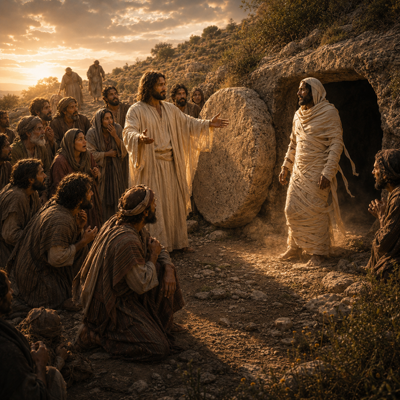
Lazarus of Bethany, a close friend of Jesus, had fallen seriously ill. His sisters Mary and Martha sent word to Jesus, but by the time Jesus arrived, Lazarus had been in the tomb for four days. Martha met Jesus on the road with a statement that was equal parts lament and faith:
Lord, if thou hadst been here, my brother had not died. But I know, that even now, whatsoever thou wilt ask of God, God will give it thee. - John 11:21-22
Jesus replied with one of the most important declarations in all of Scripture:
I am the resurrection, and the life: he that believeth in me, though he were dead, yet shall he live: And whosoever liveth and believeth in me shall never die. Believest thou this? - John 11:25-26
When Jesus came to the tomb, He wept. In just two words — Jesus wept (John 11:35) — Scripture gives us a window into the heart of God. He who knew He was about to raise Lazarus still grieved alongside those who were grieving. He who is Lord over death still felt the weight of it. That is the God we serve.
Jesus commanded the stone removed from the tomb's mouth, prayed aloud to the Father, and then called with a loud voice:
Lazarus, come forth. - John 11:43
And Lazarus came out, still wrapped in grave clothes. Many who saw it believed. Others went immediately to report it to the Pharisees, which set in motion the plot to have Jesus killed (John 11:46-53). The miracle that most powerfully demonstrated Jesus' authority over death also accelerated His own path toward the cross.
Lord, if thou hadst been here, my brother had not died. But I know, that even now, whatsoever thou wilt ask of God, God will give it thee. - John 11:21-22
Jesus replied with one of the most important declarations in all of Scripture:
I am the resurrection, and the life: he that believeth in me, though he were dead, yet shall he live: And whosoever liveth and believeth in me shall never die. Believest thou this? - John 11:25-26
When Jesus came to the tomb, He wept. In just two words — Jesus wept (John 11:35) — Scripture gives us a window into the heart of God. He who knew He was about to raise Lazarus still grieved alongside those who were grieving. He who is Lord over death still felt the weight of it. That is the God we serve.
Jesus commanded the stone removed from the tomb's mouth, prayed aloud to the Father, and then called with a loud voice:
Lazarus, come forth. - John 11:43
And Lazarus came out, still wrapped in grave clothes. Many who saw it believed. Others went immediately to report it to the Pharisees, which set in motion the plot to have Jesus killed (John 11:46-53). The miracle that most powerfully demonstrated Jesus' authority over death also accelerated His own path toward the cross.
John 11:1-44
The Olivet Discourse (Jesus' Teaching on the End Times)
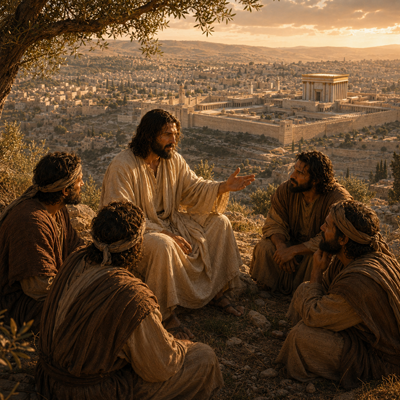
As Jesus left the Temple for the last time, His disciples pointed out the grandeur of its architecture. His reply stopped them short: not one stone of it would be left upon another. Later, as they sat on the Mount of Olives overlooking Jerusalem, four disciples — Peter, James, John, and Andrew — asked Him privately: when would this happen, and what would be the sign of His coming and of the end of the age?
Jesus' extended answer, recorded in Matthew 24–25, Mark 13, and Luke 21, is known as the Olivet Discourse. He spoke of events near at hand — the destruction of Jerusalem by Rome, which occurred in 70 AD — and events still future, when the Son of Man would return in glory. His instruction wove both together deliberately, as a near fulfillment that foreshadows the ultimate one.
He warned of false christs, wars, famines, and earthquakes — the beginning of sorrows. He spoke of a coming Great Tribulation unlike anything the world had seen. He spoke of cosmic signs: the sun darkened, the moon not giving its light, and the Son of Man coming on the clouds of heaven with power and great glory (Matthew 24:29-30).
But the emphasis of the discourse was not prediction for its own sake. It was a call to readiness:
Therefore be ye also ready: for in such an hour as ye think not the Son of man cometh. - Matthew 24:44
The discourse ends with three parables — the ten virgins, the talents, and the sheep and goats — all pressing the same question: are you found faithful when the Master returns? It remains among the most studied and debated passages in all of Scripture, and its relevance has not diminished.
Jesus' extended answer, recorded in Matthew 24–25, Mark 13, and Luke 21, is known as the Olivet Discourse. He spoke of events near at hand — the destruction of Jerusalem by Rome, which occurred in 70 AD — and events still future, when the Son of Man would return in glory. His instruction wove both together deliberately, as a near fulfillment that foreshadows the ultimate one.
He warned of false christs, wars, famines, and earthquakes — the beginning of sorrows. He spoke of a coming Great Tribulation unlike anything the world had seen. He spoke of cosmic signs: the sun darkened, the moon not giving its light, and the Son of Man coming on the clouds of heaven with power and great glory (Matthew 24:29-30).
But the emphasis of the discourse was not prediction for its own sake. It was a call to readiness:
Therefore be ye also ready: for in such an hour as ye think not the Son of man cometh. - Matthew 24:44
The discourse ends with three parables — the ten virgins, the talents, and the sheep and goats — all pressing the same question: are you found faithful when the Master returns? It remains among the most studied and debated passages in all of Scripture, and its relevance has not diminished.
Matthew 24-25
Mark 13
Luke 21:5-36
Jesus' Triumphal Entry into Jerusalem (Palm Sunday, around 30 AD)
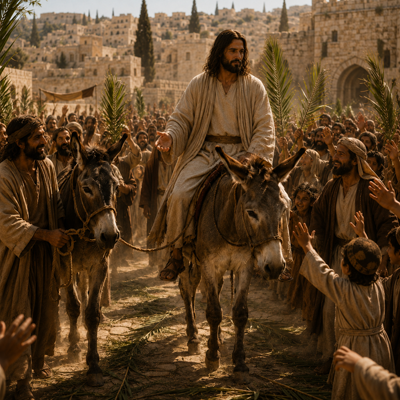
Six days before the Passover, Jesus made His entry into Jerusalem in a manner that was deliberately and unmistakably messianic. He sent two disciples ahead to bring Him a donkey's colt on which no man had ever sat. Riding into the city on this animal fulfilled a prophecy written five centuries earlier:
Rejoice greatly, O daughter of Zion; shout, O daughter of Jerusalem: behold, thy King cometh unto thee: he is just, and having salvation; lowly, and riding upon an ass, and upon a colt the foal of an ass. - Zechariah 9:9
The crowds spread their cloaks on the road and waved palm branches, and they cried out:
Blessed be the King that cometh in the name of the Lord: peace in heaven, and glory in the highest. - Luke 19:38
The Pharisees in the crowd demanded that Jesus rebuke His disciples for this. His reply was final: if these were silent, the very stones would cry out (Luke 19:40). As Jesus drew near the city, He wept over Jerusalem, lamenting that it did not recognize the day of its visitation.
The entry into Jerusalem was Jesus' public self-presentation as the Messiah. He had avoided this openly throughout His ministry, often instructing those He healed to tell no one. Now, with the cross before Him, He came openly. The people who shouted Hosanna that day would, within a week, be crying Crucify him. It is a sober reminder that enthusiasm for Jesus and true faith in Jesus are not the same thing.
Rejoice greatly, O daughter of Zion; shout, O daughter of Jerusalem: behold, thy King cometh unto thee: he is just, and having salvation; lowly, and riding upon an ass, and upon a colt the foal of an ass. - Zechariah 9:9
The crowds spread their cloaks on the road and waved palm branches, and they cried out:
Blessed be the King that cometh in the name of the Lord: peace in heaven, and glory in the highest. - Luke 19:38
The Pharisees in the crowd demanded that Jesus rebuke His disciples for this. His reply was final: if these were silent, the very stones would cry out (Luke 19:40). As Jesus drew near the city, He wept over Jerusalem, lamenting that it did not recognize the day of its visitation.
The entry into Jerusalem was Jesus' public self-presentation as the Messiah. He had avoided this openly throughout His ministry, often instructing those He healed to tell no one. Now, with the cross before Him, He came openly. The people who shouted Hosanna that day would, within a week, be crying Crucify him. It is a sober reminder that enthusiasm for Jesus and true faith in Jesus are not the same thing.
Matthew 21:1-11
Mark 11:1-11
Luke 19:28-44
John 12:12-19
The Last Supper (the night before the crucifixion)
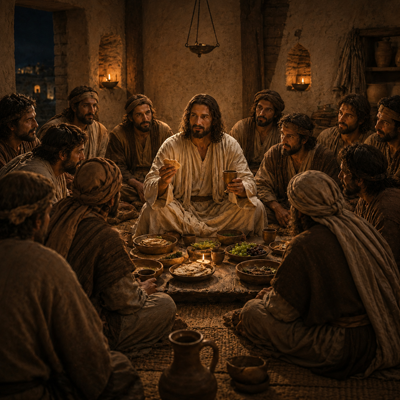
On the evening of the Passover, Jesus reclined at table with His twelve apostles in an upper room in Jerusalem. He began the evening by doing something that stunned them: He rose, took a towel and basin, and washed His disciples' feet — a task reserved for the lowest household servant. When Peter objected, Jesus explained:
If I then, your Lord and Master, have washed your feet; ye also ought to wash one another's feet. For I have given you an example, that ye should do as I have done to you. - John 13:14-15
During the meal, Jesus took bread, gave thanks, broke it, and gave it to them: Take, eat; this is my body. (Matthew 26:26) Then He took the cup: Drink ye all of it; for this is my blood of the new testament, which is shed for many for the remission of sins. (Matthew 26:27-28) In doing so, He transformed the Passover meal — a remembrance of Israel's deliverance from Egypt — into something new: a memorial of His own sacrificial death, to be observed by His followers until He returns.
He also announced that one of those at the table would betray Him. And He told Peter, who protested his loyalty, that before the rooster crowed Peter would deny Him three times. John 13-17 records at length the teaching Jesus gave that night — the promise of the Holy Spirit, the call to abide in Him as branches in a vine, the command to love one another, and His final prayer for His disciples and for all who would believe through their word. It is one of the most profound passages in Scripture, and Jesus spoke it in full knowledge of what was hours away.
If I then, your Lord and Master, have washed your feet; ye also ought to wash one another's feet. For I have given you an example, that ye should do as I have done to you. - John 13:14-15
During the meal, Jesus took bread, gave thanks, broke it, and gave it to them: Take, eat; this is my body. (Matthew 26:26) Then He took the cup: Drink ye all of it; for this is my blood of the new testament, which is shed for many for the remission of sins. (Matthew 26:27-28) In doing so, He transformed the Passover meal — a remembrance of Israel's deliverance from Egypt — into something new: a memorial of His own sacrificial death, to be observed by His followers until He returns.
He also announced that one of those at the table would betray Him. And He told Peter, who protested his loyalty, that before the rooster crowed Peter would deny Him three times. John 13-17 records at length the teaching Jesus gave that night — the promise of the Holy Spirit, the call to abide in Him as branches in a vine, the command to love one another, and His final prayer for His disciples and for all who would believe through their word. It is one of the most profound passages in Scripture, and Jesus spoke it in full knowledge of what was hours away.
Matthew 26:17-30
Mark 14:12-26
Luke 22:7-23
John 13-17
The Prayer and Arrest in Gethsemane
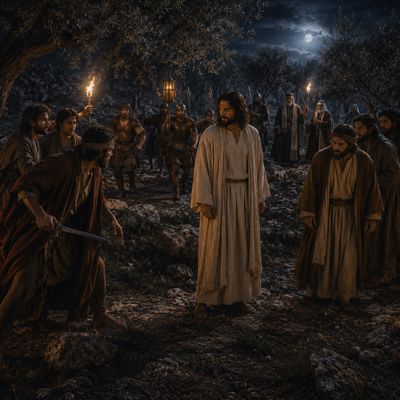
After the supper, Jesus led His disciples to the Garden of Gethsemane on the Mount of Olives, a place He often went to pray. He took Peter, James, and John deeper into the garden, telling them He was sorrowful even unto death, and asking them to watch with Him. Then He went a little further and fell on His face.
O my Father, if it be possible, let this cup pass from me: nevertheless not as I will, but as thou wilt. - Matthew 26:39
Luke records that in His agony, His sweat became as great drops of blood falling to the ground (Luke 22:44). He prayed three times, returning each time to find His disciples asleep. The "cup" He asked the Father to remove was not the cross itself in fear of pain, but the bearing of the full weight of divine wrath against sin — the cup that the prophets had described as the cup of God's judgment (cf. Isaiah 51:17; Jeremiah 25:15). He was willing to drink it. That willingness is the heart of the Gospel.
While He was still speaking, Judas arrived with a detachment of soldiers and officers sent by the chief priests. Judas had arranged a sign: the man he kissed was the one to arrest. He greeted Jesus with the word Rabbi and kissed Him. Jesus submitted to the arrest, rebuking Peter for drawing his sword and healing the ear of the high priest's servant that Peter had cut off. He was led away. His disciples fled.
O my Father, if it be possible, let this cup pass from me: nevertheless not as I will, but as thou wilt. - Matthew 26:39
Luke records that in His agony, His sweat became as great drops of blood falling to the ground (Luke 22:44). He prayed three times, returning each time to find His disciples asleep. The "cup" He asked the Father to remove was not the cross itself in fear of pain, but the bearing of the full weight of divine wrath against sin — the cup that the prophets had described as the cup of God's judgment (cf. Isaiah 51:17; Jeremiah 25:15). He was willing to drink it. That willingness is the heart of the Gospel.
While He was still speaking, Judas arrived with a detachment of soldiers and officers sent by the chief priests. Judas had arranged a sign: the man he kissed was the one to arrest. He greeted Jesus with the word Rabbi and kissed Him. Jesus submitted to the arrest, rebuking Peter for drawing his sword and healing the ear of the high priest's servant that Peter had cut off. He was led away. His disciples fled.
Matthew 26:36-56
Mark 14:32-52
Luke 22:39-53
John 18:1-12
The Trials before Jewish and Roman Authorities

From the garden, Jesus was taken first to the house of Annas, the former high priest, then to Caiaphas, the current high priest, where the Sanhedrin had assembled in the pre-dawn hours. False witnesses were brought forward but their testimonies did not agree. Finally, Caiaphas asked Jesus directly:
I adjure thee by the living God, that thou tell us whether thou be the Christ, the Son of God. - Matthew 26:63
Thou hast said: nevertheless I say unto you, Hereafter shall ye see the Son of man sitting on the right hand of power, and coming in the clouds of heaven. - Matthew 26:64
The council declared it blasphemy and voted that He deserved death. They beat Him and mocked Him. In the courtyard outside, Peter denied knowing Jesus three times before the rooster crowed. When he realized it, he went out and wept bitterly.
Jesus was then taken to the Roman governor, Pontius Pilate, who could find no fault in Him. Pilate sent Him to Herod Antipas, who mocked Him and returned Him. Back before Pilate, the crowd — stirred up by the chief priests — demanded crucifixion. Pilate, unwilling to stand against the crowd, symbolically washed his hands and handed Jesus over to be crucified. Then released he Barabbas unto them: and when he had scourged Jesus, he delivered him to be crucified. (Matthew 27:26)
Every stage of these proceedings was a miscarriage of justice: a night trial (illegal under Jewish law), purchased witnesses, a governor who admitted the accused was innocent, and a crowd given the choice between a murderer and the Son of God. This was the worst that human systems could produce, and it was the very means God used to accomplish the redemption of the world.
I adjure thee by the living God, that thou tell us whether thou be the Christ, the Son of God. - Matthew 26:63
Thou hast said: nevertheless I say unto you, Hereafter shall ye see the Son of man sitting on the right hand of power, and coming in the clouds of heaven. - Matthew 26:64
The council declared it blasphemy and voted that He deserved death. They beat Him and mocked Him. In the courtyard outside, Peter denied knowing Jesus three times before the rooster crowed. When he realized it, he went out and wept bitterly.
Jesus was then taken to the Roman governor, Pontius Pilate, who could find no fault in Him. Pilate sent Him to Herod Antipas, who mocked Him and returned Him. Back before Pilate, the crowd — stirred up by the chief priests — demanded crucifixion. Pilate, unwilling to stand against the crowd, symbolically washed his hands and handed Jesus over to be crucified. Then released he Barabbas unto them: and when he had scourged Jesus, he delivered him to be crucified. (Matthew 27:26)
Every stage of these proceedings was a miscarriage of justice: a night trial (illegal under Jewish law), purchased witnesses, a governor who admitted the accused was innocent, and a crowd given the choice between a murderer and the Son of God. This was the worst that human systems could produce, and it was the very means God used to accomplish the redemption of the world.
Matthew 26:57-27:26
Mark 14:53-15:15
Luke 22:54-23:25
John 18:12-19:16
The Crucifixion of Jesus (around 30 AD)

Jesus was led to a place called Golgotha — the place of a skull — outside the walls of Jerusalem. He was nailed to a wooden cross between two thieves. Above His head, Pilate had written the charge: JESUS OF NAZARETH THE KING OF THE JEWS (John 19:19), in Hebrew, Greek, and Latin — the three great languages of the ancient world, a proclamation posted for all to read.
From the cross, Jesus spoke seven recorded words. To the soldiers who crucified Him: Father, forgive them; for they know not what they do. (Luke 23:34) To the thief who repented beside Him: Verily I say unto thee, Today shalt thou be with me in paradise. (Luke 23:43) To His mother and to John: Woman, behold thy son; Behold thy mother (John 19:26-27). Then, in fulfillment of Psalm 22, He cried:
My God, my God, why hast thou forsaken me? - Matthew 27:46
At noon, darkness fell over the entire land for three hours. The veil of the Temple was torn in two from top to bottom — God tearing it, not man, signifying that the barrier between God and man was now removed. Jesus cried with a loud voice: It is finished (John 19:30), and gave up His spirit.
The prophecies fulfilled at the cross are extensive: Psalm 22 describes the scene in detail written a thousand years before it happened. Isaiah 53 prophesied a suffering servant wounded for our transgressions, bruised for our iniquities. Zechariah 12:10 spoke of one they would pierce. Not one of these depended on coincidence — they depended on a God who had planned the redemption of mankind before the foundation of the world (Revelation 13:8).
From the cross, Jesus spoke seven recorded words. To the soldiers who crucified Him: Father, forgive them; for they know not what they do. (Luke 23:34) To the thief who repented beside Him: Verily I say unto thee, Today shalt thou be with me in paradise. (Luke 23:43) To His mother and to John: Woman, behold thy son; Behold thy mother (John 19:26-27). Then, in fulfillment of Psalm 22, He cried:
My God, my God, why hast thou forsaken me? - Matthew 27:46
At noon, darkness fell over the entire land for three hours. The veil of the Temple was torn in two from top to bottom — God tearing it, not man, signifying that the barrier between God and man was now removed. Jesus cried with a loud voice: It is finished (John 19:30), and gave up His spirit.
The prophecies fulfilled at the cross are extensive: Psalm 22 describes the scene in detail written a thousand years before it happened. Isaiah 53 prophesied a suffering servant wounded for our transgressions, bruised for our iniquities. Zechariah 12:10 spoke of one they would pierce. Not one of these depended on coincidence — they depended on a God who had planned the redemption of mankind before the foundation of the world (Revelation 13:8).
Matthew 27:27-56
Mark 15:16-41
Luke 23:26-49
John 19:17-37
The Burial of Jesus

As evening approached on the day of the crucifixion, a man named Joseph of Arimathea went to Pilate and asked for the body of Jesus. Joseph was a wealthy member of the Sanhedrin who had not consented to their decision to condemn Jesus, and who was himself a disciple of Jesus — secretly, for fear of the Jewish leaders (John 19:38). Pilate granted his request. Nicodemus, who had come to Jesus by night at the beginning of His ministry (John 3:1-2), came with him, bringing a large quantity of myrrh and aloes.
They wrapped Jesus' body in linen cloths with the spices, following the Jewish burial custom, and laid Him in a new tomb in a nearby garden — a tomb in which no one had yet been placed. This fulfilled the prophecy of Isaiah:
And he made his grave with the wicked, and with the rich in his death; because he had done no violence, neither was any deceit in his mouth. - Isaiah 53:9
A large stone was rolled across the entrance. The next day, the chief priests and Pharisees went to Pilate and asked for a guard to be posted, remembering that Jesus had said He would rise after three days. A seal was set and a watch placed. They intended to prevent any claim of resurrection. They succeeded only in ensuring that the resurrection, when it came, would be undeniable.
They wrapped Jesus' body in linen cloths with the spices, following the Jewish burial custom, and laid Him in a new tomb in a nearby garden — a tomb in which no one had yet been placed. This fulfilled the prophecy of Isaiah:
And he made his grave with the wicked, and with the rich in his death; because he had done no violence, neither was any deceit in his mouth. - Isaiah 53:9
A large stone was rolled across the entrance. The next day, the chief priests and Pharisees went to Pilate and asked for a guard to be posted, remembering that Jesus had said He would rise after three days. A seal was set and a watch placed. They intended to prevent any claim of resurrection. They succeeded only in ensuring that the resurrection, when it came, would be undeniable.
Matthew 27:57-66
Mark 15:42-47
Luke 23:50-56
John 19:38-42
The Resurrection of Jesus (three days after the crucifixion)
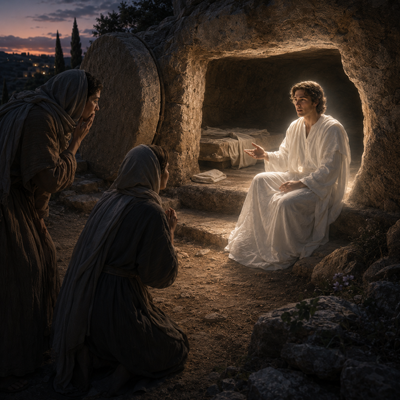
Early on the first day of the week, while it was still dark, Mary Magdalene came to the tomb. The stone had been rolled away. She ran to tell Peter and John, who ran to the tomb and found the grave clothes lying there, and the face cloth folded and set aside — not the scene of a body removed in haste, but something else entirely.
An angel appeared to the women who had come and declared the central fact of the Christian faith:
He is not here: for he is risen, as he said. - Matthew 28:6
Jesus Himself appeared first to Mary Magdalene, who did not recognize Him until He spoke her name (John 20:16). He appeared to the other women, to Peter, to the two disciples on the road to Emmaus, to ten of the apostles gathered in the upper room, and then a week later to all eleven including Thomas, who had refused to believe without seeing the wounds. Thomas looked and declared: My Lord and my God. (John 20:28)
The resurrection is not an addendum to the Gospel — it is the Gospel. Without it, as Paul states plainly, faith is vain and believers are still in their sins (1 Corinthians 15:17). But because He rose:
But now is Christ risen from the dead, and become the firstfruits of them that slept. - 1 Corinthians 15:20
He is the firstfruits — the guarantee and the beginning of the resurrection harvest that will follow for all who are in Him. Death has been defeated. The evidence was an empty tomb, dozens of eyewitnesses, and the transformation of a group of terrified, hiding disciples into men and women who proclaimed the risen Christ at the cost of their lives.
An angel appeared to the women who had come and declared the central fact of the Christian faith:
He is not here: for he is risen, as he said. - Matthew 28:6
Jesus Himself appeared first to Mary Magdalene, who did not recognize Him until He spoke her name (John 20:16). He appeared to the other women, to Peter, to the two disciples on the road to Emmaus, to ten of the apostles gathered in the upper room, and then a week later to all eleven including Thomas, who had refused to believe without seeing the wounds. Thomas looked and declared: My Lord and my God. (John 20:28)
The resurrection is not an addendum to the Gospel — it is the Gospel. Without it, as Paul states plainly, faith is vain and believers are still in their sins (1 Corinthians 15:17). But because He rose:
But now is Christ risen from the dead, and become the firstfruits of them that slept. - 1 Corinthians 15:20
He is the firstfruits — the guarantee and the beginning of the resurrection harvest that will follow for all who are in Him. Death has been defeated. The evidence was an empty tomb, dozens of eyewitnesses, and the transformation of a group of terrified, hiding disciples into men and women who proclaimed the risen Christ at the cost of their lives.
Matthew 28:1-10
Mark 16:1-8
Luke 24:1-12
John 20:1-18
The Road to Emmaus (a post-resurrection appearance, Luke only)

On the afternoon of resurrection day, two disciples were walking from Jerusalem to the village of Emmaus, about seven miles away. As they walked and talked about everything that had happened, Jesus Himself drew near and walked with them, but their eyes were kept from recognizing Him. He asked what they were discussing. They stopped, their faces downcast, and told Him of Jesus of Nazareth — His mighty deeds, His condemnation and crucifixion, their shattered hopes, and the strange report from the women that the tomb was empty.
Jesus' reply began with a gentle rebuke:
O fools, and slow of heart to believe all that the prophets have spoken: Ought not Christ to have suffered these things, and to enter into his glory? - Luke 24:25-26
And beginning at Moses and all the prophets, he expounded unto them in all the scriptures the things concerning himself. - Luke 24:27
When they reached Emmaus, they urged Him to stay, for evening was coming. As He reclined at table with them and broke bread, their eyes were opened and they recognized Him — and He vanished from their sight. They said to one another: Did not our heart burn within us, while he talked with us by the way, and while he opened to us the scriptures? (Luke 24:32)
They returned to Jerusalem immediately and found the eleven gathered together with the news: the Lord had indeed risen. The road to Emmaus teaches that Jesus is the subject of all the Scriptures — and that He is best recognized in the breaking of bread and in the opening of the Word.
Jesus' reply began with a gentle rebuke:
O fools, and slow of heart to believe all that the prophets have spoken: Ought not Christ to have suffered these things, and to enter into his glory? - Luke 24:25-26
And beginning at Moses and all the prophets, he expounded unto them in all the scriptures the things concerning himself. - Luke 24:27
When they reached Emmaus, they urged Him to stay, for evening was coming. As He reclined at table with them and broke bread, their eyes were opened and they recognized Him — and He vanished from their sight. They said to one another: Did not our heart burn within us, while he talked with us by the way, and while he opened to us the scriptures? (Luke 24:32)
They returned to Jerusalem immediately and found the eleven gathered together with the news: the Lord had indeed risen. The road to Emmaus teaches that Jesus is the subject of all the Scriptures — and that He is best recognized in the breaking of bread and in the opening of the Word.
Luke 24:13-35
The Appearance at the Sea of Galilee (John only)
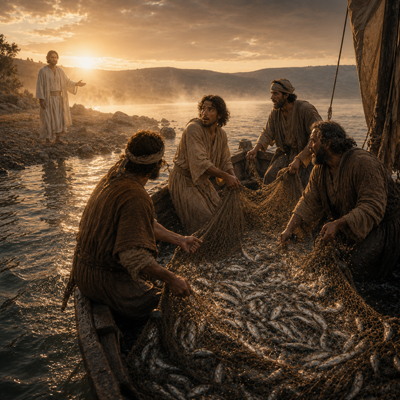
Some days later, seven of the disciples had returned to Galilee, to the Sea of Tiberias. Peter announced he was going fishing; the others went with him. They fished through the night and caught nothing. At dawn, a figure stood on the shore and called out to them, asking whether they had caught anything. When they said no, He told them to cast the net on the right side of the boat. They did, and were unable to haul the net in because of the quantity of fish. John said to Peter: It is the Lord. (John 21:7) Peter threw himself into the sea and swam to shore.
On the shore, Jesus had a charcoal fire with fish already on it and bread ready. He invited them: Come and dine. (John 21:12) After they had eaten, He turned to Peter and asked him three times whether he loved Him — once for each of Peter's three denials. Each time Peter affirmed his love, Jesus gave him a charge: Feed my lambs. Shepherd my sheep. Feed my sheep. (John 21:15-17)
The threefold restoration corresponded exactly to the threefold failure. The charcoal fire echoes the charcoal fire in the high priest's courtyard where Peter had warmed himself while denying Jesus three times (John 18:18). Jesus did not overlook what Peter had done; He met it directly, forgave it, and commissioned Peter anew. That is how Jesus deals with failure in those who love Him.
On the shore, Jesus had a charcoal fire with fish already on it and bread ready. He invited them: Come and dine. (John 21:12) After they had eaten, He turned to Peter and asked him three times whether he loved Him — once for each of Peter's three denials. Each time Peter affirmed his love, Jesus gave him a charge: Feed my lambs. Shepherd my sheep. Feed my sheep. (John 21:15-17)
The threefold restoration corresponded exactly to the threefold failure. The charcoal fire echoes the charcoal fire in the high priest's courtyard where Peter had warmed himself while denying Jesus three times (John 18:18). Jesus did not overlook what Peter had done; He met it directly, forgave it, and commissioned Peter anew. That is how Jesus deals with failure in those who love Him.
John 21:1-17
The Ascension of Jesus (40 days after the resurrection)

Over the forty days following His resurrection, Jesus appeared to His disciples many times, speaking to them about the kingdom of God (Acts 1:3). Paul records that He appeared to more than five hundred brethren at once, of whom the majority were still living at the time of writing (1 Corinthians 15:6) — an implicit challenge: ask them yourselves.
The final gathering was on the Mount of Olives. Jesus instructed His disciples to remain in Jerusalem until they received the promise of the Father — the Holy Spirit. Then He gave them their mandate:
But ye shall receive power, after that the Holy Ghost is come upon you: and ye shall be witnesses unto me both in Jerusalem, and in all Judaea, and in Samaria, and unto the uttermost part of the earth. - Acts 1:8
As they watched, He was taken up, and a cloud received Him out of their sight. Two men in white robes stood beside them and said:
This same Jesus, which is taken up from you into heaven, shall so come in like manner as ye have seen him go into heaven. - Acts 1:11
The ascension marked the end of Jesus' earthly ministry and the beginning of His heavenly one. He is now seated at the right hand of the Father (Hebrews 1:3), where He ever lives to make intercession for those who come to God through Him (Hebrews 7:25). He left, but He did not leave His people without provision: the promise of the Spirit was days away.
The final gathering was on the Mount of Olives. Jesus instructed His disciples to remain in Jerusalem until they received the promise of the Father — the Holy Spirit. Then He gave them their mandate:
But ye shall receive power, after that the Holy Ghost is come upon you: and ye shall be witnesses unto me both in Jerusalem, and in all Judaea, and in Samaria, and unto the uttermost part of the earth. - Acts 1:8
As they watched, He was taken up, and a cloud received Him out of their sight. Two men in white robes stood beside them and said:
This same Jesus, which is taken up from you into heaven, shall so come in like manner as ye have seen him go into heaven. - Acts 1:11
The ascension marked the end of Jesus' earthly ministry and the beginning of His heavenly one. He is now seated at the right hand of the Father (Hebrews 1:3), where He ever lives to make intercession for those who come to God through Him (Hebrews 7:25). He left, but He did not leave His people without provision: the promise of the Spirit was days away.
Mark 16:19-20
Luke 24:50-53
Acts 1:6-11
The Outpouring of the Holy Spirit at Pentecost (50 days after the resurrection)

Ten days after the ascension, the disciples and about 120 others were gathered in Jerusalem as Jesus had instructed, waiting in prayer. The Jewish festival of Pentecost — originally a harvest celebration held fifty days after Passover — had brought Jewish pilgrims to Jerusalem from across the known world.
Suddenly a sound like the rush of a mighty wind filled the entire house. What appeared to be tongues of fire rested on each of them, and they were all filled with the Holy Spirit and began to speak in other languages, as the Spirit gave them utterance. The crowd outside heard the commotion and gathered, each person hearing in his own language the mighty works of God.
Peter stood and preached, explaining what they were witnessing through the prophet Joel (Acts 2:16-21) and then declaring the death and resurrection of Jesus plainly. He concluded:
Therefore let all the house of Israel know assuredly, that God hath made that same Jesus, whom ye have crucified, both Lord and Christ. - Acts 2:36
Those who heard were cut to the heart. When they asked what they should do, Peter answered: Repent, and be baptized every one of you in the name of Jesus Christ for the remission of sins, and ye shall receive the gift of the Holy Ghost. (Acts 2:38) That day, about three thousand souls were added to their number.
Pentecost was the fulfillment of Jesus' promise and the birthday of the Church. The same Spirit who had overshadowed Mary at the conception of Jesus, descended upon Jesus at His baptism, and raised Him from the dead, now indwelt His people. The age of the Spirit had begun, and through that gathered body of believers, the Gospel would go to the uttermost parts of the earth — exactly as Jesus had said it would.
Suddenly a sound like the rush of a mighty wind filled the entire house. What appeared to be tongues of fire rested on each of them, and they were all filled with the Holy Spirit and began to speak in other languages, as the Spirit gave them utterance. The crowd outside heard the commotion and gathered, each person hearing in his own language the mighty works of God.
Peter stood and preached, explaining what they were witnessing through the prophet Joel (Acts 2:16-21) and then declaring the death and resurrection of Jesus plainly. He concluded:
Therefore let all the house of Israel know assuredly, that God hath made that same Jesus, whom ye have crucified, both Lord and Christ. - Acts 2:36
Those who heard were cut to the heart. When they asked what they should do, Peter answered: Repent, and be baptized every one of you in the name of Jesus Christ for the remission of sins, and ye shall receive the gift of the Holy Ghost. (Acts 2:38) That day, about three thousand souls were added to their number.
Pentecost was the fulfillment of Jesus' promise and the birthday of the Church. The same Spirit who had overshadowed Mary at the conception of Jesus, descended upon Jesus at His baptism, and raised Him from the dead, now indwelt His people. The age of the Spirit had begun, and through that gathered body of believers, the Gospel would go to the uttermost parts of the earth — exactly as Jesus had said it would.
Acts 2:1-41