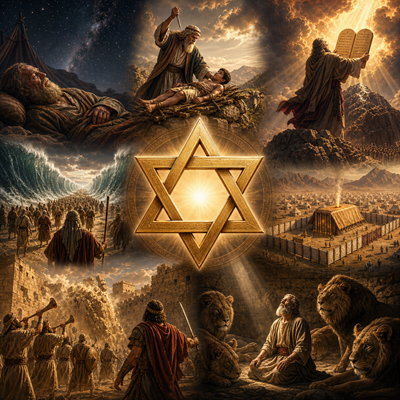
The Land and the Promise
A Biblical History of Israel: Covenant, Loss, Exile, and Restoration
Introduction
No theme runs more consistently through the whole Bible than God's covenant relationship with Israel and the land He promised her. From the first call of Abram out of Ur to the modern rebirth of the Jewish state in 1948, the story of Israel in her land is not merely a chapter of ancient history — it is the living framework within which God's plan of redemption for all peoples unfolds.
This study traces that story epoch by epoch, always anchored to the text of Scripture (KJV). Three land-theology principles guide our reading throughout: the land promise is covenantal — rooted in God's own oath, not in Israel's merit; any loss of the land is disciplinary — a consequence of covenant-breaking, not a cancellation of the promise; and every restoration of Israel to the land is prophetic — a foretaste of the final fulfilment God has sworn to bring about.
Part 1 — Patriarchal Foundations (Creation to c. 1800 BC)
Creation and the Land (Undated — Pre-History)
Before any nation exists, the land itself is part of God's created order — given to humanity as a stewardship under His authority.
In the beginning God created the heaven and the earth.
— Genesis 1:1
Post-Flood Nations and Canaan (c. 2300–2100 BC)
After the Flood, the nations spread across the earth. The land later known as Canaan is identified among the territories descending from Noah's son Ham — a detail that sets the geographic stage for all that follows.
And Canaan begat Sidon his firstborn...
— Genesis 10:15
The Call of Abram and the First Land Promise (c. 2000 BC)
God calls Abram out of Ur of the Chaldees and makes an extraordinary promise: a particular land will belong to his descendants. This is the founding moment of Israel's claim to the land — not ethnic superiority, but divine election and promise.
Unto thy seed will I give this land.
— Genesis 12:7
The Covenant Ratified with Land Boundaries (c. 2000 BC)
God formalises His promise to Abram in a covenant — a solemn, binding oath — and defines the land's boundaries explicitly: from the river of Egypt to the great river Euphrates. This is a far larger territory than Israel has ever fully occupied, and its complete fulfilment remains future.
Unto thy seed have I given this land, from the river of Egypt unto the great river, the river Euphrates.
— Genesis 15:18
Patriarchal Sojourning (c. 2000–1875 BC)
Abraham, Isaac, and Jacob live in the land as sojourners — strangers with tents, not armies. They possess the promise by faith long before possessing the land in fact. The New Testament picks this up as a model of faith: he sojourned in the land of promise, as in a strange country (Hebrews 11:9).
For all the land which thou seest, to thee will I give it, and to thy seed for ever.
— Genesis 13:15
Migration to Egypt (c. 1875 BC)
Famine drives Jacob's family down to Egypt. Even this departure was foretold in the covenant (Genesis 15:13). Israel does not abandon the land promise by leaving — God is simply growing a family into a nation in preparation for the great return.
And Israel dwelt in the land of Egypt...
— Genesis 47:27
Part 2 — Egypt, Sinai, and the Wilderness (c. 1875–1406 BC)
Israel in Egypt (c. 1875–1446 BC)
Joseph's welcome eventually gives way to oppression. A new Pharaoh "who knew not Joseph" enslaves the growing nation. But affliction does not cancel the promise — it accelerates Israel's growth and, in God's timing, creates the conditions for the mightiest act of redemption in the Old Testament.
Now there arose up a new king over Egypt, which knew not Joseph.
— Exodus 1:8
The Exodus (c. 1446 BC)
God delivers Israel from Egypt with mighty signs and wonders, explicitly aimed at returning His people to the land He had promised their fathers. The Exodus is the defining event of Old Testament redemption, a pattern Paul uses to illuminate Christian salvation (1 Corinthians 10:1–4).
To bring them up out of that land unto a good land and a large.
— Exodus 3:8
The Mosaic Covenant at Sinai (c. 1446 BC)
This is a critical milestone that the story of the land cannot be understood without. At Sinai, God gives Israel the Law — the terms of the covenant relationship between Himself and the nation He has redeemed. Deuteronomy 28–30 spells out the consequences with stark clarity: obedience brings blessing in the land; persistent disobedience brings cursing, and ultimately exile. The later loss of the land is not a surprise to God. It is the covenant working exactly as He warned it would — and it contains, even within the curses, the promise of a final restoration (Deuteronomy 30:1–5).
I call heaven and earth to record this day against you, that I have set before you life and death, blessing and cursing: therefore choose life, that both thou and thy seed may live.
— Deuteronomy 30:19
Wilderness Wandering (c. 1446–1406 BC)
Unbelief at Kadesh-barnea costs the generation of the Exodus their right to enter the land. They will die in the wilderness; their children will inherit the promise. The land waits for faith — it cannot be taken by a people who doubt the God who gave it.
Surely ye shall not come into the land...
— Numbers 14:30
Part 3 — Conquest and Settlement (c. 1406–1200 BC)
Entry into Canaan (c. 1406 BC)
Under Joshua, the new generation crosses the Jordan and begins taking possession of what God had sworn to their fathers. Every step of ground taken is a step of faith — the land is given before it is conquered, and conquered because it was given.
Every place that the sole of your foot shall tread upon, that have I given unto you.
— Joshua 1:3
Completion of the Conquest (c. 1400 BC)
The major military campaign concludes. Israel occupies the territories of Canaan and the land is divided among the twelve tribes. The faithfulness of God in fulfilling the Abrahamic promise is explicitly noted by the sacred historian.
The LORD gave unto Israel all the land which he sware to give unto their fathers.
— Joshua 21:43
Part 4 — The Period of the Judges (c. 1200–1050 BC)
Decentralised Control and Repeated Apostasy
With no king and no stable leadership, Israel cycles repeatedly through the same tragic pattern: prosperity leads to forgetfulness, forgetfulness to idolatry, idolatry to oppression by surrounding nations, oppression to repentance, repentance to deliverance by a judge — then back to the beginning. The Mosaic covenant is working exactly as warned: possession of the land is tied to faithfulness to God.
In those days there was no king in Israel: every man did that which was right in his own eyes.
— Judges 21:25
And he sold them into the hands of their enemies round about...
— Judges 2:14
Part 5 — The United Monarchy (c. 1050–931 BC)
The Kingdom Established (c. 1050 BC)
Israel demands a king. God grants their request — first Saul, then David. Under David, the twelve tribes are unified into a single kingdom that for the first time exercises real control over the full extent of the promised territories.
So David reigned over all Israel.
— 2 Samuel 5:5
Jerusalem Established as Capital (c. 1000 BC)
David captures Jerusalem and makes it the political and spiritual centre of the nation — "the city of David." Jerusalem's unique status in God's purposes will persist through all the upheavals that follow, and is not yet exhausted today.
The same is the city of David.
— 2 Samuel 5:7
The Davidic Covenant (c. 1000 BC)
This is one of the most theologically significant events in Israel's history, and cannot be overlooked in any biblical survey. God makes an unconditional covenant with David: his throne will be established forever; one of his descendants will rule without end (2 Samuel 7:12–16). This covenant does not depend on David's or his sons' faithfulness — it depends on God's sworn oath. The New Testament opens by announcing that Jesus of Nazareth is the Son of David in whom this promise is ultimately and perfectly fulfilled (Matthew 1:1; Luke 1:32–33; Acts 2:29–32). The land's future is inseparable from this royal covenant.
And thine house and thy kingdom shall be established for ever before thee: thy throne shall be established for ever.
— 2 Samuel 7:16
The Temple Built (c. 960 BC)
Solomon builds the Temple — the house of God in the land of God, the visible meeting point of heaven and earth. Worship is now permanently anchored to a specific place in the land, and the Temple becomes the heart of Israel's national and spiritual identity.
I have surely built thee an house to dwell in.
— 1 Kings 8:13
Part 6 — Divided Kingdom and Loss of the Land (931–586 BC)
Division of the Kingdom (931 BC)
Solomon's idolatry brings its consequences. At his son Rehoboam's accession, ten tribes break away to form the northern Kingdom of Israel under Jeroboam; only Judah and Benjamin remain loyal to David's line in the south. The land is now split — a division rooted in covenant unfaithfulness.
So Israel rebelled against the house of David.
— 1 Kings 12:19
Assyrian Conquest of the North (722 BC)
The northern kingdom, Israel, is swept away by the Assyrian Empire under Sargon II. The ten northern tribes are deported and dispersed among the nations — the famous "ten lost tribes." The Mosaic covenant's warning of exile (Deuteronomy 28:64) is fulfilled for the first time. Their territory passes out of Israelite control.
So was Israel carried away out of their own land...
— 2 Kings 17:23
Babylonian Conquest of Judah (605–586 BC)
The southern kingdom, Judah, survives the Assyrian threat but then falls to Babylon under Nebuchadnezzar in a series of campaigns. In 586 BC, Jerusalem falls, the Temple is burned, and the remnant of the people is carried into exile. The land — at the heart of God's covenant purposes — lies desolate. Yet even in this darkest moment the prophets insist the promise stands.
He burnt the house of the LORD.
— 2 Kings 25:9
Part 7 — Exile and Persian Restoration (586–332 BC)
The Land Rests During Exile (586–538 BC)
The Chronicler sees the 70-year exile in terms of Leviticus 26:34–35: the land receives its unpaid sabbaths. Even the desolation is purposeful — God is not absent but active, bringing His word to pass with precision.
Until the land had enjoyed her sabbaths... all the days of her desolation she kept sabbath.
— 2 Chronicles 36:21
The Return under Ezra and Nehemiah (538–432 BC)
When Cyrus of Persia defeats Babylon in 538 BC, he issues a remarkable decree permitting the Jews to return and rebuild the Temple — a fulfilment of Isaiah's prophecy naming Cyrus by name over a century before (Isaiah 44:28). The returns come in three waves: under Zerubbabel (538 BC, temple rebuilt by 515 BC), under Ezra (458 BC, spiritual reformation), and under Nehemiah (445 BC, walls of Jerusalem rebuilt). These names and their books — Ezra and Nehemiah — are the primary Old Testament narrative of this restoration. It is a partial and incomplete restoration, however: the full glories of the prophets remain unfulfilled, Israel is still under foreign authority, and the Davidic throne has not been restored. The prophets' greatest promises point beyond this return to something still future.
I will bring them again to this land.
— Jeremiah 24:6
Part 8 — Greek and Roman Rule: The Intertestamental Period (332 BC – AD 70)
The roughly 400 years between Malachi and Matthew are sometimes called the "silent years" — no new Scripture is written — but they are far from uneventful. Understanding this period is essential for reading the New Testament in context.
Hellenistic Control (332–63 BC)
Alexander the Great sweeps through the ancient world, and the land of Israel passes into the hands of his Greek successors — first the Ptolemies of Egypt, then the Seleucids of Syria. Daniel had prophesied this division of Alexander's empire with striking accuracy.
The kingdom shall be divided.
— Daniel 11:4
The Maccabean Revolt and Hasmonean Period (167–63 BC)
The Seleucid king Antiochus IV Epiphanes desecrates the Temple in Jerusalem (167 BC) — an event Jesus calls a pattern for a future fulfilment (Matthew 24:15) — and attempts to eradicate Jewish religious practice. The priestly Maccabee family leads a successful revolt, rededicating the Temple in 164 BC (an event still commemorated in Hanukkah). For about a century, the Hasmonean dynasty rules Judea as an independent kingdom — the last period of Jewish self-governance before the Roman era. This is the world that produced the religious parties of the New Testament: Pharisees, Sadducees, and the divisions between them.
And they shall pollute the sanctuary of strength, and shall take away the daily sacrifice, and they shall place the abomination that maketh desolate.
— Daniel 11:31
Roman Rule Begins (63 BC)
The Roman general Pompey captures Jerusalem in 63 BC, ending Hasmonean independence. The land becomes a client state and then a province of Rome. It is under Roman occupation that Jesus is born, ministers, is crucified, and rises from the dead. The incarnation of the Messiah takes place during this specific — and deeply significant — phase of Israel's long story in the land. The Son of David enters His people's history at its lowest political ebb, not as a conquering general but as the suffering Servant who would accomplish a greater redemption than the Exodus itself.
The Ministry of Jesus and the Land
Jesus is not incidental to Israel's history — He is its climax. Born in Bethlehem of the tribe of Judah, of the house and lineage of David, He is the fulfilment of the Abrahamic covenant (Galatians 3:16), the Mosaic law (Matthew 5:17), and the Davidic promise (Luke 1:32–33). He weeps over Jerusalem (Luke 19:41), predicts the Temple's destruction (Matthew 24:2), and promises His return to the Mount of Olives (Acts 1:11–12; Zechariah 14:4). The land is not left behind when we open the Gospels — it becomes the stage on which eternal redemption is purchased.
And when he was come near, he beheld the city, and wept over it.
— Luke 19:41
Destruction of Jerusalem (AD 70)
Exactly as Jesus had prophesied forty years earlier, the Roman general Titus destroys Jerusalem and burns the Temple (AD 70). Jewish governance ends. The destruction is so complete it fulfils the Lord's own words to the letter.
There shall not be left here one stone upon another, that shall not be thrown down.
— Matthew 24:2
Expulsion after the Bar Kokhba Revolt (AD 135)
A second catastrophic revolt under Simon bar Kokhba (AD 132–135) ends with the Roman emperor Hadrian expelling Jews from Jerusalem, renaming the city Aelia Capitolina, and renaming the province "Syria Palaestina" — a deliberate erasure of the Jewish identity of the land. The long dispersion begins in full. But Luke had recorded the Lord's own prediction of its end:
And Jerusalem shall be trodden down of the Gentiles, until the times of the Gentiles be fulfilled.
— Luke 21:24
Part 9 — The Long Dispersion (AD 135–1917)
Eighteen Centuries of Gentile Rule
For nearly 1800 years the land passes through the hands of successive Gentile powers — Byzantine Christian, Arab Muslim, Crusader, Mamluk, and finally Ottoman. Through all of it, small Jewish communities cling to the land, praying toward Jerusalem. The covenant is not cancelled; it is suspended under discipline — exactly as Moses foretold (Leviticus 26:33–44).
And I will scatter you among the heathen...
— Leviticus 26:33
And yet for all that, when they be in the land of their enemies, I will not cast them away, neither will I abhor them, to destroy them utterly...
— Leviticus 26:44
Part 10 — Modern Restoration (1917–Present)
End of Ottoman Rule (1917)
The British general Allenby captures Jerusalem from the Ottoman Empire in December 1917 — ending 400 years of Turkish rule and opening the land to the possibility of Jewish return. The same year the Balfour Declaration expresses British support for a Jewish homeland in Palestine. The prophetic clock, many believe, resumes ticking.
Jewish Return and Statehood (1948)
On 14 May 1948, David Ben-Gurion reads Israel's Declaration of Independence. In a single day, after nearly two millennia, a nation is reborn in its ancient homeland. The immediate Arab-Israeli war that follows fails to extinguish the new state. Isaiah's astonished question receives its answer in history.
Who hath heard such a thing? who hath seen such things? Shall the earth be made to bring forth in one day? or shall a nation be born at once?
— Isaiah 66:8
The Land Revived After Desolation
Early Jewish pioneers drained swamps, planted forests, and irrigated desert. The physical transformation of the land has been extraordinary — a detail Ezekiel's prophecy seems to anticipate:
This land that was desolate is become like the garden of Eden.
— Ezekiel 36:35
Part 11 — Present Day (A Biblical Perspective)
Israel Dwelling Again in the Land
The modern State of Israel exists as a partial and provisional fulfilment — a national presence restored, but not yet in the final fulfilment that the prophets envision. The full restoration awaits the return of the Messiah and the national repentance of Israel foretold in Zechariah 12:10 and Romans 11:25–26. What we see today is real and significant — but it is not the end of the story.
They shall dwell in the land that I have given unto Jacob my servant... they, and their children, and their children's children for ever.
— Ezekiel 37:25
Jerusalem Restored to Centrality
In 1967 Israel recaptured the Old City of Jerusalem, reuniting it under Jewish sovereignty for the first time since AD 70. The theological significance of this is debated among Christians — but the biblical pattern of Jerusalem as the city God has chosen is not in doubt.
For the LORD hath chosen Zion; he hath desired it for his habitation.
— Psalm 132:13
Summary: Israel and the Land at a Glance
| Period | Approximate Date | Status of the Land | Key Text |
|---|---|---|---|
| Patriarchal Era | c. 2000–1875 BC | Promised — not yet possessed | Genesis 15:18 |
| Egypt & Sinai | c. 1875–1406 BC | Covenant given — entry delayed by unbelief | Deuteronomy 30:19 |
| Conquest & Judges | c. 1406–1050 BC | Possessed — but contested by faithlessness | Joshua 21:43 |
| United Monarchy | c. 1050–931 BC | Greatest extent — Davidic covenant given | 2 Samuel 7:16 |
| Divided Kingdom | 931–586 BC | Split — northern tribes exiled 722 BC | 2 Kings 17:23 |
| Exile | 586–538 BC | Lost — covenant discipline in effect | 2 Chronicles 36:21 |
| Persian Restoration | 538–332 BC | Partial return — foreign rule continues | Jeremiah 24:6 |
| Greek & Roman Rule | 332 BC – AD 70 | Under Gentile powers — Messiah comes | Luke 1:32–33 |
| Long Dispersion | AD 135–1917 | Scattered — covenant not cancelled | Leviticus 26:44 |
| Modern Restoration | 1917–Present | National presence restored — final fulfilment pending | Isaiah 66:8 |
Concluding Land Theology
The Land Promise Is Covenantal, Not Symbolic
God's promise of the land to Abraham's seed was given as a sworn oath — not an illustration or a metaphor. The New Testament does expand the horizon (the meek shall inherit "the earth," Matthew 5:5; Abraham heir "of the world," Romans 4:13), but expansion does not erase the original, literal promise. The land remains a specific piece of geography with a specific covenant future.
The Land's Loss Was Disciplinary, Not Permanent
Every exile in Israel's history — Assyrian, Babylonian, and Roman — was the Mosaic covenant working precisely as God said it would. Discipline is not rejection. Paul is unambiguous: God hath not cast away his people which he foreknew. (Romans 11:2) The covenant breaking was Israel's; the covenant keeping is God's.
The Land's Restoration Is Prophetic, Not Accidental
The modern return of Jewish people to the land of Israel does not depend on whether one takes a particular prophetic view — the phenomenon is historically extraordinary by any measure. Whether one sees 1948 as direct fulfilment of specific prophecy or as a providential stage-setting for future fulfilment, it is not the random product of geopolitics. The God of the Bible is not surprised by the headlines.
The Land Is Secondary to Redemption, But Never Irrelevant
The land is the arena in which God's redemptive purposes for all nations are worked out. It is where the Messiah was born, lived, died, rose again, and from where He ascended. It is where He will return. The land matters not because of its soil but because of the God who chose it, the Son who walked it, and the Kingdom that will one day fill it.
For the earth shall be filled with the knowledge of the glory of the LORD, as the waters cover the sea.
— Habakkuk 2:14
Reflection and Discussion
- How does understanding the Mosaic covenant's blessings and curses (Deuteronomy 28–30) change how you read the history of Israel's exiles and restorations?
- The Davidic covenant promises an eternal throne. How does the New Testament show that Jesus fulfils this promise — and what does that mean for the future of Israel and the land?
- Does the modern restoration of Israel to the land increase your confidence in the reliability of Scripture? Why or why not?
- Paul writes that the gifts and calling of God are "without repentance" (Romans 11:29). How does Israel's long history in the land illustrate this truth?
- How should Christians today relate to Israel — in prayer, in understanding, and in expectation?
Key Scriptures for Meditation
- Genesis 15:18 — The land boundaries defined by covenant oath.
- Deuteronomy 30:1–5 — Exile and return foretold within the Mosaic covenant itself.
- 2 Samuel 7:12–16 — The Davidic covenant: an eternal throne sworn by God.
- Jeremiah 31:35–37 — If those ordinances depart from before me, saith the LORD, then the seed of Israel also shall cease from being a nation before me for ever. God's commitment to Israel's national continuity is as certain as the fixed laws of astronomy.
- Ezekiel 37:21–25 — Dry bones and the valley: national resurrection and return to the land.
- Romans 11:25–29 — The mystery of Israel: hardening in part, future fullness, and irrevocable calling.
- Zechariah 14:4, 9 — The Messiah's return to the Mount of Olives and the universal kingdom to come.
Conclusion
The history of Israel in the land is one of the most remarkable stories in all of human history — and its most remarkable quality is that it was written down in advance. The exiles happened as God said. The restorations came as He promised. A nation that had no right by human reckoning to survive 1800 years of dispersion survives — and returns. The land that three empires tried to permanently empty of Jewish presence now bears a Jewish state with a Jewish capital.
None of this is the final chapter. The prophets speak of a day when all Israel shall be saved (Romans 11:26), when the Son of David rules from Jerusalem (Zechariah 14:9), and when the knowledge of God covers the earth as the waters cover the sea (Habakkuk 2:14). The story is not over. The covenants are not cancelled. The God who called Abram out of Ur, who brought Israel out of Egypt, who raised up Cyrus to send His people home, and who scattered and regathered a nation across millennia — He is faithful. He will finish what He started.
The LORD hath sworn, and will not repent.
— Psalm 110:4