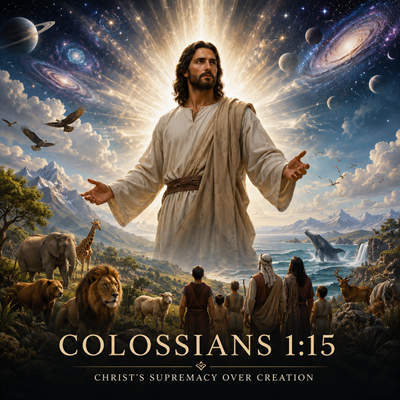
The Firstborn of Every Creature
Colossians 1:15 and the Supremacy of Christ Over Creation
Introduction
Colossians 1:15 sits at the heart of one of the richest statements about Christ in the whole New Testament.
"Who is the image of the invisible God, the firstborn of every creature:"
— Colossians 1:15
On the surface, the phrase "firstborn of every creature" has become one of the most contested phrases in the New Testament. Some groups have used it to argue that Christ is a created being — the first and greatest of God's creatures, but a creature nonetheless. If that reading were correct, it would strike at the very deity of Christ.
But a careful look at the Greek word itself, the Old Testament background behind it, and Paul's own argument in the verses that follow shows the opposite conclusion. Paul is declaring Christ's absolute supremacy over creation, not His inclusion within it.
This study walks through the passage carefully so the reasoning is clear and verifiable, not merely asserted.
The Text
The fuller context of Colossians 1:15 reads as follows:
"Who is the image of the invisible God, the firstborn of every creature: For by him were all things created, that are in heaven, and that are in earth, visible and invisible, whether they be thrones, or dominions, or principalities, or powers: all things were created by him, and for him: And he is before all things, and by him all things consist. And he is the head of the body, the church: who is the beginning, the firstborn from the dead; that in all things he might have the preeminence."
— Colossians 1:15-18
The Word "Firstborn" (Prototokos)
The word translated "firstborn" is the Greek word prototokos. It comes from two smaller words: protos, meaning "first," and tikto, meaning "to bring forth" or "to beget."
On its own, the word could be read either of two ways:
1. Temporal or ontological sense — "the first one brought forth," implying Christ came into existence at some point as the first of God's creatures.
2. Positional or rank sense — "the one holding the rank or status of firstborn," implying supremacy, preeminence, and the right of inheritance, regardless of chronological birth order.
The question this study answers is which sense Paul intended. The evidence — from the Old Testament, from Paul's own argument in this very passage, and from the grammar itself — points decisively to the second sense.
"Firstborn" in the Old Testament Is About Rank, Not Birth Order
To understand how a first-century Jewish writer like Paul would use the word "firstborn," it helps to look at how the Hebrew equivalent, bekorah ("birthright" or "firstborn status"), functioned in the Old Testament. Time and again, Scripture shows that the firstborn title was about legal status and inheritance rights — not always about who was born first.
Esau and Jacob
Esau was Isaac's literal firstborn son by birth order. Yet he sold his birthright — his firstborn status — to Jacob for a meal.
"And Jacob said, Sell me this day thy birthright. ... Then Jacob gave Esau bread and pottage of lentiles: and he did eat and drink, and rose up, and went his way: thus Esau despised his birthright."
— Genesis 25:31, 34
This alone shows that "firstborn" was a legal and social category, separable from the biological fact of being born first.
Reuben and Joseph
Reuben was Jacob's literal firstborn son. But because of his sin, the birthright — the double inheritance portion — was given instead to Joseph's sons.
"Now the sons of Reuben the firstborn of Israel, (for he was the firstborn; but, forasmuch as he defiled his father's bed, his birthright was given unto the sons of Joseph the son of Israel:)"
— 1 Chronicles 5:1
Reuben kept his birth order. He lost his firstborn status.
David — The Clearest Example
This is the most important Old Testament parallel for understanding Colossians 1:15. David was the youngest of Jesse's sons — not first in birth order at all.
"And Samuel said unto Jesse, Are here all thy children? And he said, There remaineth yet the youngest..."
— 1 Samuel 16:11
Yet God says of him:
"Also I will make him my firstborn, higher than the kings of the earth."
— Psalm 89:27
Here, "firstborn" cannot possibly mean "first one born." David was the last-born. The word means supreme, preeminent, the one given the place of highest honour and inheritance. This is the exact sense Paul draws on in Colossians 1:15. Just as God made David — the youngest son — "firstborn" in the sense of supreme king, so Christ is "firstborn" in the sense of supreme heir and ruler over all creation.
The Immediate Context Rules Out "First Created"
Even apart from the Old Testament background, Paul's own argument in the very next verse settles the matter.
Verse 16 Excludes Christ From the Category of "Created Things"
"For by him were all things created, that are in heaven, and that are in earth, visible and invisible, whether they be thrones, or dominions, or principalities, or powers: all things were created by him, and for him:"
— Colossians 1:16
Notice the structure of Paul's argument. Christ is the agent of creation — "by him were all things created." Christ is the goal of creation — "and for him." And "all things" were created by Him without exception, in heaven and earth, visible and invisible, encompassing every rank of spiritual being.
If "firstborn of every creature" meant "the first thing God created," Paul would be saying, in the very next breath, that Christ created Himself, since "all things" were made by Him. This is incoherent. Paul's argument only makes sense if Christ stands outside and over the category of created things, not as the first member within it.
The Word "For" Connects the Verses as Explanation
In the Greek text, verse 16 begins with the word hoti, meaning "because" or "for." This signals that verse 16 is the explanation of why Christ holds the title "firstborn" in verse 15. Paul is saying, in effect: "Christ is firstborn over all creation — because He created all things." The reason Christ holds supreme rank over creation is that creation owes its very existence to Him. This is a statement of sovereignty, not membership.
The Parallel Use of "Firstborn" in Verse 18
Paul uses the same word, prototokos, again just three verses later:
"And he is the head of the body, the church: who is the beginning, the firstborn from the dead; that in all things he might have the preeminence."
— Colossians 1:18
This second use of "firstborn" is extremely helpful for confirming the meaning of the first. Christ was not the first human being to ever die — death had been claiming lives since Genesis 3. Nor was He even the first person in Scripture to be raised; Lazarus, the widow's son of Nain, and others were raised before Christ's resurrection, though they died again later. What makes Christ "firstborn from the dead" is that He is supreme and preeminent in resurrection — the first to be raised to permanent, glorified, never-dying life, and the head and forerunner of all who will follow Him in resurrection.
The grammatical pattern is identical in both verses: prototokos followed by a genitive phrase describing a domain — "of every creature" and "from the dead." In both cases, the meaning is supremacy over a domain, not membership within it. Just as Christ is not one corpse among many but supreme over death, He is not one creature among many but supreme over creation.
The Purpose Clause Confirms It — Preeminence, Not Origin
Paul closes this section with the stated purpose of his whole argument:
"...that in all things he might have the preeminence."
— Colossians 1:18
This is the thesis of the entire passage. Everything Paul has said — image of God, firstborn of creation, creator of all things, sustainer of all things ("by him all things consist," v.17), head of the church, firstborn from the dead — builds toward one conclusion: Christ has supremacy and preeminence in all things. "Firstborn of every creature" is not a stray genealogical note about Christ's origin. It is the opening declaration of a sustained argument about Christ's absolute sovereignty over the entire created order.
Putting It Together — A Paraphrase
Taking all of this together, a faithful expanded paraphrase of Colossians 1:15 would read something like this:
"Christ is the visible image of the invisible God, and He holds the position of firstborn — supreme heir, sovereign ruler, and preeminent one — over all creation."
Why This Matters
This is far more than a technical point of Greek grammar. Some groups have used "firstborn of every creature" to argue that Christ is a created being — the first and greatest of God's creatures, but still a creature. If that reading were correct, it would undermine the deity of Christ and, with it, the sufficiency of His sacrifice. A created being, however exalted, cannot bear the infinite weight of sin for all mankind, nor can a created being rightly receive worship.
"And I fell at his feet to worship him. And he said unto me, See thou do it not: I am thy fellowservant... worship God."
— Revelation 19:10
Even an exalted angel refuses worship, because worship belongs to God alone. But Paul's argument — confirmed by the Old Testament background of "firstborn" as a title of rank, by the immediate context excluding Christ from the things He created, by the parallel use of the same word in verse 18, and by the stated purpose of "preeminence in all things" — shows that Colossians 1:15 is not a statement of Christ's origin. It is a statement of His supremacy.
Christ is not the first of creation. He is sovereign over creation, the eternal Son who upholds, sustains, and reigns over everything that exists — visible and invisible, in heaven and on earth.
Conclusion
Colossians 1:15 calls Christ "the firstborn of every creature." Read against its Old Testament background and its own immediate context, this title is not about when Christ began to exist. It is about the rank He holds over everything that does exist.
Esau, Reuben, and especially David show that "firstborn" in Scripture was a title that could be transferred, lost, or given to someone not literally born first — a title of inheritance and preeminence. Colossians 1:16 explicitly states that Christ created "all things," which logically excludes Him from being one of the created things Himself. The same word is used of Christ's resurrection in verse 18, where it clearly means supremacy rather than chronological priority. And the passage's stated goal — "that in all things he might have the preeminence" — confirms that the entire flow of Paul's argument is about supremacy, not sequence.
Christ is not the first of creation. He is its image-bearer, its Creator, its sustainer, and its sovereign Lord.
"Who is the image of the invisible God, the firstborn of every creature:"
— Colossians 1:15