Born in Weakness, Built to Stand
A Biblical History of the Early Christian Church: From the Incarnation to the Close of the Apostolic Age
Introduction
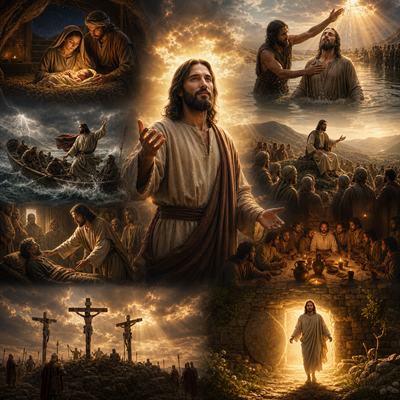
The Church of Jesus Christ did not begin with a political movement, a military victory, or the patronage of an empire. It began with a baby in a borrowed manger, a condemned man on a Roman cross, and an empty tomb on a Sunday morning. From that beginning — utterly unremarkable by worldly standards — the most transformative movement in human history was born.
This study traces the history of the early Church from the birth of Christ to the death of the last apostle, roughly AD 100. It follows the narrative of the four Gospels and the Acts of the Apostles, draws on the apostolic epistles for theological depth, and places every event within its historical context so that the beginner can understand not only what happened, but why it matters.
Four themes run through the entire story: the Church is born in weakness, not power; it expands through witness, suffering, and truth; its authority rests on Christ, Scripture, and the Holy Spirit — not geography or political favour; and the gates of hell have never prevailed against it.
...upon this rock I will build my church; and the gates of hell shall not prevail against it.
— Matthew 16:18
Part 1 — The Birth and Earthly Ministry of Jesus (c. 5 BC – AD 30)
The Birth of Jesus (c. 5–4 BC)
Jesus is born in Bethlehem of Judea during the reign of Herod the Great, while the land is under Roman occupation — fulfilling a cluster of Old Testament prophecies that converge on a single person: born of a virgin (Isaiah 7:14), in Bethlehem (Micah 5:2), of the tribe of Judah and the line of David (Genesis 49:10; 2 Samuel 7:12–16). The angels' announcement to the shepherds gives the clearest summary of His identity: Saviour, Christ, Lord.
For unto you is born this day in the city of David a Saviour, which is Christ the Lord.
— Luke 2:11
Public Ministry Begins (c. AD 26–27)
After thirty years of obscurity in Nazareth, Jesus is baptised by John in the Jordan, anointed by the Holy Spirit, and enters public ministry in Galilee. His central announcement frames everything that follows: the kingdom of God is not a future abstraction — it has arrived in Him, and those who receive it must repent and believe.
...The time is fulfilled, and the kingdom of God is at hand: repent ye, and believe the gospel.
— Mark 1:15
The Formation of the Twelve (c. AD 27)
From among His wider circle of disciples, Jesus deliberately selects twelve men — one for each tribe of Israel — to be His appointed witnesses. They are called first to be with Him, then to be sent out. This order matters: apostolic authority derives from personal knowledge of the risen Christ, not from institutional appointment. The Twelve are the living chain that will link the historical Jesus to the written New Testament and to the Church's founding proclamation.
That they should be with him, and that he might send them forth to preach.
— Mark 3:14
The Crucifixion of Jesus Christ (AD 30)
Condemned by the Jewish Sanhedrin on charges of blasphemy and handed to Pontius Pilate on charges of sedition, Jesus is crucified outside Jerusalem on the eve of Passover. What appears to be the destruction of everything His followers had hoped is, in God's sovereign design, the appointed sacrifice for sin — the Lamb of God (John 1:29) fulfilling what the Passover lamb had foreshadowed for fifteen centuries. Paul will later write that this apparent foolishness is the very power and wisdom of God ( 1 Corinthians 1:23–24).
And when they had crucified him, they parted his garments, casting lots upon them.
— Mark 15:24
The Resurrection (AD 30)
On the third day, the tomb is empty. The resurrection of Jesus Christ is the non-negotiable foundation of the Christian faith — not a spiritual metaphor but a bodily, historical event attested by multiple witnesses over forty days (Acts 1:3; 1 Corinthians 15:3–8). Without the resurrection there is no gospel, no church, and no living hope. With it, everything changes.
He is risen; he is not here: behold the place where they laid him.
— Mark 16:6
The Great Commission (AD 30)
Before His ascension, Jesus gives the mandate that will drive the Church for every century to come. All authority — in heaven and on earth — belongs to the risen Christ. On that authority, the apostles are sent to every nation to make disciples, baptise, and teach. The Commission is not merely an instruction to the original eleven; it is the Church's permanent charter, undergirded by the promise that Christ Himself accompanies His witnesses to the end of the age.
Go ye therefore, and teach all nations, baptizing them in the name of the Father, and of the Son, and of the Holy Ghost: Teaching them to observe all things whatsoever I have commanded you: and, lo, I am with you alway, even unto the end of the world.
— Matthew 28:19–20
Part 2 — The Birth of the Church (AD 30)
The Ascension (AD 30)
Forty days after the resurrection, Jesus ascends bodily into heaven from the Mount of Olives, with the promise that He will return in the same manner (Acts 1:11). The ascension is not an ending — it is an enthronement. The Son of David takes His seat at the Father's right hand (Psalm 110:1; Acts 2:33–35), from where He pours out the promised Holy Spirit and intercedes for His people. He reigns now. The Church operates under a present, active, glorified King.
...ye shall be witnesses unto me both in Jerusalem, and in all Judaea, and in Samaria, and unto the uttermost part of the earth.
— Acts 1:8
Pentecost: The Holy Spirit Descends (AD 30)
Ten days after the ascension, on the Jewish feast of Pentecost, the promised Holy Spirit falls on the gathered disciples in Jerusalem. Wind, fire, and the sudden ability to proclaim the gospel in languages they had never learned — the Spirit's arrival is unmistakable. This is the birth moment of the Church: the Spirit of Christ now indwells His people collectively, equipping them for witness, binding them together in one body, and guaranteeing the application of Christ's finished work to every believer who will ever live (John 16:7–14; Ephesians 1:13–14). The Holy Spirit is not a secondary character in this story — He is the active agent of everything that follows.
And they were all filled with the Holy Ghost, and began to speak with other tongues, as the Spirit gave them utterance.
— Acts 2:4
Peter's Sermon and the First Mass Conversion (AD 30)
Peter stands and preaches the first apostolic sermon — a public, reasoned declaration that the crucified Jesus is both Lord and Christ, proved by His resurrection. Three thousand respond and are baptised. The Church does not begin with a programme or a strategy; it begins with a proclamation. This pattern — Spirit-empowered preaching of the risen Christ producing repentance and faith — is the engine of every genuine expansion that follows throughout Acts.
Then they that gladly received his word were baptized: and the same day there were added unto them about three thousand souls.
— Acts 2:41
Part 3 — The Early Jerusalem Church (AD 30–35)
Church Life Established
Luke gives us a brief but luminous portrait of the earliest congregation. Four marks define authentic church life from the very beginning — and these marks have never been improved upon: apostolic doctrine, fellowship, the breaking of bread (the Lord's Supper), and prayer. Every generation of the Church that has flourished has returned to these four. Every generation that has declined has neglected one or more of them.
And they continued stedfastly in the apostles' doctrine and fellowship, and in breaking of bread, and in prayers.
— Acts 2:42
Persecution Begins
The Sanhedrin — the same council that condemned Jesus — arrests Peter and John and commands them to stop speaking in the name of Jesus. The apostles' response establishes the principle that will govern Christian witness under every hostile government for the next two thousand years: when human authority contradicts divine authority, there is no choice. This is not rebellion — it is a higher obedience.
We ought to obey God rather than men.
— Acts 5:29
The Writing of the New Testament Begins
It is easy to read Acts as a sequence of events and overlook what is happening simultaneously: the New Testament is being written. The Gospels and epistles are not a later reflection on the apostolic age — they are its living documents, produced within it. Paul's letters to the Galatians, Thessalonians, Corinthians, and Romans are written during his missionary journeys (roughly AD 48–58). The Gospels of Matthew and Mark likely circulate before AD 70. These texts are not biographies composed from a distance — they are the direct deposit of apostolic witness, written by men who either saw the risen Christ or worked under those who did. For the beginner: when you read your New Testament, you are reading the first-hand testimony of the apostolic church at work.
Which we have heard, which we have seen with our eyes, which we have looked upon, and our hands have handled, of the Word of life.
— 1 John 1:1
The Martyrdom of Stephen (c. AD 34–35)
Stephen, one of the seven men appointed to serve the Jerusalem congregation, is arrested, tried before the Sanhedrin, and stoned to death — the first Christian martyr. His death has two immediate consequences: it intensifies persecution and scatters the Jerusalem church, and it introduces to the story a young man named Saul of Tarsus, who approves of the stoning and will soon become the Church's most relentless persecutor — before becoming its most extraordinary missionary.
Lord, lay not this sin to their charge. And when he had said this, he fell asleep.
— Acts 7:60
Part 4 — Expansion Beyond Jerusalem (AD 35–45)
The Church Scattered by Persecution
What the Sanhedrin intended as suppression becomes, in God's sovereign design, the mechanism of expansion. The scattered believers do not go silent — they go preaching. Philip takes the gospel to Samaria; others carry it along the coast and into regions that had never heard it. Acts 1:8 is not a strategy the apostles devise — it is a prophecy the Lord fulfils, partly through the very opposition meant to silence them.
They that were scattered abroad went every where preaching the word.
— Acts 8:4
The Conversion of Saul / Paul (c. AD 34–36)
On the road to Damascus, armed with letters authorising him to arrest Christians, Saul of Tarsus encounters the risen Jesus. The encounter is sudden, blinding, and total. In an instant, the Church's most dangerous enemy becomes its most commissioned servant — appointed apostle to the Gentiles. The conversion of Paul is not incidental to the story of the Church; it is one of the most strategically significant events in the whole of Christian history. His subsequent missionary journeys, his letters to the churches, and his theology of grace would shape Christian thought for every century to come.
He is a chosen vessel unto me, to bear my name before the Gentiles, and kings, and the children of Israel.
— Acts 9:15
The Gentiles Formally Included (c. AD 40)
God directs Peter — the most prominent apostle, himself a Jew — to the house of Cornelius, a Roman centurion, a Gentile. The Holy Spirit falls on Cornelius and his household exactly as He had on the Jewish believers at Pentecost. The conclusion is unavoidable, and the Jerusalem church accepts it: salvation is not a Jewish privilege. It is for every nation, tribe, and tongue. The wall between Jew and Gentile in the purposes of God has been removed by the cross (Ephesians 2:14–16).
Then hath God also to the Gentiles granted repentance unto life.
— Acts 11:18
The Church Established in Antioch (c. AD 40–42)
Antioch in Syria becomes the first major Gentile church and the base of operations for Paul's missionary journeys. It is here — not in Jerusalem — that believers first receive the name that will identify them ever after. The name "Christian" (meaning "of Christ" or "belonging to Christ") is given to them by outsiders, but it sticks because it is accurate: these people are defined above all else by their relationship to Jesus Christ.
And the disciples were called Christians first in Antioch.
— Acts 11:26
Part 5 — Missionary Expansion and Church Planting (AD 45–62)
Paul's First Missionary Journey (c. AD 46–48)
Commissioned by the church at Antioch under the direction of the Holy Spirit, Paul and Barnabas set out on the first deliberate missionary enterprise in Church history. They travel through Cyprus and into Asia Minor (modern Turkey), planting churches in Pisidian Antioch, Iconium, Lystra, and Derbe. Paul's method is consistent throughout: begin in the Jewish synagogue, reason from Scripture that Jesus is the promised Messiah, face rejection from the majority of Jews, turn to the Gentiles, and plant a congregation of believers from both groups before moving on.
And so were the churches established in the faith, and increased in number daily.
— Acts 16:5
The Jerusalem Council (AD 49)
The rapid inclusion of Gentile believers raises a question that threatens to split the Church at its foundations: must Gentiles be circumcised and keep the Mosaic law to be saved? The apostles and elders gather in Jerusalem — the first church council — to settle the matter. The decision, reached after careful examination of Scripture and the testimony of God's work among the Gentiles, is unambiguous: salvation is by grace through faith in Christ alone. The law is not the door; Christ is. This is not a new theology — it is Abraham's own experience, as Paul will later demonstrate in Romans 4 and Galatians 3. The Jerusalem Council effectively establishes the doctrinal foundation on which all subsequent Christian theology stands.
We believe that through the grace of the Lord Jesus Christ we shall be saved, even as they.
— Acts 15:11
Paul's Second and Third Missionary Journeys (c. AD 50–57)
Paul's subsequent journeys extend the Church's reach deep into Europe. He crosses into Macedonia (northern Greece) after a vision, planting churches in Philippi, Thessalonica, and Berea. He spends eighteen months in Corinth and three years in Ephesus — two cities that will become major centres of early Christianity. It is during these years that most of Paul's letters are written: 1 and 2 Thessalonians, Galatians, 1 and 2 Corinthians, and Romans — a body of inspired theological writing that defines Christian doctrine on justification, the Holy Spirit, the resurrection, and the nature of the Church.
For I am not ashamed of the gospel of Christ: for it is the power of God unto salvation to every one that believeth; to the Jew first, and also to the Greek.
— Romans 1:16
Paul's Arrest and Imprisonment (c. AD 57–62)
Arrested in Jerusalem on a charge stirred up by opponents in the Temple, Paul appeals to Caesar as a Roman citizen and is eventually transferred to Rome — a journey marked by a dramatic shipwreck (Acts 27). His two years of house arrest in Rome are not an ending but a pulpit: he receives visitors, writes the Prison Epistles (Ephesians, Philippians, Colossians, Philemon), and continues proclaiming the kingdom of God with boldness to all who come to him. The last picture Acts gives us of Paul is a man under guard, preaching freely — a fitting image for the paradox of the Church itself.
Preaching the kingdom of God, and teaching those things which concern the Lord Jesus Christ, with all confidence, no man forbidding him.
— Acts 28:31
Part 6 — Persecution, Martyrdom, and Final Witness (AD 44–100)
Martyrdom of James the Apostle (AD 44)
James the son of Zebedee — one of the inner circle of three apostles closest to Jesus — is executed by Herod Agrippa I, becoming the first of the Twelve to be martyred. His death is recorded in a single verse in Acts, almost in passing. The brevity is not indifference; it is the tone of men who expected suffering and did not regard their own lives as the measure of success. James had been present at the Transfiguration, at Gethsemane, and at the resurrection appearances. He dies for what he personally witnessed.
And he killed James the brother of John with the sword.
— Acts 12:2
The Neronian Persecution (AD 64)
In July AD 64, a catastrophic fire destroys much of Rome. The emperor Nero, deflecting rumours that he was responsible, blames the Christians. The resulting persecution is brutal and public: Christians are thrown to animals in the arena, crucified, and burned alive as torches to light Nero's gardens. This is the first state-sponsored persecution of Christians in the Roman Empire, and it provides the immediate context for the deaths of both Peter and Paul. Far from silencing the Church, it produces a body of martyrs whose witness — the Greek word martyr simply means witness — will draw thousands more to faith in the coming generations.
Yea, and all that will live godly in Christ Jesus shall suffer persecution.
— 2 Timothy 3:12
Martyrdom of Peter (c. AD 64–67)
Peter is crucified in Rome during the Neronian persecution. Ancient and consistent testimony holds that he was crucified upside down at his own request, judging himself unworthy to die in the same manner as his Lord. Jesus had given Peter a veiled prophecy of this end decades earlier on the shore of Galilee. Peter — who had once denied knowing Jesus — dies confessing Him, and the shepherd of the early Jerusalem church lays down his life for the Shepherd who first laid down His for him.
When thou shalt be old, thou shalt stretch forth thy hands, and another shall gird thee, and carry thee whither thou wouldest not.
— John 21:18
Martyrdom of Paul (c. AD 64–67)
Paul is executed in Rome — beheaded, as a Roman citizen, rather than crucified. His own summary of his life and ministry, written from prison in the days before his death, contains no bitterness and no regret. He has run his race; he has kept the faith. The man who once held the coats of those who stoned Stephen dies with the same composure his first martyr showed — and with the same certainty of what awaits beyond death.
I have fought a good fight, I have finished my course, I have kept the faith: Henceforth there is laid up for me a crown of righteousness.
— 2 Timothy 4:7–8
The Destruction of Jerusalem (AD 70)
The Jewish revolt against Rome (AD 66–70) ends with the Roman general Titus besieging and destroying Jerusalem. The Temple is burned and razed — exactly as Jesus had prophesied forty years earlier, down to the detail that not one stone would be left on another (Matthew 24:2). For the early Church, this event carries enormous theological weight: the Temple sacrificial system — which the epistle to the Hebrews had already shown to be fulfilled and surpassed in Christ — has now ceased permanently. The Church does not need the Temple because it has the One the Temple pointed to. Jewish Christianity is forced to reconfigure entirely, and the predominantly Gentile church of the Roman world continues and grows.
There shall not be left here one stone upon another, that shall not be thrown down.
— Matthew 24:2
John Exiled to Patmos and the Book of Revelation (c. AD 90–95)
The apostle John — the last of the Twelve still living — is exiled to the island of Patmos during the persecution under the emperor Domitian. It is there that he receives the visions recorded in the book of Revelation. The final book of the New Testament is not a puzzle designed to confuse — it is a letter of encouragement to suffering churches, assuring them that Christ reigns, that their persecutors will be judged, and that the Lamb who was slain will be victorious. John writes from a prison island; the message he writes is the most triumphant in Scripture.
I John, who also am your brother, and companion in tribulation, and in the kingdom and patience of Jesus Christ, was in the isle that is called Patmos, for the word of God, and for the testimony of Jesus Christ.
— Revelation 1:9
The Death of John: The Apostolic Age Closes (c. AD 95–100)
John dies — by most accounts the only apostle not to be executed, though not for lack of attempts. With his death, the apostolic age ends. The period of direct, first-hand, authoritative eyewitness testimony is complete. The canon of Scripture is effectively closed. What the apostles deposited in the written Word is the permanent and sufficient foundation of the Church for every generation to come. No new apostles will add to it; no councils will improve on it. The Church does not move beyond the apostolic foundation — she stands on it.
Which we have heard, which we have seen with our eyes, which we have looked upon, and our hands have handled, of the Word of life.
— 1 John 1:1
Summary: The Early Church at a Glance
| Period | Approximate Date | Key Development | Key Text |
|---|---|---|---|
| Birth and Ministry of Christ | c. 5 BC – AD 30 | Incarnation, Commission, Cross, Resurrection | Matthew 28:19–20 |
| Birth of the Church | AD 30 | Ascension, Pentecost, first conversions | Acts 2:4, 41 |
| Jerusalem Church | AD 30–35 | Doctrine, fellowship, persecution, Stephen | Acts 2:42 |
| Expansion Beyond Jerusalem | AD 35–45 | Scattering, Paul's conversion, Gentiles included | Acts 9:15; 11:18 |
| Missionary Journeys | AD 46–57 | Churches planted across Asia Minor and Europe | Romans 1:16 |
| Jerusalem Council | AD 49 | Grace alone confirmed; law not the door | Acts 15:11 |
| NT Epistles Written | AD 48–95 | Paul, Peter, John, James deposit apostolic doctrine | 1 John 1:1 |
| Neronian Persecution | AD 64 | First state persecution; Peter and Paul martyred | 2 Timothy 3:12 |
| Destruction of Jerusalem | AD 70 | Temple destroyed; prophecy fulfilled | Matthew 24:2 |
| John at Patmos / Revelation | c. AD 90–95 | Final apostolic witness; canon effectively closed | Revelation 1:9 |
| Death of John | c. AD 95–100 | Apostolic age ends; written Word is the foundation | 2 Timothy 3:16–17 |
The Church at the Close of the Apostolic Age
By AD 100, something remarkable has happened. A movement that began with eleven frightened men in an upper room in Jerusalem has spread to virtually every major city in the Roman Empire and beyond — to Syria, Egypt, Persia, Ethiopia, India, and the British Isles. It has no army, no land, no treasury, and no political patron. Its founder was executed as a criminal. Its leaders have been beaten, imprisoned, and killed. And yet:
- Churches exist throughout the Roman world — in Rome itself, in Greece, Asia Minor, North Africa, and the eastern provinces.
- The New Testament is complete — twenty-seven books of apostolic testimony, doctrine, and prophecy, sufficient for every need of every generation.
- The gospel is defined and defended — grace alone, faith alone, Christ alone. The Jerusalem Council has settled the foundational question.
- Leadership has been established — the apostolic office is unique and unrepeatable; local churches are led by elders and deacons, the pattern Paul established in every city he planted.
- The precedent of suffering is set — the Church does not expect the world's approval. She has been told to expect its hostility, and she has learned to flourish under it.
The story of the early Church is not a golden age to be mourned or romanticised. It is a pattern to be understood: the Church advances not through political power or cultural prestige, but through Spirit-empowered proclamation of the crucified and risen Christ. Every generation that has returned to that pattern has found the same promise holds.
...upon this rock I will build my church; and the gates of hell shall not prevail against it.
— Matthew 16:18
Four Theological Threads
The Church Is Born in Weakness, Not Power
A crucified founder. Fishermen for leaders. Slaves and women among the first converts. No building, no army, no budget. The Church's origin is a rebuke to every generation that has tried to advance the gospel through worldly prestige. God's pattern is consistent: God hath chosen the weak things of the world to confound the things which are mighty. ( 1 Corinthians 1:27)
The Church Expands Through Witness, Suffering, and Truth
The Greek word for witness is martys — from which we get "martyr." In the early Church, witness and suffering were so often joined that the words became synonymous. The blood of the martyrs has never silenced the gospel; it has always amplified it. Tertullian, writing just a century after the apostolic age, observed that the blood of Christians is seed.
Leadership Transitions from Apostles to Elders
The apostolic office is unique: it required direct commission by the risen Christ and direct eyewitness testimony of His resurrection (Acts 1:21–22; 1 Corinthians 9:1). That office closes with the death of John. Authority in the ongoing Church rests not on apostolic succession of persons but on apostolic succession of doctrine — the faithful handing on of the gospel entrusted to the saints ( Jude 3).
Authority Rests on Christ, Scripture, and the Holy Spirit
The early Church had no cathedrals, no printing presses, no political establishment. Its authority derived entirely from the risen Christ, the written Word He inspired, and the Holy Spirit He poured out. These three have never been insufficient. They remain so today.
All scripture is given by inspiration of God, and is profitable for doctrine, for reproof, for correction, for instruction in righteousness: That the man of God may be perfect, throughly furnished unto all good works.
— 2 Timothy 3:16–17
Reflection and Discussion
- The four marks of the Jerusalem church are doctrine, fellowship, breaking of bread, and prayer (Acts 2:42). How does your own church or small group measure up to these four? Which is strongest? Which needs attention?
- The gospel spread most rapidly under persecution. What does this suggest about the relationship between comfort and spiritual complacency? Between suffering and dependence on God?
- Paul's letters were written to real congregations facing real problems — division, immorality, false teaching, grief. As you read the epistles, which letter feels most addressed to the challenges of your own life or church today?
- The apostolic age ended with the death of John. How does understanding the uniqueness and completeness of the apostolic witness shape your confidence in — and reliance on — the Scriptures you hold?
- The Great Commission was not given only to the first disciples. How are you personally participating in the task Jesus entrusted to His Church?
Key Scriptures for Meditation
- Matthew 28:18–20 — The Great Commission: authority, mandate, and promise.
- Acts 1:8 — The pattern of expansion: Jerusalem → Judea → Samaria → the uttermost parts.
- Acts 2:42 — The four marks of the healthy church.
- Acts 15:11 — Grace alone: the settled verdict of the Jerusalem Council.
- Romans 1:16 — I am not ashamed of the gospel of Christ: for it is the power of God unto salvation.
- 2 Timothy 3:16–17 — The sufficiency of inspired Scripture for every need.
- 2 Timothy 4:7–8 — Paul's farewell: the race run, the faith kept, the crown awaiting.
- Matthew 16:18 — The promise that binds the whole story together: the gates of hell shall not prevail.
Conclusion
The early Church is not a legend. It is not a myth embellished by time. It is a historical reality attested by friends and enemies alike — by the New Testament's eyewitnesses, by Roman historians who found the Christians bewildering and stubborn, by the graves of martyrs, and by the churches that exist in every nation on earth today as its direct descendants.
It began with a command to go, a promise to accompany, and a Spirit poured out to equip. It expanded not because the world welcomed it but because the message it carried was true — and truth, ultimately, cannot be permanently silenced. Not by Nero's torches. Not by Domitian's exile orders. Not by the destruction of Jerusalem. Not by two thousand years of opposition from every quarter.
The same Jesus who commissioned eleven men on a hillside in Galilee commissions His Church today. The same Spirit who fell at Pentecost indwells every believer. The same Scripture that sustained Peter in prison, Paul in chains, and John on Patmos is open in your hands. The gates of hell have had two thousand years to prevail. They have not managed it yet.
The LORD hath done great things for us; whereof we are glad.
— Psalm 126:3