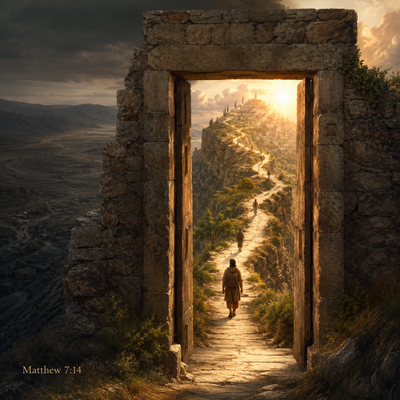
The Few
Why God Alone Saves, and Why Most Will Not Accept It
Introduction: An Uncomfortable Question
There is a question that most Christians quietly carry but rarely voice aloud, because the honest answer is deeply unsettling. The question is this: if the gospel of Jesus Christ has been preached across two thousand years of human history, across every continent, in thousands of languages, to billions of people — why does Christ Himself describe the saved as few?
This is not a question invented by skeptics. It is not a theological edge case or a matter of denominational dispute. It is a direct statement from the lips of Jesus Christ, repeated across multiple contexts, confirmed by Old Testament type, and sobering in its consistency. Few. Not a slim majority. Not roughly half. Few.
The temptation is to soften this. To assume Christ was speaking relatively, or hyperbolically, or of a particular historical moment that no longer applies. But when the same reality — few saved, many lost — appears across Noah's generation, across the parable of the wedding feast, across the Sermon on the Mount, and across Christ's direct warning in Matthew 7, the honest reader must stop and ask why. Not to despair, but to understand.
This study proposes a specific answer to that question. The reason the saved are consistently few is not primarily that the gospel is insufficiently preached, or that people lack access to Scripture, or that the church has failed in its mission — though all of those may be contributing factors in particular times and places. The deeper reason is this: fallen human nature has a powerful, consistent, and nearly universal tendency to approach God on its own terms rather than God's. Man instinctively reaches for something he can contribute, something he can point to, something that makes salvation at least partially his own achievement. And the gospel of grace — pure, unearned, entirely God's work — is deeply and instinctively resisted by a nature that wants to deserve what it receives.
This is not ultimately a study about Protestant theology or Reformation history. What this study is about is something both simpler and more profound: that God is solely responsible for saving, that man contributes nothing to it, that this truth is clearly and repeatedly taught by Christ Himself, and that the reason so few find the narrow way is precisely that so few are willing to come to God entirely on His terms, with nothing in their hands.
Section 1: The Pattern Across History — Noah and the Few
Before we examine any doctrine, we need to sit with a historical fact. It is easy to read biblical narrative and unconsciously domesticate it — to treat Noah's ark as a children's story with animals and a rainbow, losing entirely the magnitude of what it represents. Christ will not let us do that.
In Matthew 24:37-39, Jesus says:
"But as the days of Noe were, so shall also the coming of the Son of man be. For as in the days that were before the flood they were eating and drinking, marrying and giving in marriage, until the day that Noe entered into the ark, And knew not until the flood came, and took them all away; so shall also the coming of the Son of man be."
— Matthew 24:37-39
Christ is not using Noah as a vague cultural reference. He is establishing a type — a deliberate historical parallel between the world before the flood and the world at His return. And the parallel He emphasizes is not wickedness, or violence, or moral collapse, though all of those were present. The parallel He emphasizes is normalcy. They were eating, drinking, marrying. Life was proceeding as usual. The overwhelming majority of humanity saw no particular reason to change course, no compelling reason to enter the ark, no urgent awareness that judgment was imminent. And then it was too late.
Now consider the number. 1 Peter 3:20 tells us plainly:
"Which sometime were disobedient, when once the longsuffering of God waited in the days of Noah, while the ark was a preparing, wherein few, that is, eight souls were saved by water."
— 1 Peter 3:20
Eight souls. Peter doesn't leave the number vague — he specifies it. Eight. Noah, his wife, his three sons, their wives. Against the entire population of the known world. And Peter's purpose in citing this number is not to give us demographic information. He is making a theological point: that God's longsuffering is real — the ark took time to build, during which the gospel of coming judgment was available — and yet the saved were eight.
This should arrest us. This was not a world without warning. Genesis 6 makes clear that God did not act in secret. Noah is described in 2 Peter 2:5 as "a preacher of righteousness" — meaning the message was going out. The ark itself, being built over decades in plain sight, was a visible, unavoidable testimony to coming judgment. And still — eight souls.
Christ's point in Matthew 24 is that this is not an anomaly. The days of Noah are the template, not the exception. When the Son of Man returns, the world will again be largely indifferent, absorbed in the ordinary flow of life, unprepared and unresponsive. The few will be few again.
This is the first and most important thing to establish: the smallness of the saved is not a contemporary problem, not a failure of modern Christianity, not something that better evangelism or better programs would resolve. It is a pattern embedded in human nature and confirmed across the full sweep of human history, from the antediluvian world to the present.
The question is why. And Christ gives us several converging answers.
Section 2: The Narrow Gate — God's Terms, Not Man's
With the historical pattern established, we turn to Christ's direct teaching in Matthew 7:13-14:
"Enter ye in at the strait gate: for wide is the gate, and broad is the way, that leadeth to destruction, and many there be which go in thereat: Because strait is the gate, and narrow is the way, which leadeth unto life, and few there be that find it."
— Matthew 7:13-14
The language here is precise and intentional. Two gates. Two ways. Two destinations. And a stark asymmetry: many on the broad way, few on the narrow. This sits near the close of the Sermon on the Mount, and it is not an invitation — it is a warning. Christ is not saying the narrow way is difficult to walk. He is saying it is difficult to find, and that the majority will not find it.
The word translated "strait" means narrow, constricted, tight. The gate does not accommodate extra luggage. It does not permit the traveller to bring along his own credentials, his moral résumé, his religious accomplishments, his sacramental record, or his sincere good intentions. The imagery is of a passage so narrow that a person must enter it as they are, stripped of additions, or not at all.
This is the first hint at the answer to our central question. The gate is narrow not because God is reluctant to save, but because God has defined the terms of entry. And those terms exclude everything that originates with man. The traveller contributes the walking, not the road.
Now consider what makes the broad way broad. It is broad precisely because it accommodates. It accommodates moral effort. It accommodates religious sincerity. It accommodates good works, charitable living, faithful church attendance, sacramental participation, and every other form of human contribution to one's standing before God. The broad way is wide enough for man to walk through it feeling like he belongs there because of something he has done or is doing. It is comfortable, well-populated, and socially validated. And Christ says it leads to destruction.
The narrow way is narrow because it admits only one basis for entry: what God has done, received by faith. There is no room for human addition. This is not arbitrary restrictiveness on God's part. It is the logical consequence of the gospel: if salvation is by grace, it cannot simultaneously be by human merit, even partially. Romans 11:6 states this with precision:
"And if by grace, then is it no more of works: otherwise grace is no more grace. But if it be of works, then is it no more grace: otherwise work is no more work."
— Romans 11:6
Grace and merit are mutually exclusive categories. Adding any human contribution to grace does not supplement it — it nullifies it.
This is why the way is narrow, and this is why few find it. Not because God hides it, but because the natural human response to it is resistance. A gate that accepts you exactly as you are, on the basis of what Another has done entirely on your behalf, with nothing required from you but to receive it in faith — that gate is deeply counterintuitive to a nature that wants to earn, to deserve, to achieve. Man will almost always prefer the broad way, not because it is obviously wrong, but because it feels right. It feels like what a fair transaction with God should look like.
Section 3: Called But Not Chosen — The Parable of the Wedding Feast
Matthew 22 contains one of Christ's most pointed parables, and its conclusion is one of the most sobering statements in the New Testament. The parable of the wedding feast describes a king who prepares a great marriage supper for his son and sends servants to call those who were bidden. They refuse to come. He sends again — they make light of it and go their ways. He opens the invitation to everyone the servants can find in the highways, both bad and good, and the wedding is furnished with guests. But then the king enters and finds a man without a wedding garment, and has him bound and cast into outer darkness.
The parable closes with this:
"For many are called, but few are chosen."
— Matthew 22:14
This statement has generated enormous theological debate, much of it focused on questions of divine election and predestination. We will not make that the focus here, because doing so risks missing what the parable is actually demonstrating. Look at what just happened in the narrative: a man was present at the feast. He had responded to the invitation. He was physically inside the wedding hall. And yet he was without the wedding garment — and that absence was fatal.
The wedding garment in this context is not difficult to interpret. In the ancient world, royal wedding garments were provided by the host. A guest did not bring his own. To arrive at a royal feast without the king's garment was not merely a fashion violation — it was a statement. It meant the guest had refused or disregarded the provision of the king, choosing to come on his own terms rather than the king's. It was an act of presumption.
The theological parallel is direct. The righteousness required to stand before God is not something man brings. It is provided by God — the righteousness of Christ, imputed to the believer by faith. To come before God in one's own righteousness, one's own moral effort, one's own religious record, is precisely what this man did. He came on his own terms. And the king's response is not puzzlement — it is judgment.
"Many are called" — the gospel goes out broadly. The invitation is genuine. God is not playing a deceptive game in which the call is extended but never meant. The call is real. But "few are chosen" — the number who respond on God's terms, receiving His provision rather than substituting their own, is small. The choosing is the outcome of a genuine call meeting a genuine response — specifically, a response that comes on the king's terms rather than the guest's own.
This is the mechanism behind Matthew 7:14's "few." Many hear the gospel. Many respond in some form. But few respond in the specific way that the narrow gate requires — empty-handed, trusting entirely in God's provision, wearing the garment the King supplies rather than the one they have sewn themselves.
Section 4: The Most Dangerous Deception — Religious Confidence Without Christ
We come now to what may be the most disturbing passage in the entire Sermon on the Mount, and possibly in all of Christ's teaching:
"Not every one that saith unto me, Lord, Lord, shall enter into the kingdom of heaven; but he that doeth the will of my Father which is in heaven. Many will say to me in that day, Lord, Lord, have we not prophesied in thy name? and in thy name have cast out devils? and in thy name done many wonderful works? And then will I profess unto them, I never knew you: depart from me, ye that work iniquity."
— Matthew 7:21-23
Let us be careful to observe who these people are, because it is easy to read this passage in a way that domesticates it. These are not obvious unbelievers. They are not atheists, pagans, or open mockers of Christ. They address Him as Lord. They have prophesied in His name. They have cast out devils in His name. They have done many wonderful works in His name. By every external, visible, social, and religious measure, these are people who appear to be solidly within the household of faith.
And Christ says He never knew them.
The Greek word translated "knew" here is ginosko — experiential, relational knowing. Christ is not saying He was unaware of them. He is saying there was never a genuine saving relationship. They called Him Lord. They performed religious activity in His name. But the relationship was never real, because underneath the religious activity, something was deeply wrong.
What was wrong? Look carefully at what they appeal to. They appeal entirely to what they have done. "Have we not prophesied? Have we not cast out devils? Have we not done many wonderful works?" Every verb is first person plural. Everything they bring before Christ is their own activity. They have confused religious performance for saving relationship. They have come to the gate carrying everything they have done for God, and Christ sends them away.
This is the works-based impulse taken to its most dangerous expression. Not crude irreligion, but sophisticated, active, apparently Christ-centered religion, which is nonetheless fundamentally about human achievement rather than divine grace. These people genuinely believed their works were sufficient evidence of their standing. They were wrong, catastrophically and eternally wrong, and they did not discover it until it was too late.
It is worth pausing on Christ's phrase "ye that work iniquity." This seems paradoxical — these are people who have been doing religious works, not obvious wickedness. But the iniquity, understood in context, is the very thing of substituting human religious effort for genuine saving faith. To approach God on the basis of one's own works, even religious works done in Christ's name, is ultimately an act of self-exaltation — placing one's own merit at the centre of salvation rather than Christ's finished work. In that sense, the works themselves become the iniquity.
This passage should function as a serious diagnostic for every reader. The question it forces is not "am I religious enough?" but "is my confidence resting on what I have done, or on what Christ has done?" Those two foundations may look similar from the outside. From the inside, and before the throne, they are infinitely different.
Section 5: The Law Taken Seriously — Why Human Effort Cannot Save
We need to understand why human effort is insufficient, not merely assert it. And for this, Christ gives us a remarkable demonstration within the same Sermon on the Mount that contains Matthew 7:13-14.
In Matthew 5:20, Christ says:
"For I say unto you, That except your righteousness shall exceed the righteousness of the scribes and Pharisees, ye shall in no case enter into the kingdom of heaven."
— Matthew 5:20
This statement would have landed like a thunderclap on His Jewish audience. The Pharisees were not regarded as casual believers. They were the recognized experts in the Law, the most rigorous religious practitioners in Israel, men who structured every hour of every day around meticulous legal observance. To exceed their righteousness — by any human standard — was virtually unthinkable.
And then Christ proceeds to show exactly what that would require. In Matthew 5:29-30 He says:
"And if thy right eye offend thee, pluck it out, and cast it from thee: for it is profitable for thee that one of thy members should perish, and not that thy whole body should be cast into hell. And if thy right hand offend thee, cut it off, and cast it from thee: for it is profitable for thee that one of thy members should perish, and not that thy whole body should be cast into hell."
— Matthew 5:29-30
Now, a surface reading might suggest Christ is commanding literal self-mutilation as a means of avoiding sin. But understood in its proper context, this is deliberate hyperbole serving a precise theological purpose. Christ has just finished explaining that the Law's prohibition on adultery extends beyond the physical act to the thought life — looking upon a woman with lust is adultery of the heart (Matthew 5:28). He is demonstrating that the Law, taken with full seriousness, reaches not merely behavior but motive, thought, and desire — the inner life that no external religious observance can fully police.
And then He pushes to the logical extreme: if your eye causes you to sin, take it out. If your hand causes you to sin, cut it off. The point is not that you should actually do this. The point is that even if you did — even if you took the most drastic, most costly, most extreme physical measures to comply with the Law — you still would not have solved the problem. Because the problem is not the eye. The problem is not the hand. The problem is the heart, and you cannot excise your heart and survive.
This is the diagnostic genius of the Sermon on the Mount taken as a whole. Christ is not raising the bar on works-righteousness and challenging His listeners to try harder. He is systematically demonstrating that the bar, properly understood, is unreachable by human effort. The Law does not merely regulate conduct — it demands a purity of heart, motive, and thought that fallen humanity cannot produce by self-improvement. The standard is confirmed by Matthew 5:48:
"Be ye therefore perfect, even as your Father which is in heaven is perfect."
— Matthew 5:48
Read in sequence, Matthew 5:20 through 5:48 is not a call to religious intensification. It is a systematic demolition of the idea that human effort, however sincere, however extreme, can produce the righteousness God requires. The Pharisees, for all their meticulous observance, had not even gotten close. Exceeding them — without the gift of God's righteousness — is not a higher achievement. It is an impossibility.
This is the essential bridge. If the most drastic human religious effort still falls infinitely short, then the only alternative is a righteousness that does not originate with man at all. And that is precisely what the gospel offers.
Section 6: What God Alone Has Done — The Gift That Cannot Be Earned
Having established the problem from multiple angles — the historical pattern, the narrowness of the gate, the mechanism of the call, the danger of religious self-deception, and the impossibility of law-keeping — we arrive at the answer. And the answer is not a program, a practice, or a higher level of religious commitment. The answer is a gift.
"For by grace are ye saved through faith; and that not of yourselves: it is the gift of God: Not of works, lest any man should boast."
— Ephesians 2:8-9
These two verses are among the most precisely constructed theological statements in all of Scripture. Break them down carefully. Saved by grace — the source is God's unmerited favour, not human deserving. Through faith — the instrument is trust, not achievement. "And that not of yourselves" — the entire package, grace and faith together, does not originate with man. It is the gift of God. Not of works — the exclusion of human contribution is explicit. Lest any man should boast — Paul identifies the very instinct we have been tracing throughout this study. If salvation included any human element, man would boast of it. The design of grace eliminates that possibility entirely.
Note carefully what Paul is saying about faith itself. "That not of yourselves: it is the gift of God" — the antecedent refers to the entire preceding clause, salvation by grace through faith. Faith is not the human contribution to an otherwise divine transaction. Faith is itself part of the gift. Man does not supply the faith that lays hold of grace. God grants the faith by which grace is received. This is a crucial distinction, because it closes the last potential door through which human merit might enter. Even the believing is God's work in the believer.
Romans 3:24-28 makes the same case from a different angle:
"Being justified freely by his grace through the redemption that is in Christ Jesus: Whom God hath set forth to be a propitiation through faith in his blood, to declare his righteousness for the remission of sins that are past, through the forbearance of God; To declare, I say, at this time his righteousness: that he might be just, and the justifier of him which believeth in Jesus. Where is boasting then? It is excluded. By what law? of works? Nay: but by the law of faith. Therefore we conclude that a man is justified by faith without the deeds of the law."
— Romans 3:24-28
Justified freely — the word "freely" is the same used in John 15:25 where Christ says they hated Him without a cause. Freely means without prior cause, without prior merit, without any contributing factor on the recipient's part. The justification is free because there is nothing in man that prompted it or contributed to it. It is purely the work of God in Christ.
And Paul asks the rhetorical question: where is boasting? It is excluded. Not diminished, not discouraged, not made inappropriate — excluded. Because if there is nothing human in the transaction, there is nothing human to boast of.
Titus 3:5 adds this:
"Not by works of righteousness which we have done, but according to his mercy he saved us, by the washing of regeneration, and renewing of the Holy Ghost;"
— Titus 3:5
The negative is stated plainly: not by works of righteousness which we have done. The positive is equally plain: according to His mercy. Regeneration — the new birth — is the work of the Holy Ghost, not the product of human decision-making or religious effort. Man does not regenerate himself and then invite God in. God regenerates, and the result is saving faith.
Now the question of James 2:24 must be addressed, because it is the passage every reader will bring to this discussion:
"Ye see then how that by works a man is justified, and not by faith only."
— James 2:24
Does this contradict everything we have just established? It does not, and understanding why is important. James is not describing the basis of justification before God — he is describing the evidence of genuine faith before men. The entire context of James 2 is that a faith which produces no visible transformation, no practical love, no outward fruit, is not genuine saving faith — it is dead faith (James 2:17). James is not adding works to the instrument of salvation. He is insisting that real salvation, real faith, real regeneration, will be evidenced in a changed life.
Paul and James are not contradicting each other. Paul is answering the question: how is a sinner justified before God? Answer: by faith, not works. James is answering the question: how do we recognize genuine faith? Answer: by its fruit. Both are necessary and both are true. The works James describes are the fruit of salvation, not its root.
This also answers the concern that salvation by faith alone produces moral passivity. It does not, for two reasons. First, the regenerated believer has a new nature (2 Corinthians 5:17) that genuinely desires to please God — not to earn salvation, but because salvation has already been received and gratitude is the natural response. Second, as James makes clear, a faith that produces no fruit at all is not saving faith. The absence of any transformation is evidence that the transaction never occurred.
Section 7: Assurance for the Genuine Believer
Having spent most of this study dwelling in warning passages, we need to be equally clear about what those passages do not mean for the genuine believer. Matthew 7:21-23 is a sobering warning, but it is not a basis for perpetual anxiety in the one who has come to Christ in genuine faith, resting entirely on His finished work.
"And I give unto them eternal life; and they shall never perish, neither shall any man pluck them out of my hand. My Father, which gave them me, is greater than all; and no man is able to pluck them out of my Father's hand."
— John 10:28-29
The language here is absolute. Eternal life — not provisional life, not life contingent on continued performance. They shall never perish — the negative in the Greek is emphatic, doubled, the strongest possible negation. Neither shall any man pluck them out of my hand. And then, as if to seal it completely, the Father's hand is added — the believer is held in both simultaneously, and the Father is greater than all.
The people Christ turns away in Matthew 7:23 are not people who came to Him in genuine faith and then lost their salvation through insufficient works. They are people who never had a genuine relationship with Him at all — whose entire framework was religious performance rather than saving trust. The diagnostic question remains: is your confidence in what you have done, or in what He has done? If the honest answer is the latter — if you have come to Him empty-handed, trusting His finished work, receiving His righteousness because you know you have none of your own — then Matthew 7:23 is a warning that does not apply to you.
Romans 8:38-39 makes the scope of that security explicit:
"For I am persuaded, that neither death, nor life, nor angels, nor principalities, nor powers, nor things present, nor things to come, Nor height, nor depth, nor any other creature, shall be able to separate us from the love of God, which is in Christ Jesus our Lord."
— Romans 8:38-39
Paul's list is exhaustive by design. He is not leaving a gap through which separation might slip. Every possible category of threat — cosmic, temporal, present, future — is named and excluded. The love of God in Christ Jesus is the permanent home of the one who is genuinely in Him.
The assurance the believer has is not based on his own consistency or his own achievement — which would be a shaky foundation indeed. It is based on the character and power of God, who does not begin a saving work and leave it unfinished:
"Being confident of this very thing, that he which hath begun a good work in you will perform it until the day of Jesus Christ:"
— Philippians 1:6
God completes what He starts. The believer's security is as firm as God's faithfulness, which is to say, absolute.
Conclusion: The Gate Is Narrow, But It Is Open
We return to where we began. Few find the narrow way. Eight souls in Noah's generation. Few chosen from the many called. Many who cry "Lord, Lord" turned away. This is not comfortable reading, and we should not try to make it so. Christ did not speak these things to comfort us into complacency. He spoke them to wake us up, to force an honest examination of where our confidence actually rests.
The gate is narrow because God has defined its terms, and His terms exclude everything that originates with man. Not because God is reluctant, not because He takes pleasure in the smallness of the saved, not because He has hidden the entrance from those who might genuinely seek it. He is not willing that any should perish:
"The Lord is not slack concerning his promise, as some men count slackness; but is longsuffering to us-ward, not willing that any should perish, but that all should come to repentance."
— 2 Peter 3:9
The invitation is real, the call goes out broadly, and the gate — though narrow — is open.
The reason the way is narrow and the found are few is that fallen human nature consistently, persistently, almost universally refuses to come on God's terms. Man wants to bring something. He wants the transaction to involve his effort, his sincerity, his religious record, his moral improvement, his sacramental faithfulness, his wonderful works done in Christ's name. The broad way is crowded because it accommodates all of these. It is the way that makes intuitive sense to a nature that wants to deserve what it receives.
But the narrow gate admits only one thing: a sinner, empty-handed, trusting entirely in what God has done in Jesus Christ. The righteousness required is not yours — it was never going to be yours, as the Sermon on the Mount makes devastatingly clear. The faith by which you receive it is itself God's gift. The regeneration that makes you a new creation is the work of the Holy Spirit. There is nothing in the transaction that originates with you, and therefore nothing in it that can be undone by you.
This is the gospel in its fullest and most honest form. It is offensive to human pride. It is counterintuitive to human nature. It strips away every basis for self-congratulation before God. And it is the most liberating truth in all of human existence: that the weight of your eternal standing does not rest on your shoulders, your performance, your consistency, or your religious achievement. It rests entirely on the finished work of Jesus Christ, received by a faith that He Himself supplies.
The gate is narrow. But it is open. And for the one who enters it — empty-handed, trusting wholly in Him — it leads to life.
"Enter ye in at the strait gate."
— Matthew 7:13