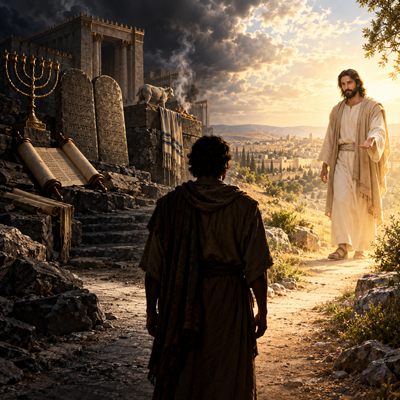
The End of the Law
A Study of Romans 10:4
"For Christ is the end of the law for righteousness to every one that believeth."
— Romans 10:4
Introduction — One Verse, a Whole Gospel
Few verses in the Bible pack so much into so few words. In one sentence, Paul tells us what changed when Christ came, and just as importantly, what did not.
When we first read this verse, some questions come up naturally. What does Paul mean by "the end of the law"? Did God's law simply stop mattering? And why does Paul add the words "for righteousness"?
Let's work through it together.
Part 1 — Start With the Context
Romans 10:4 does not stand alone. It is part of a larger section, Romans chapters 9 through 11, where Paul explains where Israel stands before God. The verses just before it set the stage:
"Brethren, my heart's desire and prayer to God for Israel is, that they might be saved. For I bear them record that they have a zeal of God, but not according to knowledge. For they being ignorant of God's righteousness, and going about to establish their own righteousness, have not submitted themselves unto the righteousness of God."
— Romans 10:1-3
Notice what Paul is talking about: righteousness before God.
Israel's problem was not a lack of religious devotion. Paul says plainly that they had "a zeal of God." Their problem was the direction of that zeal. They were "going about to establish their own righteousness" instead of submitting "unto the righteousness of God."
Then comes our verse:
"For Christ is the end of the law for righteousness to every one that believeth."
— Romans 10:4
Those two words, "for righteousness," are the key that unlocks the whole verse. Paul is not simply saying, "Christ ended God's law." He is saying that Christ is the end of the law as a way of becoming righteous before God.
Part 2 — What Does "End" Mean?
The Greek word translated "end" is telos (τέλος).
Telos can mean an ending or termination. It can also mean a completion, an outcome, or a goal: the point something was heading toward all along. No single English word captures both ideas at once, and Paul means both.
| Sense of Telos | What It Means for Romans 10:4 |
|---|---|
| Goal | Christ is the destination the law was pointing toward |
| End | Christ ends the law as a road to righteousness |
The Lord Jesus said this Himself:
"Think not that I am come to destroy the law, or the prophets: I am not come to destroy, but to fulfil."
— Matthew 5:17
The Lord did not come to tear the law down. He came to fulfil it. The law was always pointing forward to Him.
Part 3 — The Law Could Show Righteousness, But Not Give It
Paul makes one thing very clear throughout Romans: the law itself was never the problem.
"Wherefore the law is holy, and the commandment holy, and just, and good."
— Romans 7:12
The problem is us.
The law sets out God's perfect standard, but fallen human beings cannot meet it. So the law cannot serve as a ladder for sinners to climb up to God. Instead, it shows us how far short we fall. Paul said this earlier in the letter:
"Therefore by the deeds of the law there shall no flesh be justified in his sight: for by the law is the knowledge of sin."
— Romans 3:20
Notice that last phrase: "by the law is the knowledge of sin."
The Straight Ruler
Picture a perfectly straight ruler laid beside a crooked line. The ruler shows you exactly how crooked the line is, but it cannot straighten it. God's law works the same way. It reveals His righteous standard and exposes our failure to meet it, but it has no power to fix us.
Israel's mistake, and the mistake of many religious people today, is trying to turn the ruler into a means of salvation.
Part 4 — Christ Did What We Could Not
Paul explains how God solved this problem:
"For what the law could not do, in that it was weak through the flesh, God sending his own Son in the likeness of sinful flesh, and for sin, condemned sin in the flesh: That the righteousness of the law might be fulfilled in us, who walk not after the flesh, but after the Spirit."
— Romans 8:3-4
Again, Paul does not blame the law. He says it was "weak through the flesh." Our sinful nature was the weak link.
Christ perfectly fulfilled every righteous requirement God's law demanded. So instead of trying to build our own righteousness through obedience, we receive righteousness through Him:
"Even the righteousness of God which is by faith of Jesus Christ unto all and upon all them that believe: for there is no difference:"
— Romans 3:22
Part 5 — "To Every One That Believeth"
This may be the most important phrase in the whole verse.
Paul does not say "to every one that successfully keeps the commandments." He does not say "to every one that combines faith with enough good works." He says "to every one that believeth."
A few verses later he spells out what that belief looks like:
"That if thou shalt confess with thy mouth the Lord Jesus, and shalt believe in thine heart that God hath raised him from the dead, thou shalt be saved. For with the heart man believeth unto righteousness; and with the mouth confession is made unto salvation."
— Romans 10:9-10
Look at the connection: believeth → righteousness.
That is the contrast Paul has been building:
• Romans 10:3: Israel going about to establish their own righteousness
• Romans 10:4: Christ, the end of the law for righteousness, to every one that believeth
That is the Gospel in miniature.
Part 6 — Two Kinds of Righteousness
Paul makes the contrast even sharper in the next verse:
"For Moses describeth the righteousness which is of the law, That the man which doeth those things shall live by them."
— Romans 10:5
Then in verse 6 he turns to "the righteousness which is of faith." So there are two principles:
| Righteousness | Its Principle | Verse |
|---|---|---|
| Which is of the law | Do | Romans 10:5 |
| Which is of faith | Believe | Romans 10:6, 9-10 |
Here is the difficulty with the first. If righteousness depends on keeping the law, the standard is not "try your best" or "do reasonably well." The standard is perfect obedience, all of it, all the time. Paul puts it bluntly:
"For as many as are of the works of the law are under the curse: for it is written, Cursed is every one that continueth not in all things which are written in the book of the law to do them."
— Galatians 3:10
James agrees:
"For whosoever shall keep the whole law, and yet offend in one point, he is guilty of all."
— James 2:10
If the law is the basis for being made right with God, then partial obedience counts for nothing. No one passes that test, which is why Christ is our only hope.
Part 7 — Does This Mean Christians Can Live However They Want?
No. This point matters a great deal.
Scripture is clear that believers today are not under the law of Moses:
"For sin shall not have dominion over you: for ye are not under the law, but under grace."
— Romans 6:14
The law had a job to do, and it did it:
"Wherefore the law was our schoolmaster to bring us unto Christ, that we might be justified by faith. But after that faith is come, we are no longer under a schoolmaster."
— Galatians 3:24-25
But being free from the law is not the same as being free to sin. Paul answers that idea immediately:
"What shall we say then? Shall we continue in sin, that grace may abound? God forbid. How shall we, that are dead to sin, live any longer therein?"
— Romans 6:1-2
He also makes clear that faith does not throw out God's law. It puts it in its proper place:
"Do we then make void the law through faith? God forbid: yea, we establish the law."
— Romans 3:31
The believer is not lawless. Paul describes himself as "not without law to God, but under the law to Christ" (1 Corinthians 9:21).
Cause or Fruit?
There is an enormous difference between these two statements:
| Statement | What It Makes Obedience |
|---|---|
| "I obey God in order to become righteous." | The cause of salvation |
| "Because God has made me righteous in Christ, I want to obey Him." | The fruit of salvation |
That distinction keeps us from two opposite errors: legalism on one side and lawlessness on the other.
Part 8 — Christ Is Where the Law Was Pointing
The Old Testament law did more than give commandments. Its sacrifices, priesthood, ceremonies, holy days and tabernacle all pointed beyond themselves:
"For the law having a shadow of good things to come, and not the very image of the things, can never with those sacrifices which they offered year by year continually make the comers thereunto perfect."
— Hebrews 10:1
A shadow tells you that something real is coming. When Christ came, the reality had arrived:
| The Shadow | The Reality |
|---|---|
| The sacrifices | The true Sacrifice |
| The priesthood | The true High Priest |
| The Passover | The true Passover Lamb |
| The tabernacle | God dwelling among men in the person of His Son |
This is why telos is such a fitting word. Christ is not a random replacement for the law. He is the destination the law was heading toward all along.
Part 9 — Paul Lived This Verse
Paul's own story is a living commentary on Romans 10:4. Before he met Christ, Paul could say of himself:
"Concerning zeal, persecuting the church; touching the righteousness which is in the law, blameless."
— Philippians 3:6
Yet after meeting Christ, his whole desire changed:
"And be found in him, not having mine own righteousness, which is of the law, but that which is through the faith of Christ, the righteousness which is of God by faith:"
— Philippians 3:9
Set the two passages side by side:
| Romans 10:3 | Philippians 3:9 |
|---|---|
| "their own righteousness" | "mine own righteousness" |
| "the righteousness of God" | "the righteousness which is of God by faith" |
Paul had made the very same mistake he describes Israel making. He had been extraordinarily religious, extraordinarily zealous and extraordinarily devoted to the law, and none of it could justify him. He needed Christ, just like everyone else.
Conclusion
Romans 10:4 tells us that Christ is the fulfillment and goal of the law. He brings to an end every attempt to earn righteousness before God by keeping the law, because righteousness is now received through faith in Him by everyone who believes.
There is a beautiful irony in this passage. Israel was "going about to establish their own righteousness," while righteousness was standing right in front of them in a Person. They were trying to earn what God was freely offering in Christ.
That is why Paul could conclude:
"Therefore we conclude that a man is justified by faith without the deeds of the law."
— Romans 3:28
Put simply:
• The law says: Here is the righteousness God requires.
• Our failure under the law says: You cannot produce it yourself.
• The Gospel says: Look to Christ.
That is the heart of Romans 10:4.
Questions for Reflection
1. Israel had "a zeal of God, but not according to knowledge" (Romans 10:2). Can a person be sincerely religious and still not be saved? Why?
2. Think about the picture of the straight ruler and the crooked line. In what ways has God's law shown you your own need for a Saviour?
3. Are there areas of your life where you still feel you have to "earn" God's approval? How does Romans 10:4 answer that feeling?
4. What is the difference between obeying God in order to be saved and obeying God because you are saved? Which one describes your own walk?
5. Paul counted his own law-righteousness as nothing compared to the righteousness of God by faith (Philippians 3:9). What might you be tempted to trust in besides Christ?
Memory Verse
"For Christ is the end of the law for righteousness to every one that believeth."
— Romans 10:4
Key Verses
Romans 10:1–10 · Matthew 5:17 · Romans 7:12 · Romans 3:20–22 · Romans 3:28 · Romans 3:31 · Romans 8:3–4 · Galatians 3:10 · James 2:10 · Romans 6:1–2 · Romans 6:14 · Galatians 3:24–25 · 1 Corinthians 9:21 · Hebrews 10:1 · Philippians 3:6–9