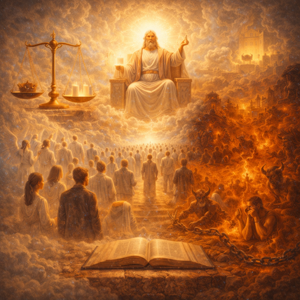
Why will God judge the world?
What is the purpose of judgment?
(Holiness, justice, vindication of righteousness)
What is the purpose of judgment?
(Holiness, justice, vindication of righteousness)
For many newcomers, the idea of divine judgment feels unsettling-especially when placed alongside God's love, mercy, and patience. Scripture, however, presents judgment not as a contradiction of God's goodness, but as an essential expression of who He is. A God who never judges would ultimately be a God who does not care about truth, justice, or the suffering caused by evil. The Bible teaches that God's judgment serves multiple purposes: to uphold His holiness, to establish true justice, to vindicate righteousness, and to set all things right.
God's holiness demands judgment
God is not morally neutral. He is perfectly holy, and His holiness cannot coexist with unaddressed sin.
For the LORD our God is holy.
Psalm 99:9
Holiness means God is completely set apart from evil. If God were to ignore sin indefinitely, He would deny His own nature. Judgment is not an arbitrary act-it is the necessary response of a holy God to moral rebellion.
Thou art of purer eyes than to behold evil, and canst not look on iniquity.
Habakkuk 1:13
Judgment affirms that evil is truly evil, not merely unfortunate or inconvenient.
Judgment establishes true justice
Human justice systems are flawed-limited by ignorance, bias, power, and time. God's judgment corrects what human justice cannot.
Shall not the Judge of all the earth do right?
Genesis 18:25
Scripture consistently portrays God as the ultimate righteous Judge, one who sees all motives, secrets, and hidden injustices.
Because he hath appointed a day, in the which he will judge the world in righteousness by that man whom he hath ordained.
Acts 17:31
Judgment ensures that every wrong is addressed, every injustice answered, and every act weighed rightly-not by appearances, but by truth.
Judgment vindicates righteousness
In this world, righteousness is often mocked, oppressed, or ignored. Scripture promises that God's judgment will publicly vindicate those who trusted Him.
Say ye to the righteous, that it shall be well with him.
Isaiah 3:10
God's judgment reveals that obedience, faith, and perseverance were not in vain. It distinguishes between false righteousness and true faith, between outward religion and inward obedience.
For there is nothing covered, that shall not be revealed; neither hid, that shall not be known.
Luke 12:2
Judgment brings clarity where confusion once reigned.
Judgment reveals the seriousness of sin
Sin is frequently minimized in modern thinking-treated as weakness, preference, or social conditioning. Scripture presents sin as rebellion against God Himself.
The soul that sinneth, it shall die.
Ezekiel 18:4
Judgment demonstrates that sin has real moral weight and eternal consequences. Without judgment, grace becomes meaningless, and forgiveness becomes cheap. The cross itself proves the seriousness of sin: if sin could be overlooked without cost, Christ would not have needed to suffer.
Judgment and mercy are not opposites
God's judgment does not cancel His mercy-it magnifies it.
The Lord is not slack concerning his promise, as some men count slackness; but is longsuffering to us-ward, not willing that any should perish, but that all should come to repentance.
2 Peter 3:9
God delays judgment to allow time for repentance. Judgment comes only after patience, warning, revelation, and grace have been repeatedly offered. Those who reject mercy ultimately face justice-not because God is unwilling to forgive, but because forgiveness was refused.
Judgment sets the stage for restoration
God's judgment is not merely punitive; it is restorative. It clears away evil so that righteousness can dwell permanently.
Nevertheless we, according to his promise, look for new heavens and a new earth, wherein dwelleth righteousness.
2 Peter 3:13
Without judgment, evil would continue forever. Judgment allows creation itself to be renewed, purified, and healed.
Jesus and final judgment
Scripture teaches that judgment has been entrusted to Jesus Christ.
For the Father judgeth no man, but hath committed all judgment unto the Son.
John 5:22
This means judgment is not executed by a distant, unfeeling force-but by the very One who bore humanity's sin, suffered injustice, and offered salvation. Those who reject Christ face judgment from the same Savior they refused.
A personal question, not merely a future event
Judgment is not only about the end of the world-it confronts every human heart now.
So then every one of us shall give account of himself to God.
Romans 14:12
The question is not whether God will judge, but whether one will face judgment clothed in personal righteousness-or in the righteousness of Christ.
Summary and reflection
God judges the world because:
- He is holy and must oppose evil
- He is just and must address wrong
- He vindicates righteousness and truth
- He reveals the seriousness of sin
- He clears the way for restoration
- He honors the sacrifice of Christ
Judgment is not the failure of God's love-it is the fulfillment of His righteousness.