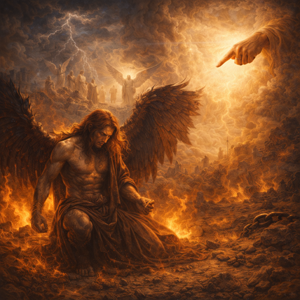
Who is Satan? Where did he come from?
Why does God allow him to exist?
Why does God allow him to exist?
Few biblical subjects generate more confusion, fear, or speculation than Satan. Popular culture often portrays him as a caricature-either a red-skinned figure with horns or an abstract symbol of evil-yet Scripture presents a far more sober and precise picture. The Bible neither exaggerates Satan's power nor minimizes his reality. Instead, it reveals who he is, where he came from, what his role is now, and why God, who is sovereign and holy, allows his continued existence for a limited time. This study examines Satan strictly through Scripture, grounding the discussion in biblical revelation rather than tradition or mythology.
Who is Satan?
Satan is a real, personal, created being. He is not an impersonal force, nor is he equal to God. He is a fallen angel who now stands in opposition to God's purposes. The name Satan means "adversary," while devil means "slanderer" or "accuser." Scripture describes him as:
- The adversary of God's people
- A deceiver and liar
- An accuser
- A tempter
Be sober, be vigilant; because your adversary the devil, as a roaring lion, walketh about, seeking whom he may devour.
1 Peter 5:8
Jesus Himself affirms Satan's real and personal nature:
He was a murderer from the beginning, and abode not in the truth, because there is no truth in him. When he speaketh a lie, he speaketh of his own: for he is a liar, and the father of it.
John 8:44
Where did Satan come from?
Satan was not created evil. Like all angels, he was originally created good. His fall was the result of pride and rebellion. Two Old Testament passages provide insight into his origin and fall, using earthly kings as immediate contexts while pointing beyond them to a deeper spiritual reality. Ezekiel 28:12-17 describes a being who was:
- Created perfect
- Full of wisdom and beauty
- In Eden
- An anointed cherub
Thou wast perfect in thy ways from the day that thou wast created, till iniquity was found in thee.
Ezekiel 28:15
Isaiah 14:12-15 reveals the heart of his rebellion:
How art thou fallen from heaven, O Lucifer, son of the morning!
Isaiah 14:12
His sin was pride-seeking to exalt himself above God rather than remain in submission to Him.
What was Satan's sin?
Satan's rebellion centered on self-exaltation and independence from God's authority. Isaiah records five statements beginning with "I will," revealing his ambition to replace God rather than serve Him.
I will exalt my throne above the stars of God… I will be like the most High.
Isaiah 14:13-14
This rebellion led to his fall and eventual judgment, though that judgment has not yet been fully executed.
What is Satan's role now?
Satan is active in the world, but always under God's ultimate authority. He cannot act beyond what God permits. Scripture describes his current activity as:
- Deceiving the nations
- Accusing believers
- Tempting humans to sin
- Opposing the work of God
Wherein in time past ye walked according to the course of this world, according to the prince of the power of the air.
Ephesians 2:2
He is also described as the accuser:
The accuser of our brethren is cast down, which accused them before our God day and night.
Revelation 12:10
Yet even in his activity, Satan remains a defeated enemy. His power is real, but limited.
Why does God allow Satan to exist?
This is one of the most difficult questions for believers and seekers alike. Scripture does not give a single, simple answer, but it provides several clear truths.
God's sovereignty is never threatened
Satan exists only by God's permission and within God's limits. In the book of Job, Satan cannot touch Job without God's consent:
Behold, all that he hath is in thy power; only upon himself put not forth thine hand.
Job 1:12
God is never reacting to Satan; Satan is always operating within God's sovereign plan.
Satan's existence exposes the reality of human hearts
Temptation reveals what is already present within the human heart. Satan cannot force obedience or rebellion; he can only entice. James explains this clearly:
But every man is tempted, when he is drawn away of his own lust, and enticed.
James 1:14
God allows Satan's activity to demonstrate the difference between outward religion and genuine faith.
God uses even opposition to accomplish His purposes
The greatest example is the cross itself. Satan sought to destroy Christ, yet through the crucifixion, God accomplished salvation.
For of a truth against thy holy child Jesus, whom thou hast anointed, both Herod, and Pontius Pilate, with the Gentiles, and the people of Israel, were gathered together, For to do whatsoever thy hand and thy counsel determined before to be done.
Acts 4:27-28
What Satan intends for evil, God turns toward redemption.
Why doesn't God destroy Satan immediately?
Scripture teaches that Satan's final judgment is certain, but it is appointed for a specific time.
And the devil that deceived them was cast into the lake of fire and brimstone.
Revelation 20:10
Until then, God's patience allows:
- The full unfolding of human history
- The gathering of the redeemed
- The demonstration of His justice and mercy
God's delay is not weakness, but purposeful restraint.
What is the Christian's response to Satan?
Believers are not called to fear Satan, obsess over him, or engage him directly in their own strength. Instead, Scripture instructs Christians to:
- Resist him through faith
- Stand firm in Christ
- Rely on God's armor
- Trust in Christ's victory
Submit yourselves therefore to God. Resist the devil, and he will flee from you.
James 4:7
The believer's confidence rests not in personal strength, but in Christ's finished work.
Conclusion
Satan is a real, fallen, created being who rebelled against God through pride and now opposes God's purposes. Yet he remains under God's authority, restrained by divine sovereignty, and destined for final judgment. God allows Satan's temporary existence to reveal truth, test faith, expose hearts, and ultimately magnify His justice, mercy, and redemptive power through Jesus Christ. Evil is not eternal. Satan is not equal to God. The outcome is already decided.