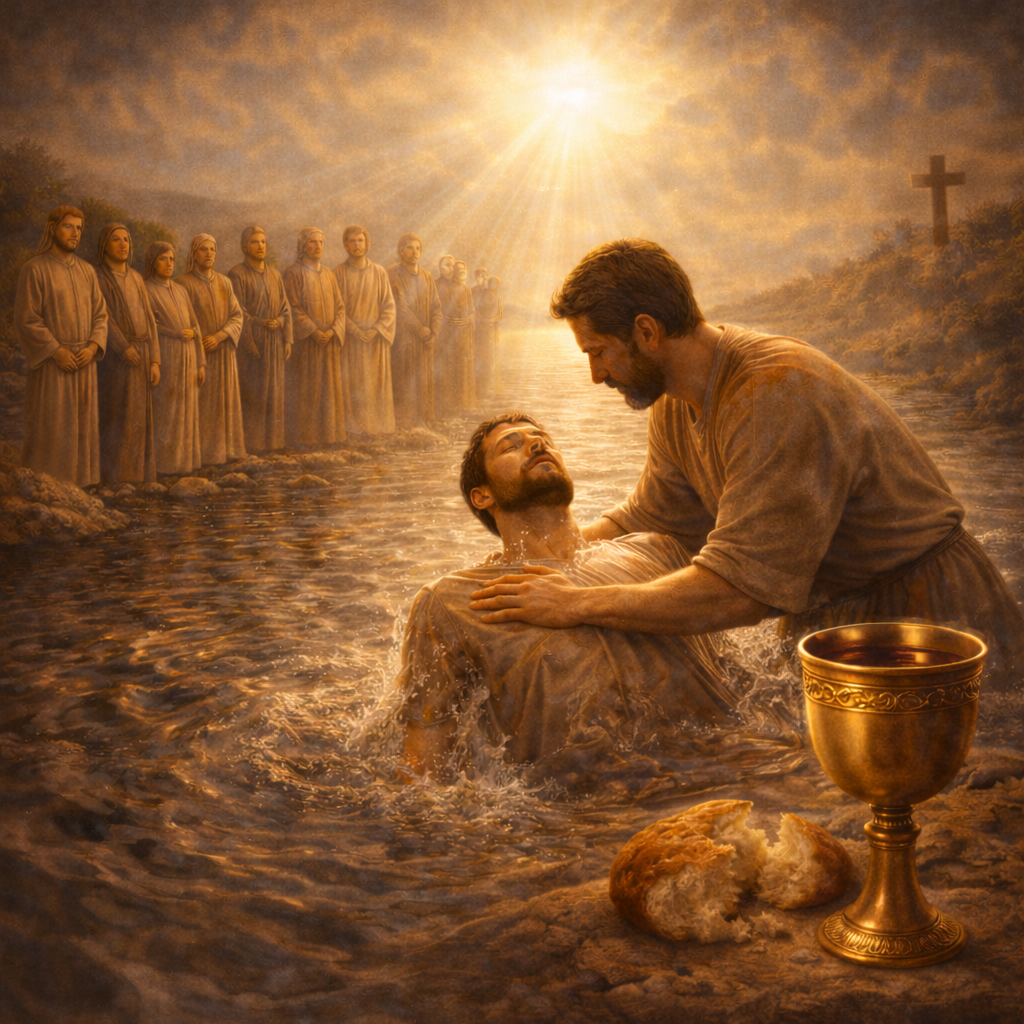
What Is the Role of Baptism and Communion?
Category: Questions About Salvation
Introduction
Many people-especially those new to Christianity-assume that baptism and communion are the means by which salvation is obtained or maintained. Others dismiss them as symbolic traditions with little real importance. Scripture presents a clearer and more balanced understanding. Baptism and communion are commanded by Christ, practiced by the early church, and rich in meaning-but they are not saving acts. They are acts of obedience that flow from salvation, not requirements to earn it.
Salvation Comes Before Ordinances
The Bible is explicit that salvation is by grace through faith, not by religious acts.
For by grace are ye saved through faith; and that not of yourselves: it is the gift of God: Not of works, lest any man should boast.
Ephesians 2:8-9
If baptism or communion were required for salvation, they would be works added to grace-something Scripture consistently rejects.
Baptism: Identification, Not Regeneration
What Baptism Is
Baptism is an outward act that identifies a believer with:
- Christ's death
- Christ's burial
- Christ's resurrection
Therefore we are buried with him by baptism into death: that like as Christ was raised up from the dead by the glory of the Father, even so we also should walk in newness of life.
Romans 6:4
Baptism publicly declares what has already taken place inwardly through faith.
What Baptism Is Not
Baptism does not:
- Wash away sins
- Regenerate the soul
- Complete salvation
The thief on the cross was saved without baptism.
To day shalt thou be with me in paradise.
Luke 23:43
Salvation was granted on the basis of faith alone.
Why Jesus Commanded Baptism
Jesus commanded baptism as an act of obedience and discipleship.
Go ye therefore, and teach all nations, baptizing them in the name of the Father, and of the Son, and of the Holy Ghost: teaching them to observe all things whatsoever I have commanded you.
Matthew 28:19-20
Baptism is the believer's first step of obedience after salvation, not the cause of it.
Communion: Remembrance, Not Re-sacrifice
Instituted by Christ
Communion was established by Jesus on the night before His crucifixion.
This is my body which is given for you: this do in remembrance of me.
Luke 22:19
Its purpose is remembrance, proclamation, and self-examination.
What Communion Represents
The bread and cup symbolize:
- Christ's body given for us
- Christ's blood shed for us
For as often as ye eat this bread, and drink this cup, ye do shew the Lord's death till he come.
1 Corinthians 11:26
Communion looks backward to the cross and forward to Christ's return.
Communion Does Not Impart Salvation
Scripture never teaches that communion imparts saving grace. Jesus' sacrifice was once for all.
By the which will we are sanctified through the offering of the body of Jesus Christ once for all.
Hebrews 10:10
Communion does not repeat or extend Christ's sacrifice; it remembers it.
A Serious Act for Believers
Communion is not casual or meaningless. Paul warns believers to approach it reverently.
But let a man examine himself, and so let him eat of that bread, and drink of that cup. For he that eateth and drinketh unworthily, eateth and drinketh damnation to himself, not discerning the Lord's body.
1 Corinthians 11:28-29
This examination is not about worthiness to be saved, but honesty and reverence before God. Approaching communion carelessly dishonours the sacrifice it commemorates.
Why These Ordinances Still Matter
Though not saving, baptism and communion are vital because they:
- Teach the gospel visually
- Unite believers in shared confession
- Strengthen faith through obedience
- Keep the cross central in Christian life
Jesus commanded them because they shape the believer's walk, not because they replace faith.
The Order Matters
Scripture consistently shows this order:
- Faith in Christ
- Salvation by grace
- Obedience through baptism
- Ongoing remembrance through communion
If ye love me, keep my commandments.
John 14:15
Conclusion
Baptism and communion are:
- Acts of obedience, not means of salvation
- Symbols that proclaim gospel truth
- Commands from Christ for believers
- Practices meant to deepen faith, not replace it
They are powerful precisely because they point away from themselves — and directly to Jesus Christ, in whom alone salvation is found.