Category: Questions About Jesus Christ · Study 3D
Introduction
Of all the doctrines in the Christian faith, the Trinity is among the most profound — and the most frequently misunderstood. New believers often encounter it early and find it confusing, not because the Bible is unclear, but because the concept itself reaches beyond ordinary human experience. How can God be one, and yet exist in three persons? How can the Father, the Son, and the Holy Ghost all be God — and yet not be each other?
Scripture does not shy away from this mystery. In fact, the Apostle Paul calls it exactly that:
The Trinity is not a contradiction to be solved — it is a mystery to be received with humility. But it is not without explanation, and Scripture gives us a great deal to work with. This study will walk through what the Bible teaches about the three persons of God, why each exists, and what their distinct roles mean for us.
One God — Not Three
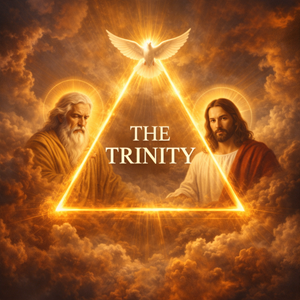
The starting point must be clear: there is only one God. This is the bedrock of all Scripture and was declared to Israel from the very beginning. The Trinity does not teach that there are three gods. It teaches that the one God exists in three distinct persons — Father, Son, and Holy Ghost — each fully God, each with a distinct role and purpose, yet eternally one.
God Himself declared His nature to the woman at the well through Jesus:
God the Father is pure spirit — without body, without limitation, the sovereign Creator and sustainer of all things. The Son and the Holy Ghost are not separate gods alongside Him. They are the same God, expressing Himself in different forms, each with a specific purpose in His plan of redemption.
The Three Persons at a Glance
God the Father
God the Father is the sovereign Lord of all creation — eternal, all-knowing, all-powerful, and present everywhere. He is the source of all that exists. He established His law, revealed Himself to Israel through the prophets, and set in motion the plan of redemption that would be fulfilled through His Son. He is not a distant God who stepped back after creation. He is actively involved in the affairs of men and nations, working all things according to His perfect will.
He is pure spirit — He has no physical form. When Scripture speaks of the "hand of God" or the "eyes of the Lord," these are expressions that communicate His action and attention in language we can understand, not descriptions of a physical body.
Jesus the Son
The second person of the Trinity is Jesus Christ — God manifested in human flesh. He did not begin to exist at His birth in Bethlehem. He existed from eternity as the Word of God, and at the appointed time, He took on human form and entered history as a man.
He came with two great purposes: first, to serve as the perfect and final sacrifice for the sins of mankind; second, to one day reign as King over the earth. John the Baptist announced His arrival with these words:
Jesus lived a sinless life — the only person ever to do so — and by dying on the cross and rising from the dead, He satisfied the just requirement of God's law on behalf of all who believe. As fully God and fully man, He bridges the gap that sin created between humanity and the Father. He is not merely a teacher or a moral example, though He is both. He is the one and only Saviour.
The Holy Ghost
The third person of the Trinity is the Holy Ghost — also called the Holy Spirit. Before the ascension of Jesus, the Holy Ghost was present in the world and came upon certain people for specific purposes. After Jesus ascended to heaven, He sent the Holy Ghost to dwell not merely among believers, but within them. This was a profound shift in how God relates to His people.
Jesus told His disciples plainly that His departure was necessary for the Holy Ghost to come:
The Holy Ghost serves as guide, comforter, and teacher. He convicts us of sin, leads us into truth, and is the presence of God living within every true believer. He is not an impersonal force — He is a person, the third person of the Godhead, with will, emotion, and the full nature of God.
Each Is Fully God — Yet They Are Not Each Other
This is where the Trinity can feel most difficult to grasp. The Father is God. The Son is God. The Holy Ghost is God. And yet the Father is not the Son, the Son is not the Holy Ghost, and the Holy Ghost is not the Father. They are distinct persons sharing one divine nature.
We see all three present simultaneously at the baptism of Jesus — the Son being baptized, the Father speaking from heaven, and the Holy Ghost descending as a dove. They were not the same person appearing in sequence. They were three distinct persons, present at the same moment, acting in their distinct roles.
This is genuinely mysterious, and Scripture presents it as such. But the difficulty in grasping it fully does not make it untrue. It simply means that God, by His very nature, exceeds what human categories can fully contain.
A Parable to Help Us Understand
While no earthly illustration can fully capture the Trinity, a simple parable may help newcomers begin to think about it in a practical way.
Consider an ordinary man — a mechanic by trade, a husband, and a father. He is one person. He has one identity. And yet the people in his life relate to him in three completely different ways, because he plays three completely different roles.
To his customers at the garage, he is their mechanic — the skilled tradesman they trust to fix their car and keep them safely on the road. They depend on his expertise and his reliability.
To his wife, he is her husband — the man who loves her, shares his life with her, and raises their family alongside her. Her relationship with him is nothing like the customer's.
To his daughter, he is her father — the one who provides for her, protects her, and teaches her how to live. She knows a side of him that no customer ever will.
He has not become a different person in each relationship. He is still the same man. But his role, his purpose, and his relationship to each person is distinct — and each relationship is real and meaningful in its own right.
In something of the same way — though infinitely greater and more complex — God the Father, Jesus the Son, and the Holy Ghost are one God. Each relates to us differently. Each serves a distinct purpose in the plan of redemption. Yet there is only one God.
The parable has its limits, as all parables do. The mechanic is one person playing different roles at different times — God is three distinct persons simultaneously. But for a newcomer wrestling with the concept, it is a place to begin.
Why Does the Trinity Matter?
The Trinity is not a theological puzzle invented by church councils. It is the revealed nature of God as presented in Scripture. Understanding it — even partially — matters for several reasons:
- It explains how God could become man in Jesus without ceasing to be God
- It explains how Jesus could pray to the Father — they are distinct persons in real relationship
- It explains how God can dwell within believers through the Holy Ghost while also reigning in heaven
- It shows that God is not a solitary, isolated being — within the Trinity there is eternal relationship, love, and community
Salvation itself involves all three persons: the Father who sent the Son, the Son who gave His life as the sacrifice, and the Holy Ghost who seals and indwells the believer. The Trinity is not a doctrine to file away — it is the very shape of the Gospel.
Conclusion
The Trinity is one of the great mysteries of the Christian faith — not a contradiction, but a truth that exceeds the boundaries of ordinary human understanding. Scripture presents it clearly: there is one God, eternally existing in three persons — Father, Son, and Holy Ghost — each fully divine, each distinct, each with a specific role in the plan of redemption.
God the Father is the sovereign Creator and Lord of all. Jesus the Son is God manifest in the flesh — the perfect sacrifice and coming King. The Holy Ghost is God dwelling among and within His people — guide, comforter, and seal of salvation.
They are not three gods. They are not one person wearing three masks. They are one God in three persons — a truth that is, as Paul wrote, without controversy great in its mystery, and worthy of a lifetime of reverent study.