Why Are Humans Born Sinful?
What Is Original Sin?
What Is Original Sin?
Category: Questions About Humanity
Introduction
One of the most fundamental questions in Christianity is this: Why are humans born sinful?
Why do even infants—who have committed no conscious acts—grow into people who naturally choose selfishness, pride, and rebellion against God? Why does Scripture teach that all have sinned (Romans 3:23) and that we are shapen in iniquity (Psalm 51:5)?
To answer this, we must understand Original Sin—what happened in Eden, how it changed humanity, and why every person inherits a fallen nature. Scripture explains not only the fall, but also the hope of redemption through Christ.
God Created Humanity Good, Innocent, and in Perfect Fellowship
The Bible begins with a clear foundation: God made a perfect world, filled with His goodness.
In the beginning God created the heaven and the earth.
Genesis 1:1
God saw everything that he had made, and, behold, it was very good.
Genesis 1:31
Humanity was created:
- In God's image (Genesis 1:26)
- Innocent, free from sin
- In harmony with God
- With the capacity to obey or disobey
There was no evil, no death, no rebellion, and no corruption.
The Bible is clear: sin was not part of God's design — it was an intrusion.
The Fall: How Original Sin Entered the Human Race
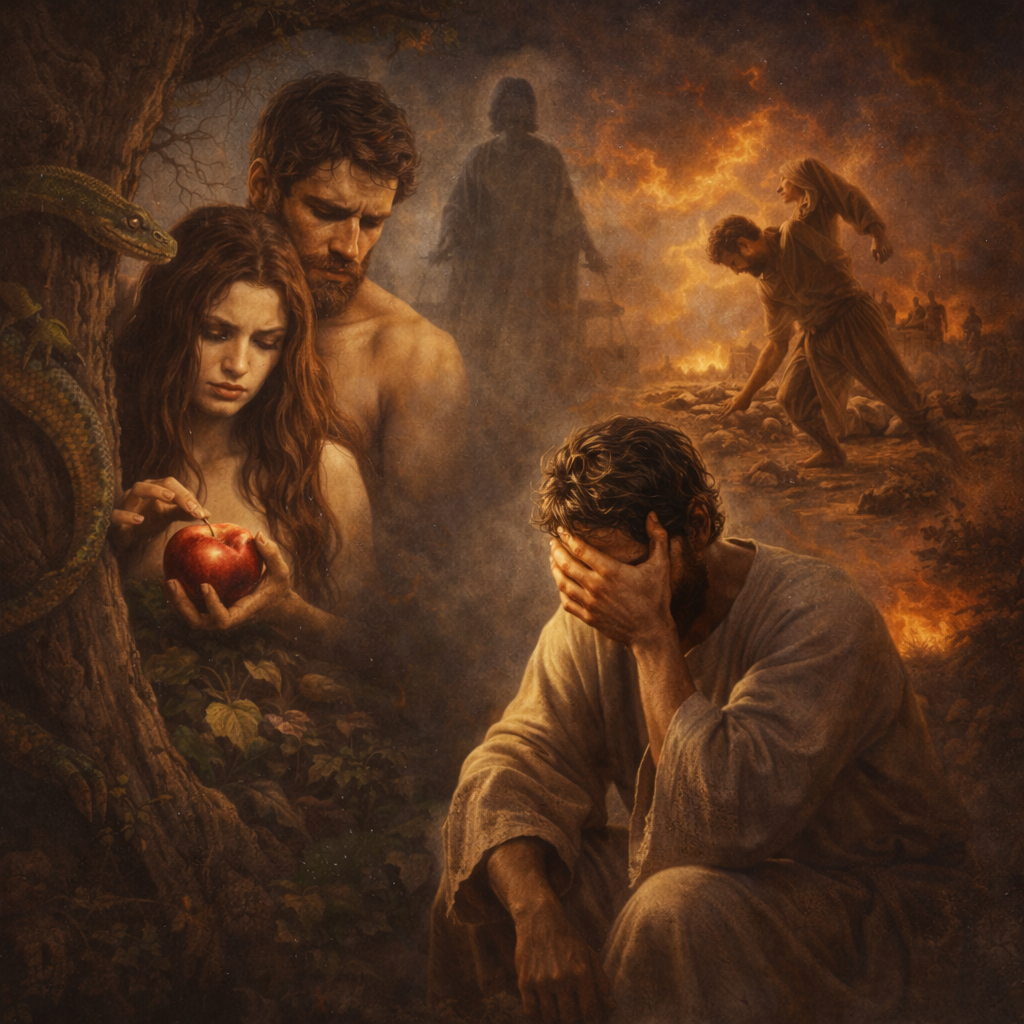
In Genesis 3, under the serpent's deception, the first humans broke God's command:
Yea, hath God said…?
Genesis 3:1
She took of the fruit thereof, and did eat, and gave also unto her husband with her; and he did eat.
Genesis 3:6
The consequences were immediate:
- Their eyes were opened
- They felt shame
- They hid from God
- They experienced fear
- They were expelled from Eden
More importantly, their spiritual nature changed.
Human beings became:
- Separated from God
- Corrupted in desire
- Unable to return to innocence
- Morally bent toward rebellion
This is the essence of Original Sin.
Adam's Responsibility and the Nature of the First Sin
Scripture places the primary responsibility for humanity’s fall upon Adam:
And Adam was not deceived, but the woman being deceived was in the transgression.
1 Timothy 2:14
- Adam received God's command before Eve existed (Genesis 2:15-18)
- Adam was the covenant head of humanity (1 Corinthians 11:3)
- Through one man's sin, death entered the world (Romans 5:12)
Thus, Adam's failure:
- Brought sin into the world
- Corrupted human nature
- Made all his descendants sinners
As the head of humanity, Adam’s fall became the fall of all.
Spiritual vs. Physical: What Exactly Was the First Sin?
Scripture emphasizes that the heart of the first sin was not physical, but spiritual — an act of unbelief and rebellion.
- The command was spiritual (Genesis 2:17)
- The serpent's temptation was spiritual (Genesis 3:5)
- The consequences were spiritual first — separation from God
- Awareness of nakedness and shame followed (Genesis 3:7)
- The relationship between man and woman was distorted (Genesis 3:16)
This reveals that every part of human nature — mind, body, and desire — became corrupted by spiritual rebellion.
Jesus distinguishes physical lineage from spiritual lineage (John 8:37 vs. 44)
Humanity’s problem is a fallen nature, not merely isolated acts of wrongdoing.
The first sin was:
- Unbelief
- Pride
- Desire to be "as gods"
- Rebellion against God's word
All humanity inherits this fallen nature.
Why Are Humans Born Sinful?
Paul explains it succinctly:
By one man's disobedience many were made sinners.
Romans 5:19
Humanity’s sinful nature is not learned — it is inherited.
- A corrupted spiritual nature
- A will inclined toward sin
- Desires contrary to God
- Mortality and death
- A world under the curse
The contemporary world does not reflect God's original design but is characterized by pervasive darkness.
For we wrestle not against flesh and blood, but against principalities, against powers, against the rulers of the darkness of this world, against spiritual wickedness in high places.
Ephesians 6:12
Humans sin because:
- We are born separated from God
- We are spiritually dead (Ephesians 2:1)
- Our desires are bent toward self, not God
- We cannot obey perfectly even when we want to
Original sin explains:
- Why children need no teaching to misbehave
- Why all societies struggle with evil
- Why human effort cannot cure the human condition
- Why we need salvation, not self-improvement
The Fallen World: Creation Also Suffers
Cursed is the ground for thy sake.
Genesis 3:17-19
For we know that the whole creation groaneth and travaileth in pain together until now.
Romans 8:22
The world is characterized by darkness and spiritual conflict.
Jesus prayed, Thy will be done in earth, as it is in heaven (Matthew 6:10).
- Death entered the world
- Nature became hostile
- Disease, decay, and catastrophe exist
- The world is under spiritual warfare
Human guilt corrupted the entire order of creation.
The Path to Redemption
Stage 1 - The Law
- To reveal sin
- To restrain evil
- To foreshadow the sacrifice of Christ
The Law was holy but could not change human nature.
Stage 2 - Jesus Christ, the Last Adam
The last Adam was made a quickening spirit.
1 Corinthians 15:45
- Lived without sin
- Bore our sin on the cross
- Offers new birth
- Restores spiritual life
- Reverses Adam's curse for all who believe
Stage 3 - New Creation
A new heaven and new earth (Isaiah 65:17; 2 Peter 3:13; Revelation 21:1)
Redemption is not just individual — it is cosmic.
Summary: What Original Sin Means
Original Sin is the inherited fallen nature received from Adam. It explains:
- Why humans naturally sin
- Why we are spiritually dead at birth
- Why we need salvation
- Why Jesus is called the "last Adam"
- Why the world is broken
- Why God's plan includes a new creation
Original Sin is not just an event — it is a condition passed through all generations.
Conclusion
The world's suffering is a stark divergence from God's original plan, yet God has already set in motion a redemptive plan fulfilled in Christ.
Sin explains why humanity is broken, guilty, and estranged from God. Christ explains why there is hope. Because of Adam, all are born sinful. Because of Christ, all may be made new.