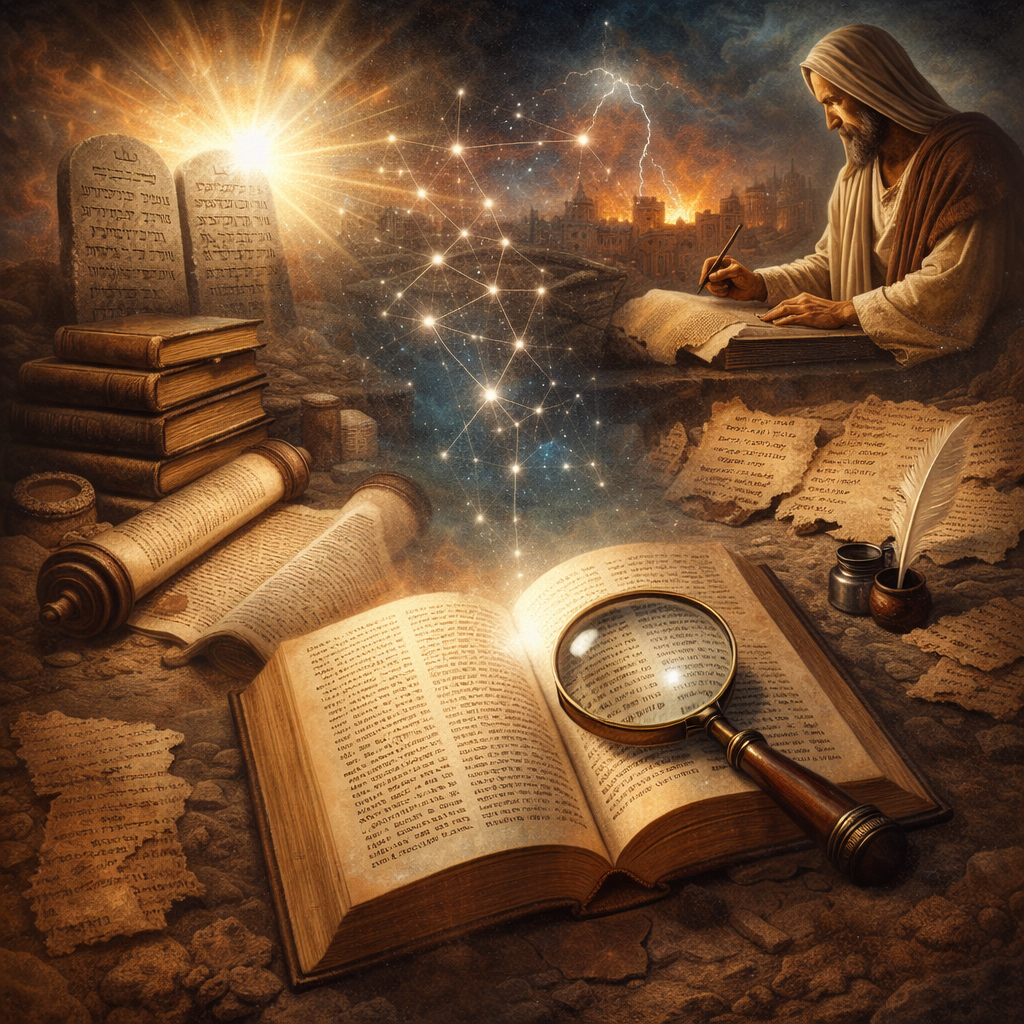
Is the Bible Truly God's Word?
How Do We Know It Is Reliable?
How Do We Know It Is Reliable?
Category: Questions About God and His Nature
Introduction
Every seeker eventually encounters one central question: Can the Bible be trusted? If the Bible is not reliable, then all claims about God, salvation, and eternity collapse. If the Bible is reliable, it becomes the solid rock upon which faith can rest.
This study explains why Christians affirm the Bible as the inspired Word of God, and how its canon, accuracy, preservation, and unity provide overwhelming evidence for its divine origin.
What the Bible Claims About Itself
The Bible is not shy about its identity. It repeatedly claims to be the very Word of God, not merely religious wisdom or human philosophy.
Key statements include:
All scripture is given by inspiration of God.
2 Timothy 3:16
The word of the LORD endureth for ever.
1 Peter 1:25
Holy men of God spake as they were moved by the Holy Ghost.
2 Peter 1:21
The word "inspired" literally means God-breathed. Scripture presents itself not as man's thoughts about God but God's revelation to humanity.
Either this claim is true-or history's greatest and most influential book is built upon a lie. There is no middle ground.
The Formation of the Biblical Canon
The "canon" refers to the set of books recognized as Scripture.
Old Testament Canon
The Old Testament was:
- Written between ~1500-400 BC
- Authored by prophets and leaders recognized by Israel
- Copied and preserved by scribes with meticulous care
- Already fully established by the time of Jesus
Jesus and the apostles frequently quoted the Old Testament as Scripture (Matthew 5:17
; Luke 24:44
). There was no debate among Jews over which books belonged.
New Testament Canon
The New Testament:
- Was written between ~45-95 AD
- Authored by apostles or those under their direct authority
- Was immediately circulated among churches
- Was recognized because of its apostolic origin and doctrinal consistency
Contrary to popular myths:
- The canon was not determined by political councils
- Early believers did not choose "which books they liked"
- The church did not confer authority upon the books
- The books were recognized-not granted-as Scripture
By the late 2nd century, nearly the entire New Testament is referenced by early Christian writers. By the 4th century, formal recognition simply affirmed what the churches had long accepted.
The canon was not the invention of men-
it was the preservation of what God had already spoken.
it was the preservation of what God had already spoken.
Prophetic Accuracy: God Proves His Word
One of the strongest evidences of divine authorship is prophecy.
God Himself declares prophecy as His signature:
Behold, the former things are come to pass, and new things do I declare… before they spring forth I tell you of them.
Isaiah 42:9
Hundreds of specific prophecies in Scripture have been fulfilled with historical precision.
Examples:
- Detailed rise and fall of empires (Babylon, Persia, Greece, Rome) - Daniel 2, 7-8
- The destruction of Jerusalem - Luke 19:43-44
- The scattering and later regathering of Israel - Deuteronomy 28; Ezekiel 36-37
- Precise details of Messiah's birth, life, betrayal, death, and resurrection - Psalm 22; Isaiah 53; Micah 5:2
Prophecy is not vague or symbolic-it is exact:
dates, locations, names, events.
dates, locations, names, events.
No other religious book contains predictive prophecy like the Bible.
Fulfilled prophecy is God's proof that His Word is true.
Fulfilled prophecy is God's proof that His Word is true.
Textual Preservation: The Bible We Have Is the Bible They Wrote
Some claim the Bible has been altered over time.
Manuscript evidence proves otherwise.
Manuscript evidence proves otherwise.
Old Testament Preservation
Until 1947, the oldest Hebrew manuscripts were from around AD 900. Then the Dead Sea Scrolls were discovered.
Comparison showed:
- Over 95% word-for-word accuracy
- Variations minor and not doctrinal
- Nearly identical to manuscripts copied 1,000 years later
This demonstrates astonishing preservation.
New Testament Preservation
The New Testament is supported by:
- Over 5,800 Greek manuscripts
- Over 10,000 Latin manuscripts
- Over 9,000 manuscripts in other ancient languages
- Over 1,000,000 quotations by early Christian leaders that can reconstruct nearly the entire New Testament
For comparison:
- Homer's Iliad has ~1,800 manuscripts
- Caesar's Gallic Wars has ~10
- Plato's writings often have fewer than 10
The New Testament is the best-attested document in ancient history.
Modern translations rely on thousands of manuscripts, ensuring accuracy far beyond that of any other ancient text.
God preserved His Word perfectly enough that no doctrine is lost, obscure, or uncertain.
Unity of Scripture: One Story, One Author
The Bible is:
- 66 books
- Written over ~1,500 years
- By ~40 authors
- In 3 languages
- On 3 continents
- From kings to shepherds, prophets to fishermen
And yet…
It speaks with one unified voice.
Major themes are consistent throughout:
- God's holiness
- Humanity's sin
- The need for a Redeemer
- The promise of the Messiah
- God's plan for Israel
- The coming kingdom
- Redemption through blood
- Restoration of all things
No other collection of writings-religious or secular-shows such structural unity across centuries.
This unity reveals one divine mind behind many human authors.
Archaeological Confirmation
Archaeology has repeatedly confirmed the historical reliability of Scripture.
Findings include:
- Names such as David, Hezekiah, Nebuchadnezzar, Pontius Pilate
- Cities, nations, and kings once doubted
- Customs and laws that match biblical descriptions
- Cultural and historical details consistent with their time periods
Not once has archaeology contradicted the Bible.
Instead, it continually validates it.
Instead, it continually validates it.
Moral and Spiritual Power of Scripture
The Bible transforms lives in a way no human work can.
It:
- Convicts the conscience
- Reveals the condition of the heart
- Produces repentance and faith
- Offers hope in suffering
- Brings comfort in death
- Empowers moral transformation
- Unifies believers across nations and ages
Jesus said:
The words that I speak unto you, they are spirit, and they are life.
John 6:63
This life-giving power is itself evidence of divine origin.
The Testimony of Jesus Christ
Finally, the ultimate authority on Scripture is Jesus Himself.
Jesus believed and taught:
- The Old Testament is the Word of God (Matthew 22:29 )
- Every part is true, down to the "jot" and "tittle" (Matthew 5:18 )
- Scripture cannot be broken (John 10:35 )
- His own words carry absolute divine authority (John 12:49-50 )
- His followers would speak by the Spirit (John 16:13 )
If we trust Jesus, we must trust Scripture-
because Jesus trusted it without reservation.
because Jesus trusted it without reservation.
Conclusion
The Bible is not merely a religious text-it is the supernaturally inspired, historically preserved, prophetically verified, and spiritually powerful Word of God. Its formation, unity, accuracy, and fulfillment of prophecy stand unmatched in human history.
We can trust the Bible because:
- God breathed it
- Jesus affirmed it
- Prophecy proves it
- History confirms it
- Preservation safeguards it
- Transformation displays its power
The Bible is reliable, authoritative, and true-
the firm foundation for faith, life, and salvation.
the firm foundation for faith, life, and salvation.